
The Mystery of the Moon's "Three-Eyed Female Corpse"
A Clash Between Scientific Fact and Urban Legend
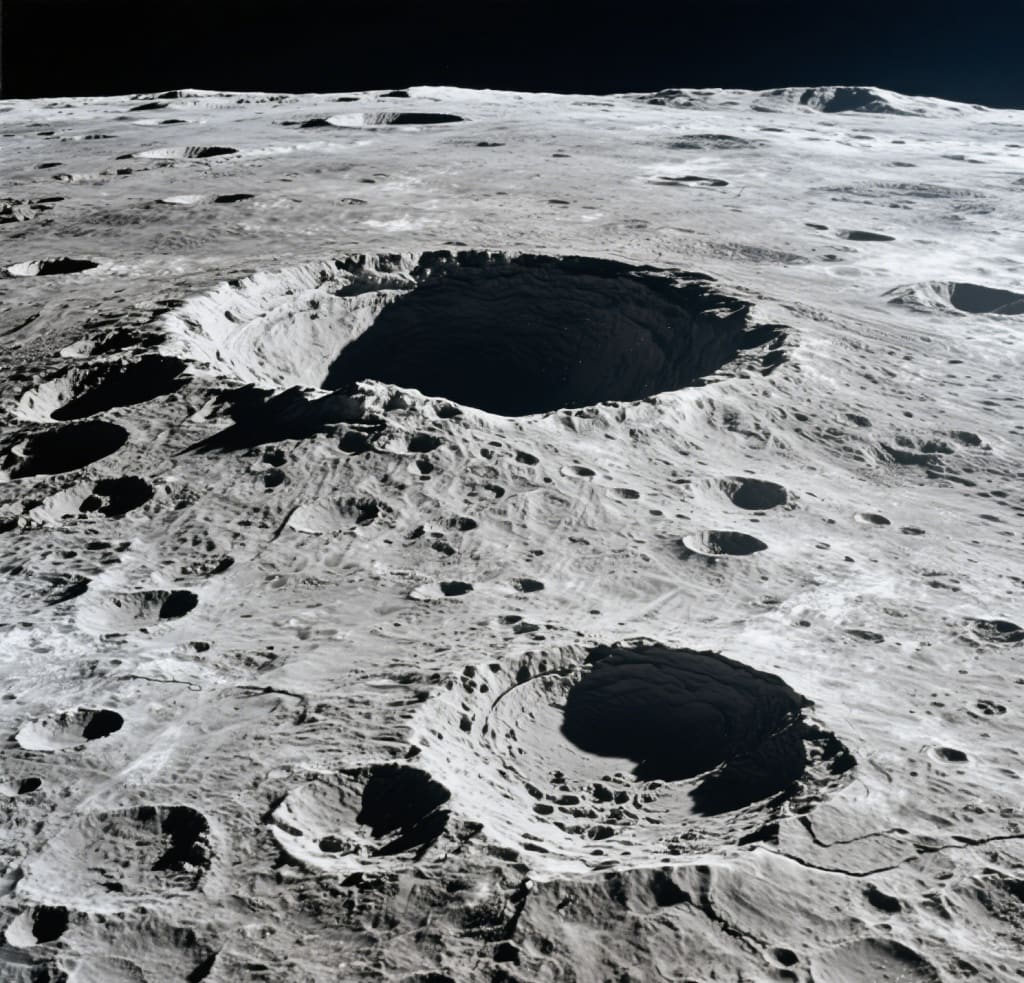
Among humanity's explorations of the cosmos, the legend of the Moon's "three-eyed female corpse" remains one of the most controversial topics. This story, blending science fiction and mysticism, begs the question: How much of it is rooted in scientific fact? Let us dissect this decades-old urban legend from multiple perspectives. I. Empirical Findings from Scientific Exploration Since the mid-20th century, lunar exploration has been continuous. From the Soviet Union's *Luna* program to the U.S. *Apollo* missions and China's *Chang'e* project, the three major space powers have unveiled the Moon's mysteries through over 200 missions. Tens of thousands of high-resolution images and data confirm: 1. The lunar surface consists mainly of basalt plains and impact craters. 2. Temperature swings exceed 300°C, with no liquid water present. 3. The atmosphere is so thin it is practically a vacuum. In such extreme conditions, no life—let alone a well-preserved "three-eyed corpse"—could survive. II. Origins and Evolution of the Legend The "three-eyed female corpse" narrative first emerged in the 1970s, based on several unverified claims: 1. A secret *Apollo 20* mission 2. The discovery of an alien spacecraft on the far side of the Moon 3. The retrieval of extraterrestrial biological samples However, these theories contain glaring inconsistencies: - The *Apollo* program ended after *17* due to budget constraints. - All lunar mission footage is publicly available. - China's Chang'e 4 found no anomalies on the far side. III. Scientific Explanations and Critical Analysis 1. Image Authenticity: Alleged photos of the "corpse" show obvious signs of digital manipulation and poor resolution. 2. Biological Plausibility: Three-eyed anatomy lacks evolutionary precedent in vertebrates. 3. Preservation Conditions: Without atmospheric protection, organic matter would rapidly degrade under cosmic radiation. IV. Cultural and Psychological Underpinnings The endurance of this legend reflects humanity's romanticized view of space: 1. Projection of mythological archetypes (e.g., the Chinese deity *Erlang Shen*) onto space exploration. 2. Wishful thinking about extraterrestrial life. 3. Conspiratorial distrust of government transparency. Yet science reveals the Moon as a silent world, beautiful in its geological reality and role as Earth's natural satellite. Conclusion As *Chang'e 5* returns fresh lunar samples and NASA's *Artemis* program prepares for new crewed missions, we must approach such tales with rationality. The universe's true mysteries lie not in fabricated alien stories but in unanswered scientific questions. As astronomer Carl Sagan noted, *"Extraordinary claims require extraordinary evidence."* Without conclusive proof, the "three-eyed female corpse" remains confined to science fiction.
About the Creator
Killing him slowly
There’s an intruder in my house again. He stumbles through the door, wet carrier bags in hand. He’s bought me offerings. I show my appreciation, letting him caress my beautiful body. He wants to touch me. I rub myself against his legs. He sighs, dropping the bags. He can’t resist touching me. Running his hand slowly down my spine, I arch my back towards his caress, let out a low purr. It’s what we both need.
By N J Delmas6 days ago in Horror




Comments
There are no comments for this story
Be the first to respond and start the conversation.