
Gene Siskel vs Maniac: How Critics, Shock Marketing & Backlash Defined the 1980 Slasher
Gene Siskel famously walked out on William Lustig’s Maniac (1980) and attacked its Times Square kiosk marketing — how did the cast and director respond, and what did the controversy do to the film’s reception and box office?

If you know Maniac (1980), you probably know it stirred up trouble—blood, gore, controversy, and fierce criticism. But nothing quite compares to Gene Siskel’s public walk-out and verbal takedown of the film. Here’s what Siskel said (or is reported to have said), how star Joe Spinell and director William Lustig responded, and what the reaction meant for Maniac’s legacy.
⸻
Siskel’s Walk-Out & Early Condemnation
Gene Siskel reportedly walked out of a screening of Maniac after about half an hour. His criticism, as reported in later sources, called the film “pointless” and “packed with gratuitous violence,” especially in its depiction of women in danger.
Siskel never wrote a full-length review of Maniac because, as mentioned, he left around the 30-minute mark. He did, however, include a brief but angry diatribe about the film on his weekly series At the Movies alongside Roger Ebert. In their recurring “Dogs of the Week” segment—co-hosted by Spot the Wonder Dog—Siskel called Maniac a “disgusting horror show that forced me out of the theater in less than 30 minutes.”
He continued:
“Maniac is a repulsive story about a berserk killer in New York. This is an extremely brutal film that thoroughly grossed me out.”
That public condemnation carried significant weight in early 1981. Siskel’s voice was one of the most influential in American film criticism, and his outrage would become part of the film’s legend.
⸻
Joe Spinell’s Defense of Maniac
It’s unclear whether Maniac star and co-writer Joe Spinell ever directly addressed Siskel’s criticisms. But he did speak about the broader controversy surrounding the film, saying simply:
“If you don’t like horror films, don’t come and see it.”
Spinell later elaborated in interviews that:
“The horrible thing is that people like this really exist.”
He meant that his character, Frank Zito—a deranged serial killer—was rooted in real-life pathology, not exploitation. Spinell seemed to accept that many viewers (and critics) found Maniac gruesome but rejected the idea that it was meaningless or misogynistic.
He was also quick to clarify that Frank Zito wasn’t a reflection of himself. “I love all people,” Spinell said in later interviews, emphasizing his distance from the violence his character embodied.
In the years after Maniac, Spinell claimed to have been working on a sequel that would have cast him as a children's show host who secretly murders abusive parents, acting as a protector and avenger of children. Spinell made a short called Maniac 2: Mr. Robbie based on that premise but he passed away in 1989 before he could make a full feature. He was only 53 year old.
⸻
William Lustig’s Reaction
Director William Lustig, on the other hand, seemed to enjoy the uproar, to a point.
“Maniac was getting very negative reviews. I mean, it was getting angry, negative reviews,” he recalled bemused.
Lustig framed the backlash as part of a larger cultural battle. In the early 1980s, horror films—especially those depicting violence against women—were under intense scrutiny. Maniac became a lightning rod for that debate. The film was placed on the much talked about Video Nasties list in England.
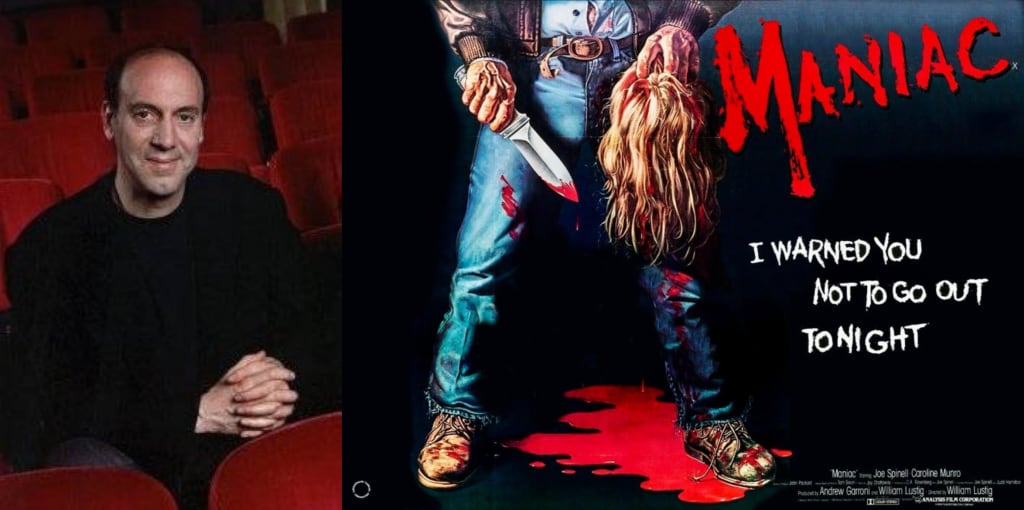
In an unusual aside, William Lustig himself criticized parts of the film’s marketing campaign. In a Bloody Disgusting interview, Lustig recalled seeing the final poster art for the first time and being shocked by its extremity: the bloody head, the knife, the visceral tone. Even Spinell, he said, was surprised by how graphic it was.
The poster, depicting a killer holding a scalp and a bloody knife, does not appear anywhere in the film. It was the invention of marketing executives at Analysis Film Releasing Corporation—meant to sell the idea of Maniac more than the movie itself. It captured the brutality of the film’s atmosphere, but not an actual image from the screen.
Oddly enough, no one seems to know for certain who created that infamous artwork. The poster artist remains uncredited, though some collectors speculate it came from an in-house advertising team rather than a named illustrator.
⸻
What We Do and Don’t Know: Controversy, Kiosks, & Effects
Several sources mention Maniac being released unrated, leading to censorship fights and edited versions in some markets. The film skipped going to the ratings board as an X-Rating would have doomed the film. Releasing it unrated meant skirting around the rules of theater owners who would have rejected any film with an X-Rating.
Gene Siskel and other critics were particularly angered by the film’s marketing—especially the poster—and by reports of video kiosks outside theaters in New York’s Times Square that played graphic clips from the film to lure passersby. On CBS 2 Chicago, Siskel criticized these kiosks directly, even questioning whether they could be considered a disturbance of the peace.
A big thank-you goes to YouTuber Jason Bagherian, who recovered this CBS 2 news report from 1981, preserving a rare record of Siskel’s outrage.
⸻
Impact: Box Office, Reputation & Cult Status
Despite its controversy—or perhaps because of it—Maniac earned a solid return for its modest budget. It was never a mainstream hit, but among grindhouse and horror audiences, it made an impact.
Critical reception at the time was overwhelmingly negative. Lustig admitted that mainstream critics “dismissed” the film. But over the decades, Maniac developed a strong cult following. Fans praise Spinell’s haunting performance, Tom Savini’s groundbreaking effects (especially the notorious shotgun scene), and the film’s grimy, psychological atmosphere.
The backlash undoubtedly limited its theatrical reach. Siskel noted that he spoke to Chicago theater owners who refused to carry the film. Maniac notably skipped being rated by the MPAA in order to avoid X-Rating. The X-Rating would have been a death knell for the film as most mainstream American theaters refused to carry any X-Rated film. Releasing the film without a rating allowed Maniac to skirt the rules of theater owners.
The backlash however, also had the effect of intriguing many fans of hardcore horror. The same fans who championed many of the titles on the Video Nasties list, were eager for the chance to see Maniac and the cult fandom that arose from that helped the film build a legacy that only grew once the film became available on Home Video.
⸻
Why It Matters Today
Maniac is a case study in how critics can amplify controversy—and how that can both hurt and help a film’s afterlife. It also shows how horror fans often find meaning and artistry where mainstream critics see only exploitation.
The Siskel backlash helps explain why Maniac remains a lightning rod decades later: a blend of moral panic, shocking imagery, and raw emotion that continues to divide audiences. Love it or hate it, Maniac still bleeds authenticity—and that’s part of what keeps it alive.
About the Creator
Movies of the 80s
We love the 1980s. Everything on this page is all about movies of the 1980s. Starting in 1980 and working our way the decade, we are preserving the stories and movies of the greatest decade, the 80s. https://www.youtube.com/@Moviesofthe80s
Keep reading
More stories from Movies of the 80s and writers in Horror and other communities.
Two Miners, Two Valentines: Comparing My Bloody Valentine (1981) and My Bloody Valentine (2009)
Throwback vs. Remake — the bottom line (budget & box office) George Mihalka’s original My Bloody Valentine (1981) was a modest Canadian slasher shot on location in Nova Scotia. Its production budget is commonly listed at about $2.3 million, and it grossed roughly $5.7 million in the U.S., giving it a small theatrical return but the beginnings of a cult reputation.
By Movies of the 80s4 months ago in Horror
Silver Screen Magic with Mae West
American actress and singer Mae West became a popular film actress during the Great Depression. She started entertaining in vaudeville, then performed on Broadway, and finally went to Hollywood. She signed up with Paramount Pictures and made her debut in the 1932 film “Night After Night.” She also starred in musicals, comedies, and crime dramas. The American Film Institute named her one of the best classic Hollywood actresses.
By Rasma Raisters7 days ago in Geeks


Comments
There are no comments for this story
Be the first to respond and start the conversation.