
You Wouldn’t Survive This Year and Here’s Why!
Hell on Earth Happened a Long Time Ago - Here's a Description of the Tragedy.


The year 536 AD is one of if not the worst years to be alive. This is a strong statement, I know! But, as you will see, it won’t be further from the truth.
“It was the beginning of one of the worst periods to be alive if not the worst year” (2)
THE BEGINNING
According to old chronicles, at the beginning of 536 AD, strange and sudden enormous dark clouds engulfed the sky, creating a perpetual twilight that blocked the sun’s light, transforming the world into a dark and sad place.
Byzantine historian Procopius wrote:
“For the sun gave forth its light without brightness, like the moon, during this whole year, and it seemed exceedingly like the sun in eclipse, for the beams it shed were not clear nor such as it is accustomed to shed” (6)
These endless ash clouds had an enormous reach, stretching for a vast part of Europe, North Africa and some parts of Asia, turning every corner of the northern hemisphere a living nightmare.
CLIMATE IMPACT
For eighteen continuous months, the majority of the sun’s radiation was unable to reach the Earth, causing a significant temperature drop (that summer, temperatures plummeted by 1.5ºC to 2.5ºC). This marked the beginning of the coldest decade in the past 2300 years, now known as the ‘Late Antique Little Ice Age’ (LALIA).
- An important and often overlooked aspect of volcanic eruptions is the fact that the ash and gases released can acidify the water in clouds, lowering its pH, resulting in acid rain;
- This acidic rainfall can damage crops, and contaminate water sources, potentially leading to the death of animals and plants, and even causing damage to various types of materials used in construction, such as limestone and metal accessories.
Temperature Drop: When a volcano erupts, it releases large volumes of substances like sulfur, bismuth, and carbon dioxide into the upper atmosphere. These form an aerosol layer that acts as a shield, reflecting most of the sun’s radiation into space, leading to a cooling effect and causing the Earth’s temperature to drop.
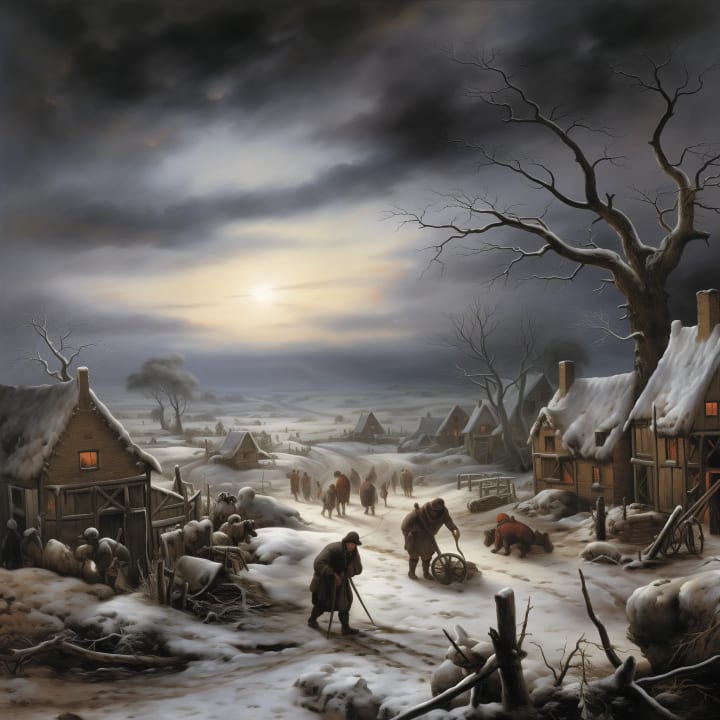
Acidic Rain: When a volcano erupts, it releases gases such as sulfur dioxide (SO₂) and nitrogen oxides. These gases can react with atmospheric compounds to form sulfuric acid (H₂SO₄), nitric acid (HNO₃), and hydrochloric acid (HCl). When dissolved in water, these acids can significantly lower the pH, leading to acid rain. (1)
AGRICULTURAL COLLAPSE AND FAMINE
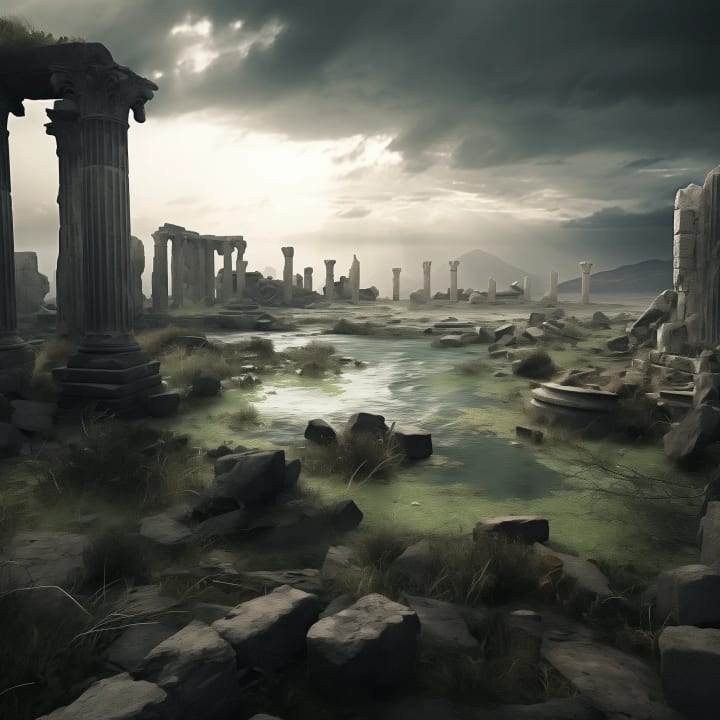
The perpetual twilight that haunted people’s lives had devastating effects on plant life, making the essential process of photosynthesis difficult to sustain.

Photosynthesis requires direct sunlight to produce energy by splitting water molecules (H₂O) into oxygen (O₂), hydrogen ions (H⁺), and electrons. These electrons then react with carbon dioxide (CO₂) to produce glucose, which is essential for plant growth.
Click here to learn more about this incredilble natural process!
As a result, crops failed to grow across vast stretches of land, leading to widespread shortages of food for both people and their farm animals. The resulting famine had catastrophic consequences for the population, drastically increasing the number of starving people.
In addition, contaminated water was causing serious health problems that contributed to the dissemination of diseases and further worsened people’s suffering.
This strange event was considered a myth for years. Just stories written in old chronicles, but, in recent years, studies have been done to understand if there is any truth to these old tales.
THE JUSTINIAN PLAGUE
Following the devastating climatic events of 536 AD, the world faced another monster, with the outbreak of the Justinian Plague in 541 AD.
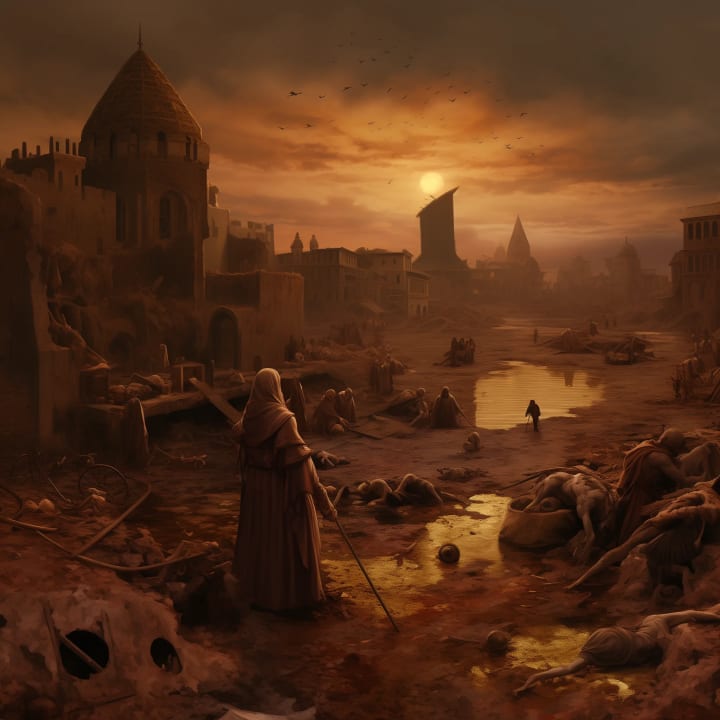
This plague, caused by the Yersinia pestis bacterium, spread across the Eastern Roman Empire, killing 35%–55% of the population and speeding the collapse of this once mighty empire.
This bacterium causes a form of bubonic plague, similar to the Black Death. It has comparable effects, with the most common symptom being inflammation of the lymph nodes, called buboes. (7)
THEORIES

Several theories have been proposed to explain the cause of this global disaster:
Volcanic Eruptions: The most widely accepted theory is that a massive eruption or a series of eruptions occurred. There is still a debate about where they originated, but possibly it was from North America or Iceland. (5)
A significant volcanic event in Indonesia around 540 AD has been suggested as a contributing factor to the exacerbation of the climatic effects observed during this period.
Researchers have linked this eruption to the prolonged duration of the cooling effects.
They correlated data from the analysis of SO₄²⁻ (sulfate) deposits found in ice cores extracted from the Antarctic ice sheet (though the uncertainty of this analysis is too large to draw definitive conclusions) and similar deposits from Iceland.
Additionally, tree-ring chronologies were analyzed, examining the distribution and size of the rings to identify periods of slowed growth.
- Celestial Impact: Another study proposes that a celestial body, in this case, “the Carpentaria impact event”, might have released massive volumes of debris into the atmosphere. This impact would have had similar climatic effects by blocking sunlight and causing a sudden cooling of the Earth’s surface; (4)
- Combinations of Events: Some scientists support the idea that the combined effect of one or more eruptions and a celestial impact was responsible for this strange event.
Researchers found spherules of pure iron oxide in the GISP2 ice core, in a depth that covers the time from 536.15 to 536.66 A.D.
This was interpreted as a by-product of an impact ejection and they found an impact injection layer in the Gulf of Carpentaria, Australia, containing abundant magnetite spherules, similar to the ones sampled from the ice core.
CONCLUSION
This reminds us of the immense power of nature and the reality that events like this can happen again.
Due to the principle of repeatability, there is still much research needed to prevent widespread chaos from such occurrences.
We can’t stop these natural forces but we can develop strategies to mitigate their effects.
“This clearly shows the marked impact that volcanic eruptions have on our climate and, in some cases, on human health, economics and so history.” (3)
This is one of the reasons why history is so interesting and important. In 2010, we witnessed a smaller demonstration of this with the eruption of Iceland’s Eyjafjallajökull volcano, which released an ash plume that affected most of Europe, grounding aeroplanes, cancelling flights and contaminating agricultural and water sources.
I hope you enjoyed it and learned something from it! If so, leave a like and comment, that means the world to me!
Thank you for your time.
REFERENCES
- https://www.britannica.com/science/acid-rain/Chemistry-of-acid-deposition (1)
- https://www.science.org/content/article/why-536-was-worst-year-be-alive (2)
- https://www.smithsonianmag.com/science-nature/sixth-century-misery-tied-not-one-two-volcanic-eruptions-180955858/ (3)
- https://ui.adsabs.harvard.edu/abs/2008AGUFMPP41B1454A/abstract (4)
- https://agupubs.onlinelibrary.wiley.com/doi/full/10.1029/2007GL03245 (5)
- https://www.gutenberg.org/files/16765/16765-h/16765-h.htm (6)
- https://oxfordre.com/classics/display/10.1093/acrefore/9780199381135.001.0001/acrefore-9780199381135-e-8566 (7)
About the Creator
J.Fernandes
I have a deep connection with words and the meaning of life. So, I decided to share that passion with people and help them in whatever way I can.
Reader insights
Nice work
Very well written. Keep up the good work!
Top insights
Excellent storytelling
Original narrative & well developed characters
Expert insights and opinions
Arguments were carefully researched and presented
Eye opening
Niche topic & fresh perspectives
Heartfelt and relatable
The story invoked strong personal emotions
Keep reading
More stories from J.Fernandes and writers in History and other communities.
The Secrets of an Ancient Codex
The Voynich Manuscript is an old relic forged by the unknown, with a purpose yet to be unveiled by the tiresome specialists who work day and night to uncover its secrets. However, it seems to provide a vivid set of drawings that can make you think about the pure essence of wisdom, shared as an intriguing set of images, complemented by an unknown language that seems elusive to the most brilliant minds.
By J.Fernandes12 months ago in History
Center Stage with Gina C.
*** I'm keen to republish the interviews I did for my series with Vocal creators. It's been a few years and I thought it might be nice to revisit these wonderful conversations. I'll be releasing them one at a time for a few weeks/months.
By Heather Hubler4 days ago in Interview


Comments (1)
I loved History when I was in school. It's been more than 5 years and I miss history... Never got the chance to read it again. The trojan war", Greeks and Athens", the Babylonians", Cyrus the great, etc... I miss 'em all. They've become like a childhood memory 🥺 Thank you for sharing it... It sparked in me a light to study History again... Reading your article made me feel like I was holding my History book in hand... Thank you, John... John?