
Wolf Messing and others: Which astrologers and fortune-tellers worked in Hrodna 100 years ago
True stories based on old newspapers studies


During the economic crisis of 1929–1931 and on the eve of World War II, astrologers and fortune-tellers became frequent visitors to Hrodna. This is not surprising—during critical times, people seek assurance that everything will be alright. We browsed old Polish newspapers to find out which “seers” visited our city during that period.
Predicting the Future for Half a Day's Wages
Thanks to his radio appearances, the “palmist-astrologer” Ryszard Morawski-Kalvini gained great popularity. He allegedly studied in India under “masters of secret knowledge” and later enhanced his skills abroad. With the onset of the global economic crisis in 1929, he became something like the “Kashpirovsky” of Polish radio.
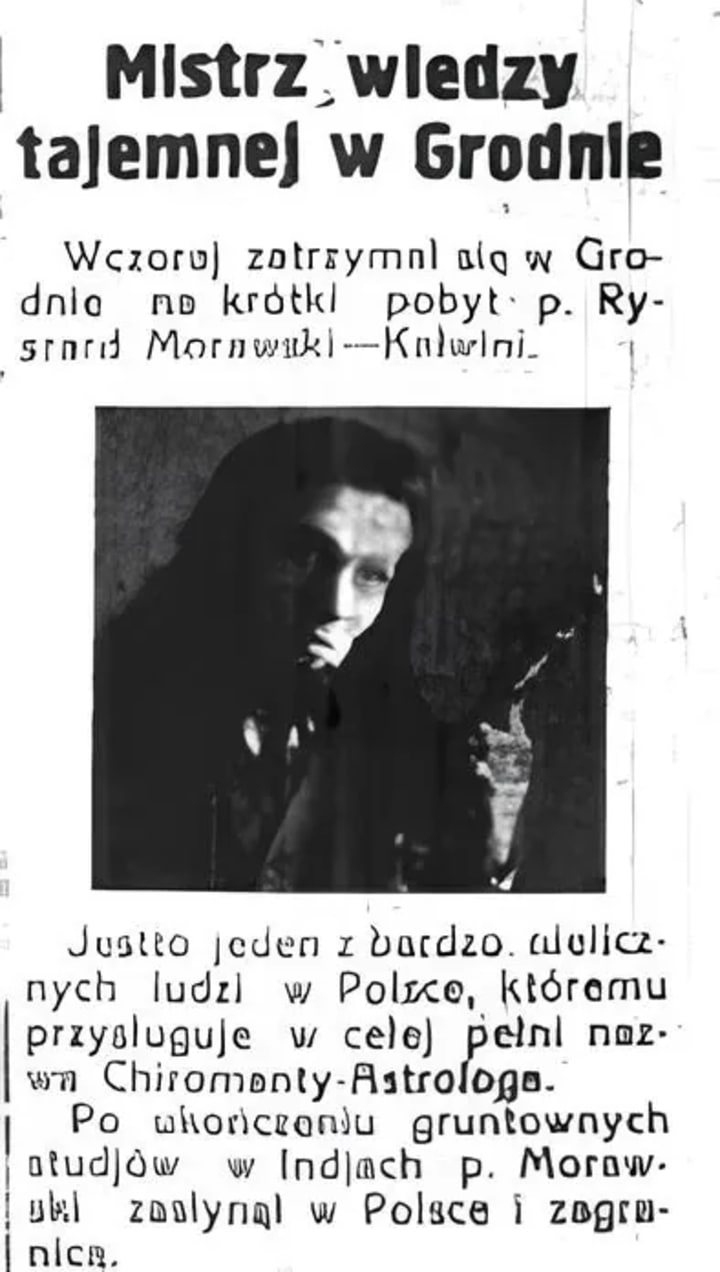
Long queues of people eager to learn their future came to Morawski-Kalvini’s sessions. In Hrodna, this “astrologer” stayed in 1932 at the “Slavyansky” Hotel on Dominikanska Street 18, where he received clients in Room No. 20.
A local newspaper even published his portrait and described the palmist like this:
“Thanks to his foresight, bordering on clairvoyance, he attracted the interest of the scientific world with his vast secret knowledge. He knows everyone’s past and future. His advice is invaluable in life matters, marriage, finance, court, and lotteries.”
Morawski-Kalvini said he could predict the future and recount the past by the lines on a person’s hands, their face, and—something new for that time but widespread in the 1990s—by photographs and even handwriting.
More often than Morawski-Kalvini, Grodno was visited by the “astrologer-seer” Antoni Vasilevsky, who in 1931–1932 stayed at the “Europejski” Hotel at Dominikanska Street 24 and received clients from 10 a.m. to 8 p.m. in Room No. 6. He promised to predict the future by palm and facial lines—for only 1.5 zlotys (about half a day’s wage for an average worker). However, in July 1932, during another visit to Grodno, Vasilevsky lowered his fees for “advice on various life matters,” starting at 1 zloty.

Helping People Become Millionaires for a Small Fee
In the mid-1930s, a new type of “medium” spread—predictors of lottery results, who gave various advice, but not in person—by mail.
They usually advertised their services in high-circulation newspapers such as Kurjer Warszawski. They offered those wishing to become millionaires to send a letter with money enclosed to a given address. One also needed to provide their name and return address. For example, in 1936, the “predictor” Golzani from Krakow became popular. He also offered help in love and other life situations.
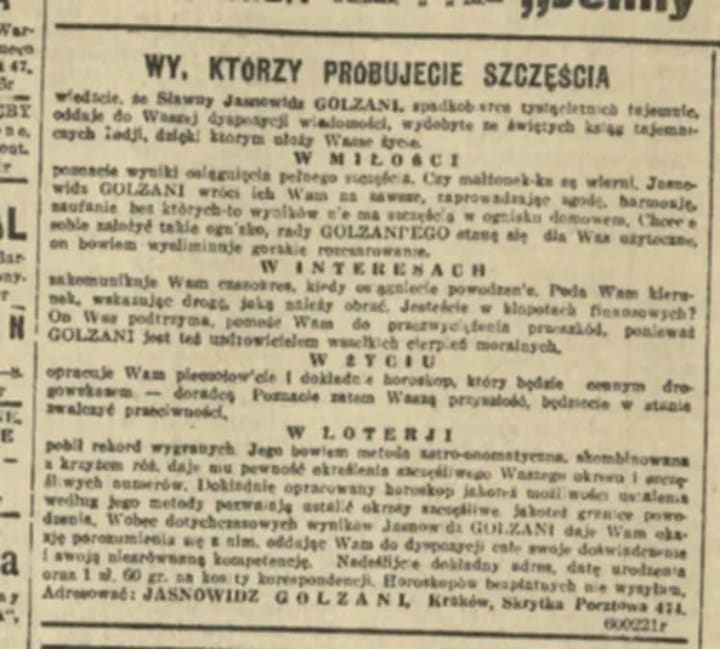
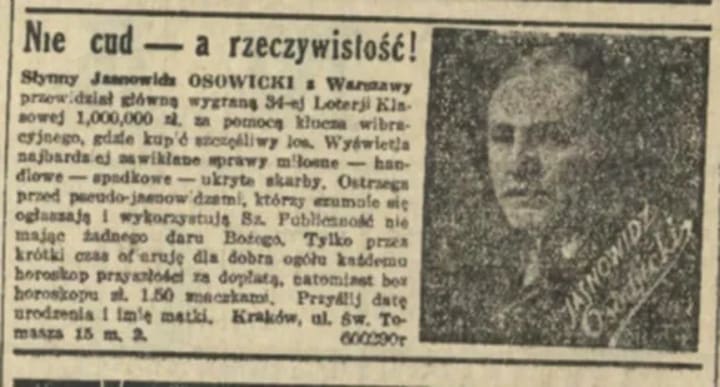
Meanwhile, the “famous seer Osovitsky from Warsaw” claimed in an ad that with the help of a “vibrational key,” he bought a winning lottery ticket and won 1 million zlotys. He even warned potential clients about “pseudo-seers” and urged them to contact him—providing their date of birth and, curiously, their mother’s name. The 1.5 zloty fee had to be sent to Krakow (not Warsaw).
How Wolf Messing Performed in Hrodna
In 1938, Hrodna was visited by Wolf Messing and his troupe—a man whose name is associated with predictions for Adolf Hitler and Joseph Stalin. Unlike the astrologers popular in the early 1930s who worked one-on-one, Messing gave public performances. One of them took place in Grodno on July 18, 1938. Tickets to the show ranged from 30 groszy to 1.5 zlotys.
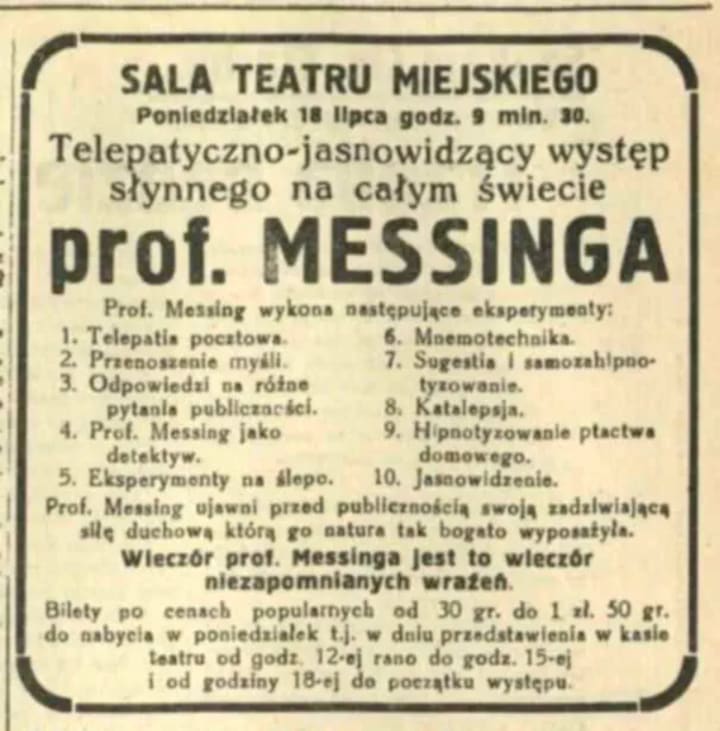
Messing amazed audiences with his mnemonic techniques and hypnosis, and also performed experiments with telepathy, “catalepsy,” and predictions.
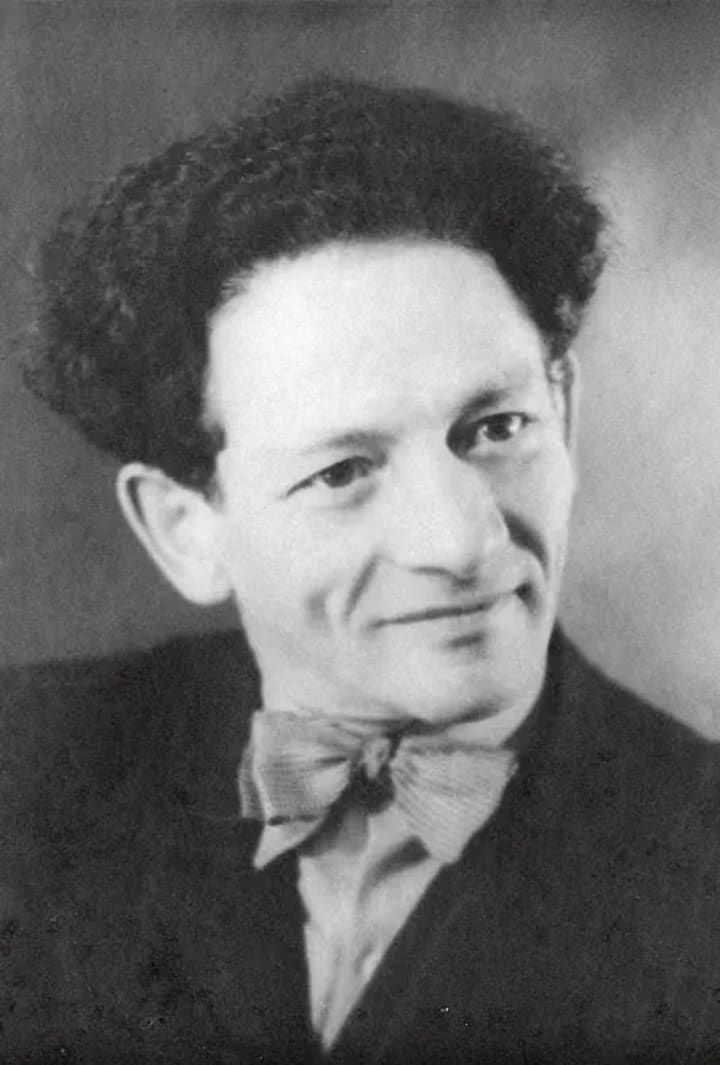
When World War II began in 1939, Wolf Messing ended up in Soviet-occupied Grodno along with Jewish refugees fleeing the Nazis from Poland. Messing landed in a local prison and, according to legend, hypnotized a guard and walked out of his cell.
In his memoirs, Messing recalls performing in Hrodna after the city was occupied by the Soviets. He remembered that performance in particular because, although he had already learned Russian quite well, he sometimes still said “complete nonsense.”
“Once, right before a performance, I had a big argument at the hotel. I came out to the audience and addressed them: ‘Gentlemen comrades.’ Luckily, this was in Hrodna, a city that had only recently been Polish. The audience thought I was joking and laughed. In fact, I didn’t know how to joke at all.”
An Orthodox “Miracle Worker” from the Belarusian-Polish Borderlands
Unlike the heavily promoted astrologer-tourists, various fortune-tellers and “miracle workers” were very popular among the rural folk. Sometimes they even made it into newspaper articles, which tried to illustrate the “ignorance reigning in our lands.” For example, one of the most well-known “miracle workers” in the Grodno region during the interwar period was the Orthodox priest Kudravtsov from Kleszczele (today part of Poland, right on the border with Belarus).
People came to the priest-miracle worker from all over interwar Poland. But in January 1935, an unfortunate incident occurred during a visit to Kudravtsov. A young couple came from near Kovel—Olga Kravchuk, who had left her husband and run off with her lover, Grigory Navechovsky. After a few days at the miracle worker’s place, the relationship soured. It reached the point where Navechovsky struck Kravchuk on the head with an axe—twice. She was taken in serious condition to a hospital in Hrodna.
A Horrific Incident Near Vilnius
Similar situations involving various “healers” appeared in Grodno newspapers from other parts of Western Belarus. On February 27, 1932, journalists reported on a healer named Adolf Barlin from the village of Butki in Derevnitskaya commune (now Pruzhany District, Brest Region). He became known after curing a girl of a dangerous ulcer. But soon, two of his patients, whom he had treated with herbs, died. Their relatives reported the matter to police, and Barlin was arrested.
On April 3, 1934, a Hrodna newspaper reported a horrific case in the village of Lyakhitskiye Bary near Vilnius. A local woman, Anela Shimanova, had a six-year-old son named Antuk who contracted scabies. A neighbor, Lobanova—known as a healer—advised her to smear the boy with tar, heat the stove, and keep him inside it for five minutes. After that, the disease would supposedly disappear.
Shimanova didn’t resist the advice and placed the boy on a shovel, locking him in the stove. When the boy started screaming, the healer reassured the mother that this was the disease “leaving his body”—that’s why he was screaming so terribly. When the cries stopped, Lobanova figured the disease was gone—it had been five minutes, after all. When the stove was opened, the boy was pulled out with terrible burns. He died within minutes. Both women were arrested.
First Belarusian-language version of this story was published at Hrodna.life: https://hrodna.life/articles/astrolahi/
About the Creator
Keep reading
More stories from writers in History and other communities.
The Penguin Who Walked Away: Not a Tragedy, but a Choice.
Every once in a while, the internet turns a moment from nature into a metaphor for human pain. Recently, a video of a penguin walking away from its colony went viral, framed as a heartbreaking image of abandonment, lost love, or emotional defeat. Millions watched it through a romantic lens, calling it tragic and cruel.
By Voxwrite ✍️ 4 days ago in History
Hannibal Barca: Tactical Genius Beyond Politics
History often favors the victors, but strategy remembers the exceptional. Few commanders embody this truth more clearly than Hannibal Barca. Though he ultimately lost the Second Punic War, Hannibal remains one of the most studied military minds of all time. His genius did not lie in ruling empires or shaping laws, but in something purer and rarer—battlefield intelligence unchained by politics. Hannibal was not a builder of states. He was a master of movement, deception, and human psychology.
By Fred Bradford3 days ago in History
Time to change your life.
Is it even possible for you to change your life? A lot of people, more than there should be, are unhappy with their lives. But what are they doing about it? Usually nothing. People talk about how shitty their lives are and want change, but are they not taking the actions to change?
By Jen Phillipsa day ago in Humans
Not Just For Clean Up: A History Of The MCU's Department of Damage Control
Initially an organisation that seemed to exist to help the heroes of the Marvel Cinematic Universe, from Phase Four onwards, the Department of Damage Control has shifted into a more antagonistic role. Most recently seen in the Wonder Man series, the current incarnation of Damage Control seems to target superpowered individuals, regardless of whether that person poses an active or intentional threat.
By Kristy Andersonabout 14 hours ago in Geeks




Comments
There are no comments for this story
Be the first to respond and start the conversation.