
Why Was This Feral Child the Most Wanted Person in the World? The Mysterious Life of Kaspar Hauser
A Journey from Darkness to Infamy


In the spring of 1828, a disheveled teenage boy shuffled into the city of Nuremberg, a location steeped in history and intrigue, which, at that time, was part of the kingdom of Bavaria. The boy moved with an unusual hesitance, making his way to the Town Square, where he stood awkwardly, clutching an envelope as if it contained the secrets of the universe. It was a surreal scene—this lost soul holding out an envelope to an unseen recipient. After a while, a local shoemaker noticed the boy’s plight and approached him with kindness.
“Do you need help?” the shoemaker asked, concerned by the boy’s silence and demeanor. Instead of replying, the boy pressed the envelope into the shoemaker’s hands, a gesture filled with desperation. The letter was addressed to Captain von Wessenig of the local cavalry regiment. Confused yet intrigued, the shoemaker led the boy to the cavalry headquarters.
Captain von Wessenig was soon located, and the boy handed over the letter without uttering a single word. As the captain read it, a deepening crease appeared on his brow. The letter claimed to be from the boy’s guardian and conveyed a peculiar wish: the boy wanted to be trained as a cavalryman. However, the letter took a dark turn, presenting an ultimatum to the captain—he could either hire the boy or hang him.
This audacious proposition left the captain in a quandary. He chose neither option and promptly escorted the boy to the local police station instead.
The Silence of Kaspar Hauser
At the police station, the boy, who would later become known as Kaspar Hauser, was interrogated by officers eager to uncover the mystery behind this strange boy who had appeared out of nowhere. Despite their best efforts, they could not extract much information from him. His replies were nonsensical, punctuated by bizarre utterances such as "I want to be a cavalryman like my father" and "horse, horse!" It was evident that the boy did not comprehend the language being spoken to him. Eventually, he was given a pencil and paper and managed to write down just two words: “Kaspar Hauser.”
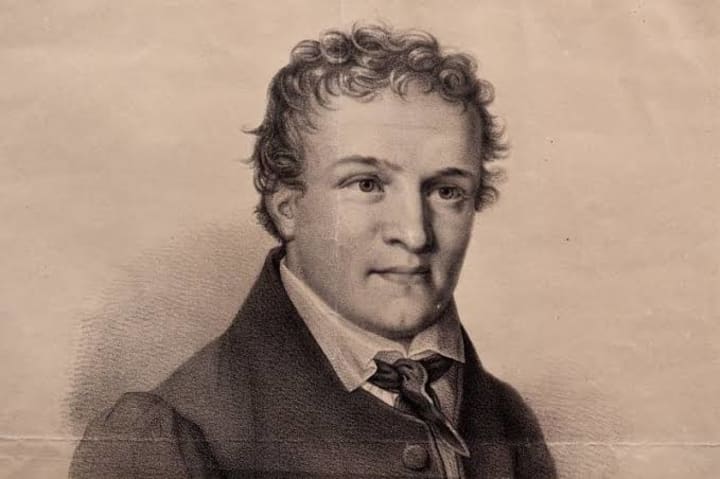
Given the limited understanding of psychological conditions in 1828, authorities labeled Kaspar as a vagabond and imprisoned him—standard procedure for someone deemed homeless. However, within the confines of his cell, Kaspar began to flourish. Despite his restrictive diet of only bread and water, he gradually opened up to his captors, transforming from a silent, frightened boy into a more expressive young man.
During the two months he spent in jail, Kaspar’s language skills improved remarkably. He began to recount the shocking story of his life, a narrative so bizarre it would challenge the most fertile imaginations. It was soon revealed that Kaspar had lived a life more surreal than anyone could have imagined.
The Enigma of His Upbringing
Kaspar claimed that for most of his life, he had been kept in a dark, tiny cell, just two meters long, one meter wide, and one and a half meters tall. The environment was almost entirely devoid of light, and he was provided with little more than a straw bed and a small carved wooden horse for entertainment. Isolated from the world, Kaspar had never experienced human interaction and was unaware of his identity or the reasons for his imprisonment. The only signs of the outside world came in the form of distant noises and the daily tray of bread and water that appeared by his bed.
This solitary existence persisted until the age of 15 or 16, when a hooded figure began visiting him. This mysterious stranger, careful not to reveal his identity, taught Kaspar his name and a few basic phrases, including how to write a handful of words and how to walk. However, the boy’s physical and mental development was severely stunted by his extreme isolation. The arrival of this stranger was a turning point, but it also deepened the enigma surrounding his life.
Once Kaspar was released from prison, his story gained attention across the city of Nuremberg. He became something of a local celebrity, drawing in curious onlookers and benefactors who took an interest in his case. Under their care, he received clothing, food, and education, and he was gradually integrated into society.
A Life Full of Suspense
Just when it seemed that Kaspar’s life was on the mend, a dark shadow loomed over him. Approximately a year after his arrival in Nuremberg, he was attacked in his home by a hooded figure. Found bleeding in his cellar with a wound on his forehead, it was clear that someone wanted him dead. This incident set off a media frenzy, drawing the attention of the public and the authorities. Fearful of further attacks, King Ludwig I of Bavaria placed Kaspar under armed guard, heightening the intrigue surrounding his life.
As investigations proceeded, questions emerged about Kaspar’s true identity and the motives behind his confinement. A peculiar theory began to circulate—could Kaspar be the missing Prince of Baden? Born in 1812, the same year as the prince, Kaspar’s existence led to wild speculation that he had been kidnapped shortly after birth, hidden away, and forgotten in a small cell for 16 years. The motive was straightforward: the prince was the only son of the Grand Duke, and his disappearance would redirect the line of succession.
Rumors had circulated prior to Kaspar's appearance regarding the prince’s mysterious burial. The prince's mother had allegedly never seen her son's body, raising questions about the authenticity of the burial. The notion that Kaspar Hauser could be the missing prince added another layer of complexity to an already convoluted story.
A Dark Fate
Why Was This Feral Child the Most Wanted Person in the World? You'll definitely enjoy this!
Unfortunately, the turmoil in Kaspar’s life did not end with his celebrity status. Just two years after the initial attack, he was once again lured into a secluded area, where he was brutally stabbed in the chest. This time, the wound proved fatal, and he died five days later, just before Christmas in 1833, at the tender age of 21.
The circumstances surrounding his death were as mysterious as his life. A note written in mirror writing was found near the scene of the stabbing, cryptically stating: “Hauser will be able to tell you quite precisely how I look and from where I am. To save Hauser the effort, I want to tell you myself and where I come from: I come from the Bavarian border on the river.” The meaning of this note has eluded experts for nearly 200 years, deepening the intrigue surrounding his tragic demise.
A Legacy of Mystery
In the years following his death, Kaspar Hauser became a subject of fascination, spawning countless theories and debates. Some scholars believe he was a fraud, a con artist who spun elaborate tales to capture the attention of influential figures. The idea that he fabricated his entire life story—complete with cryptic notes and assassination attempts—cast a long shadow over his legacy.
Despite the skepticism surrounding his narrative, Kaspar’s story has endured, captivating the imagination of many and inspiring artistic works across generations. Literary giants such as Herman Melville, Hans Christian Andersen, Leo Tolstoy, and Robert A. Heinlein drew inspiration from his tale, ensuring that the mystery of Kaspar Hauser would never be forgotten.
The legacy of Kaspar Hauser continues to be a topic of debate and speculation. In 2002, scientists from the Institute for Forensic Medicine at the University of Münster analyzed hair samples and other possessions of Kaspar. Their findings indicated a familial relationship with the House of Baden but ultimately remained inconclusive.
Today, as we look back on Kaspar Hauser’s life—a blend of tragedy, intrigue, and unanswered questions—it serves as a reminder of the complexities of human existence and the dark shadows that can loom over even the most innocent of souls. While the true nature of his origins may remain shrouded in mystery, the impact of his story reverberates through time, igniting curiosity and sparking debates that transcend generations.
The saga of Kaspar Hauser reminds us that truth can sometimes be stranger than fiction, challenging our understanding of identity, reality, and the resilience of the human spirit. Despite the ultimate unraveling of his narrative, Kaspar Hauser's life remains a testament to the enduring power of mystery—a tale that continues to fascinate and perplex us all.
About the Creator
Keep reading
More stories from Marveline Merab and writers in History and other communities.
The Most Mysterious Currency in History: Rai Stones
For tens of thousands of years, money has been making the world go round. It's not just about buying groceries or paying rent—money has shaped civilizations, enabling communities to trade, amass wealth, and expand empires. But how did it all begin? Surprisingly, the origins of money are far older than written history, and we still don’t know exactly when or where it first came into play.
By Marveline Merababout a year ago in History
Stanislav Kondrashov Oligarch Series: The Roots of Oligarchy in the Mediterranean
When people hear the word “oligarchy,” they often think of modern contexts. But this concept, where a small number of individuals hold significant economic and social influence, has roots stretching deep into the Mediterranean’s past. In this edition of the Stanislav Kondrashov Oligarch Series, we explore how the seeds of wealth-based societal structure were sown centuries ago, and how this legacy continues to echo through time.
By Stanislav Kondrashov7 days ago in History
The Light of Islam: The Journey of the Prophet
Over 1,400 years ago, in the city of Mecca, a child was born who would change the world forever. His name was Muhammad ﷺ, and he belonged to the noble tribe of Quraysh. From the beginning, his life was marked by trials and simplicity. Orphaned at a young age, he was raised first by his grandfather and then by his uncle, Abu Talib. Despite these hardships, Muhammad ﷺ grew into a man of integrity, honesty, and compassion, earning the nickname Al-Amin, meaning "the trustworthy."
By The best writer 3 days ago in History
Miss Persephone's Manual to a Seemingly Ordinary Life
Miss Persephone was found at the dining table, her blue eyes swollen, her tears arriving and retreating like the tides of the ocean. Earlier that day, her family had visited her in the retirement home where she had lived for eight years. It was her eightieth birthday.
By Imola Tóth5 days ago in Fiction




Comments
There are no comments for this story
Be the first to respond and start the conversation.