
The Most Mysterious Currency in History: Rai Stones
The Fascinating Tale of Money: From Rai Stones to Bitcoin

For tens of thousands of years, money has been making the world go round. It's not just about buying groceries or paying rent—money has shaped civilizations, enabling communities to trade, amass wealth, and expand empires. But how did it all begin? Surprisingly, the origins of money are far older than written history, and we still don’t know exactly when or where it first came into play.
For a long time, anthropologists believed that money was invented to replace bartering. After all, bartering sounds so... prehistoric, right? But here’s the kicker: no evidence suggests any society solely relied on bartering. None. And when you think about it, bartering is a pretty inefficient way of doing business. You’d need what economists call a "double coincidence of wants." In plain English, you both have to want what the other person is offering. Not exactly practical for large-scale economies.
When Food Scarcity Gave Birth to Money
So, what did ancient humans do when their trading systems hit a snag? It’s possible money emerged as a tool to cope with food scarcity. Imagine two neighboring tribes: one specializes in hunting mammoths, the other in fishing. What happens when mammoths migrate or the fish don’t bite? Money—a way to ensure survival during tough times by facilitating trade between tribes. Pretty nifty, right?
Now, before you start picturing cavemen pulling out wads of cash, let’s clear something up. The money we’re talking about back then wasn’t anything like the coins or bills you find in your wallet today. In fact, the concept of "money" has taken many weird and wonderful forms throughout history.
Peppercorns, Parmesan, and... Eels?
Believe it or not, for much of human history, commodity money ruled the world. Commodity money refers to any item that has intrinsic value. Peppercorns, tea, shells, and silk were once valuable currencies. In medieval Italy, parmesan cheese wasn’t just for pasta—it was also collateral for bank loans. And if you lived in medieval England, 40 sticks of eels could pay your rent for an entire year. (Move over Bitcoin, we’ve got eels!)
Prisons, with their restriction on traditional currency, have also given rise to some creative alternatives. Cigarettes were once the go-to prison currency, but recently, ramen noodles have taken over. Drug-free urine? Yeah, that’s another one, though I wouldn’t recommend trying to pay for groceries with it.
The Largest Currency You’ve Never Heard Of: Rai Stones
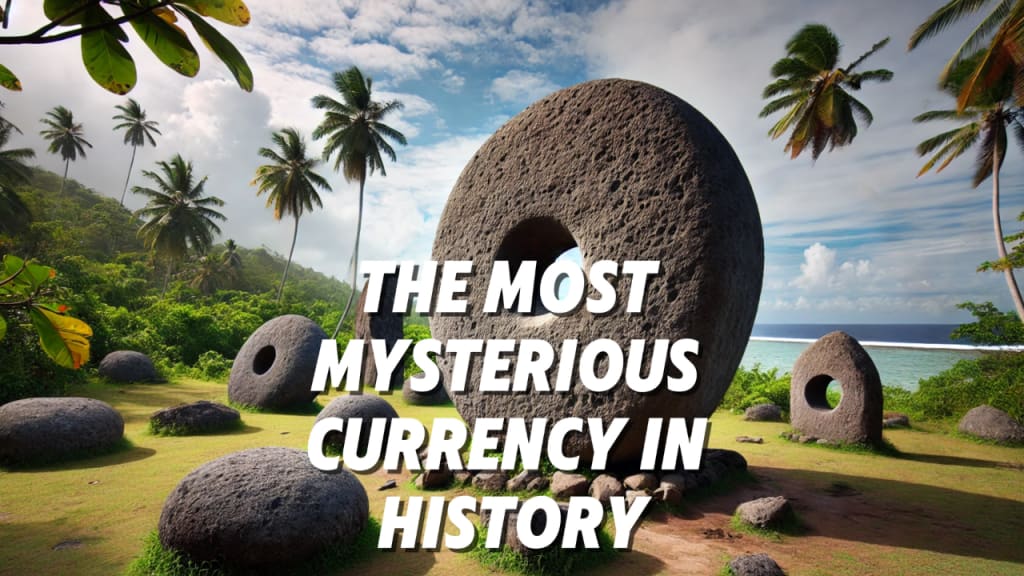
Of all the bizarre forms of currency, one stands out as truly monumental: Rai Stones, used on the tiny Yap Islands of Micronesia. Picture a coin. Now make it four meters tall and weighing four tons—roughly the size of an Asian elephant. The smallest ones are still a hefty 30 centimeters across, making these stones about as practical to carry as a baby elephant.
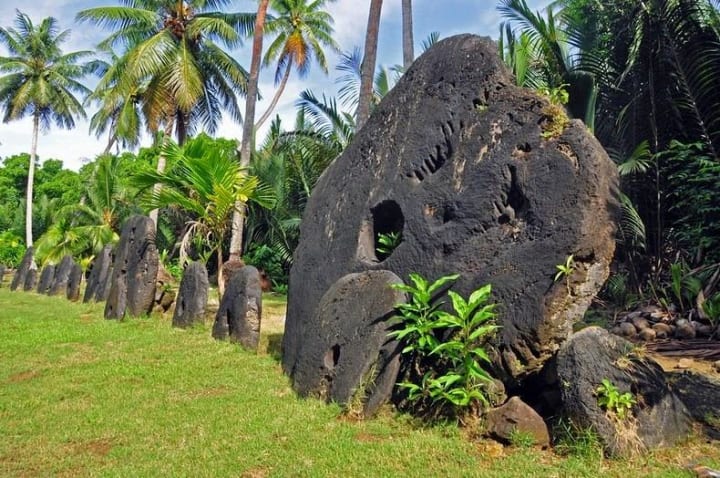
The stones weren’t just an island novelty. For centuries, these enormous limestone discs served as legitimate currency for important social transactions like marriages and political agreements. But how do you trade something you can’t move? Simple: you don’t.
Trading What You Can’t Carry
Once a rai stone arrived at its destination, it stayed put. Forever. Even if ownership changed hands, the stone remained in place. Sometimes, rai stones were so large that boats capsized while trying to transport them. No worries—the sunken stones were still valuable and could be traded based on word of mouth. As long as everyone agreed on its value, a stone at the bottom of the ocean was as good as gold.
But how was the value of these stones determined? It wasn’t just about size. Factors like how difficult the stone was to obtain, the craftsmanship, and the stone’s history all played a role. A particularly well-carved stone made by a respected artisan could be worth more than a larger, clumsily made one. And certain stones could fetch different prices depending on the occasion—a wedding stone might be worth more than a stone used in a simple food trade.
Enter the "Rai Stone Cowboy"
Rai Stones: The Most Mysterious Currency in History. You'll definitely enjoy this!
Fast forward to 1871, when an Irish-American sailor named David O’Keefe washed ashore on Yap. He saw an opportunity where others saw a collection of heavy rocks. O’Keefe introduced the islanders to modern tools, making it easier to carve new rai stones. He even set himself up as a trader, acquiring his own private island and marrying several Yapese wives along the way. (Sorry, Mrs. O’Keefe back in America!)
O’Keefe’s innovations, however, had unintended consequences. By making the creation of rai stones easier, he inadvertently caused inflation. The value of the new stones didn’t compare to the old ones, which had required immense effort to acquire. It turns out that even in the world of giant stone coins, inflation can rear its ugly head.
Rai Stones and Bitcoin: Surprisingly Similar
Now, you might be thinking, "Cool story, but what does this have to do with modern times?" Well, if you’re into Bitcoin, this might surprise you: rai stones and Bitcoin have a lot in common. Both rely on a ledger system to keep track of transactions. Bitcoin uses blockchain, a secure public record of every transaction ever made. Rai stones used word of mouth, with ceremonial gatherings where island chiefs announced trades. No banks. No paperwork. Just a trusted community keeping the system running smoothly.
Like Bitcoin, rai stones were "mined" from a finite resource—in this case, limestone from the island of Palau. And both systems depend on the trust and consensus of the community to maintain value. Half a millennium before anyone heard of cryptocurrencies, the Yapese had already mastered decentralized money.
Still Trading Giant Rocks? You Bet!
Despite David O’Keefe’s influence and the subsequent inflation, rai stones didn’t disappear. In fact, they’re still used for special transactions on Yap today. Regular money handles the daily grind, but for important social events, the islanders still turn to their trusty, oversized stone coins. Thousands of other currencies have come and gone, but the rai stones of Yap stand tall—literally.
So, the next time you’re fumbling with change or checking your Bitcoin balance, take a moment to appreciate the ingenuity of the past. Whether it’s a giant stone coin or a digital token, money in all its forms has one job: helping us get what we need, one transaction at a time.
And who knows? Maybe rai stones will make a comeback. After all, when it comes to longevity, they’ve already outlasted most other currencies. Forget Dogecoin—I'm off to huddle some rai stones!
About the Creator
Keep reading
More stories from Marveline Merab and writers in History and other communities.
Why This Grave Has a Cage On It: Body Snatching in 19th Century Britain
Imagine this: mourners gather around a coffin in a churchyard, paying their last respects. After the somber ceremony, they drift off to the local pub for a wake, leaving the grave covered with earth, believing the deceased is safely laid to rest. But beneath the stillness of the night, while the last few mourners reminisce over one last pint, a shadowy figure emerges from the darkness. Several men, driven by a grim necessity, dig up the grave, pull out the body, and quickly rebury the empty coffin, covering it back with earth. Over the coming weeks, relatives return to lay flowers and pay their respects, completely unaware that their loved one is no longer there.
By Marveline Merababout a year ago in History
No ICE, No KKK, No Fascist USA
"I don't 'do' politics." Politics will do you, regardless. Watching from the sidelines for the last year I can see far too many similarities in the way Trump's ICE Gestapo is to Nazi Germany. Considering the United States just invaded Venezuela and kidnapped their President and his wife I would say we are there.
By Lyvia Jack3 days ago in History
3 Moments When Reality Accidentally Became a Horror Movie
Horror movies usually rely on a simple agreement with the audience: this could never really happen. Ghosts follow rules, monsters have weaknesses, and there’s always a clear point where reality hands the story over to fiction. Real life, unfortunately, does not care about narrative structure, logic, or closure.
By Enoch Sagini2 days ago in History




Comments (1)
A beautiful intertwining of history with the present, in the dimension of human need for survival and in the field of discovering ways to exchange products. The opinion that history does not teach is erroneous. Well done!