
Why Was There a War Over Dinosaur Bones? The Bone Wars
How a Bitter Rivalry Shaped Paleontology and the Quest for Thunder Lizards

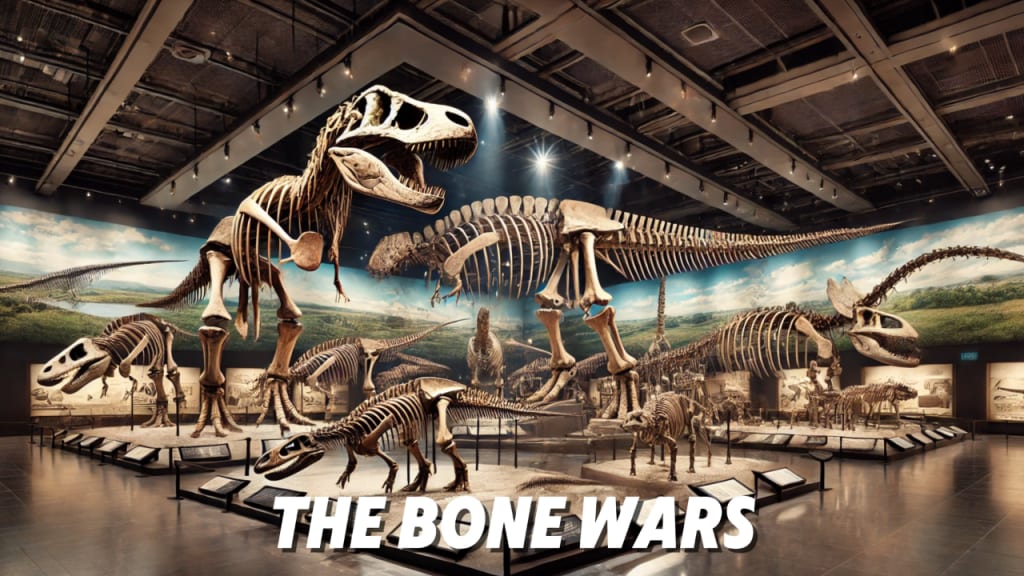
When you hear the phrase “thunder lizards,” what comes to mind? Probably some massive, lumbering reptile that shakes the earth with every step. And you'd be right—well, mostly. The Brontosaurus, or "thunder lizard" in Greek, was one of the largest creatures to ever roam the Earth, measuring around 23 meters long with a neck to match and a tail that seemed to go on forever.
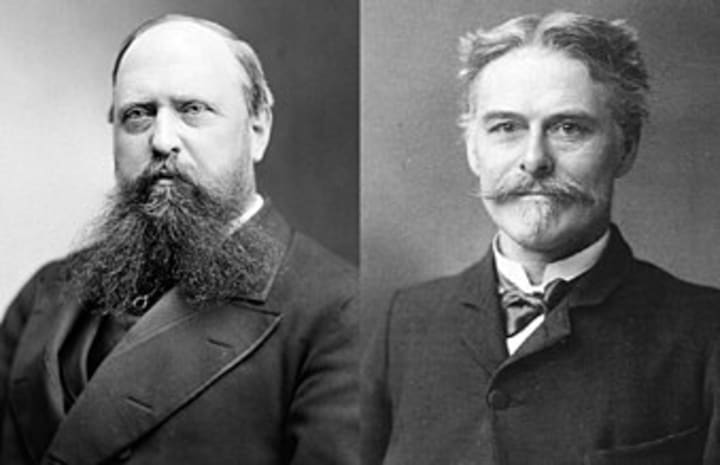
But the story of the Brontosaurus is more than just one of awe-inspiring size. Its history is fraught with controversy, mistakes, and bitter rivalries—a casualty of the famous "Bone Wars," a fierce competition between two of the most prominent paleontologists of the 19th century: Edward Drinker Cope and Othniel Charles Marsh.
This is a tale of betrayal, backstabbing, and a quest for dominance in the field of paleontology. It’s also the story of how one of the most famous dinosaurs was discovered, disappeared, and then reappeared in scientific history.
A Good Time to Be Alive... If You Like Fossils
The late 19th century, also known as America’s Gilded Age, was an exciting time of rapid industrial growth and economic prosperity. Cities expanded, railroads stretched across the country, and wages were better than ever. And, with the frontier still largely unexplored, people had both the time and the resources to head out on fossil-hunting expeditions.
This period became known as "The Great Dinosaur Rush," a time when everyone, from seasoned scientists to eager amateurs, wanted to get their hands on ancient bones. Fossils became highly sought-after treasures, not just for their scientific value but also for their monetary worth. At the time, a good specimen could fetch over £200—a tidy sum in those days, enough to buy you a pretty decent car today.
However, the true driving forces behind the Bone Wars weren't just the economic prospects. For Edward Drinker Cope and Othniel Charles Marsh, it was about far more than money: it was about prestige, recognition, and the all-too-human desire to be remembered as the best.
The Seeds of Rivalry
To understand how this intense feud came to be, let’s go back to the winter of 1869, when Cope and Marsh first crossed paths in Berlin. At the time, Cope was a young, ambitious paleontologist traveling through Europe to visit museums, connect with fellow scientists, and (perhaps not so coincidentally) avoid being drafted into the American Civil War. Marsh, on the other hand, was busy studying for his third university degree at the University of Berlin.
Despite their different backgrounds, the two men shared a passion for paleontology. Cope was born into a wealthy Philadelphia family and had pursued natural history against his father’s wishes, publishing an impressive 37 scientific papers by the time he met Marsh. Marsh, by contrast, had grown up in poverty in New York but was lucky enough to have a wealthy uncle, George Peabody, who funded his education and even built him a museum. Marsh, although older than Cope, had not published nearly as much.
Though their personalities couldn’t have been more different—Cope was young, charming, and hot-tempered, while Marsh was methodical and introverted—the two scientists initially hit it off. They exchanged fossils, letters, and even named newly discovered species after each other. For a time, it seemed like the beginning of a beautiful professional friendship.
Betrayal at the Clay Pit
The friendship between Cope and Marsh took a nosedive when Marsh committed his first major betrayal. Cope invited Marsh to tour a New Jersey clay pit where important fossils were frequently discovered. But instead of simply enjoying the experience, Marsh secretly bribed the pit owner, William Foulke, to send any future fossil discoveries to him instead of Cope.
When Cope found out, he was furious. Marsh’s underhanded move shattered their friendship, turning it into a bitter rivalry that would escalate into an all-out war.
The Elasmosaurus Blunder
Why Was There a War Over Dinosaur Bones? You'll definitely enjoy this!
After Marsh's betrayal, Cope suffered a humiliating blow to his reputation. He had discovered the fossil remains of an aquatic dinosaur he named Elasmosaurus, but in his excitement, he made a crucial mistake: he placed the dinosaur’s head on the wrong end of its body, attaching it to its tail instead of its neck.
Marsh saw this as the perfect opportunity to embarrass his rival. While Joseph Leidy, Cope's mentor, had been the first to notice the error, Marsh took credit for pointing it out. He gleefully spread the news, tarnishing Cope's reputation. Cope was mortified. In a desperate attempt to save face, he tried to buy and destroy every scientific journal that had published his mistake. Unfortunately for him, the damage was done.
This particular act of humiliation would linger over Cope’s career, fueling the feud between the two men.
Marsh Makes His Own Mistakes
Ironically, Marsh was no stranger to making mistakes himself. In 1877, he discovered the fossils of a long-necked dinosaur he named Apatosaurus. However, the skeleton was missing a skull, so Marsh did what any scientist in a hurry might do—he found a random skull lying around and stuck it on.
Later, Marsh discovered yet another long-necked dinosaur, but because this one had the correct skull, he failed to recognize it as Apatosaurus and gave it a new name: Brontosaurus. This mistake wasn’t caught until 1903, long after Marsh had made his name, and the Brontosaurus name was phased out. But in a surprising twist, a study in 2015 found that Apatosaurus and Brontosaurus fossils were different enough to be considered separate species. Marsh’s thunder lizard, Brontosaurus, was finally back.
Battle for the Bonefields
As the feud heated up, Cope began to make his own bold moves. He trespassed onto Marsh’s fossil-hunting grounds and even hired some of Marsh’s former workers. Together, they discovered a treasure trove of fossils in Wyoming, much to Marsh’s dismay.
Meanwhile, Marsh wasn’t taking these invasions lightly. He armed his own fossil diggers and instructed them to keep Cope’s men away at all costs. The tension at fossil sites like Como Bluff became so intense that it nearly led to gunfights. In their desperation to one-up each other, both men’s teams resorted to dynamiting fossils just to prevent their rival from getting their hands on them.
Public Scandals and Fallout
While their rivalry played out in the fossil fields, the real carnage occurred in the public eye. Marsh, ever the politician, used his connections in Washington to get himself appointed as the head of the U.S. Geological Survey, cutting off Cope’s access to federal funding. Cope’s financial struggles worsened, especially after some bad investments in silver and gold mines.
But Cope wasn’t done yet. In 1880, he dropped a bombshell. He had kept a meticulous journal of every mistake Marsh had ever made, including misuse of government funds and plagiarism. Cope handed the journal over to a journalist, sparking a public scandal that shocked the scientific community.
The End of the Bone Wars
As both men aged, their careers and reputations were left in tatters. Cope never regained his wealth, and Marsh spent his final years trying to defend himself from Cope’s accusations. When Cope died in 1897, he left one final challenge to his rival: he requested that his brain be measured and compared to Marsh’s, confident that his would be larger and therefore superior. Marsh, however, never took him up on the offer.
In the end, the Bone Wars left both men bruised, but their legacy endures. Between them, Cope and Marsh discovered and described over 130 species of dinosaurs, laying the foundation for modern paleontology. Their rivalry, though fueled by ego, competition, and pettiness, helped shape the future of the field they both loved.
And perhaps, in a way, their thunderous feud was fitting for the creatures they studied—giants whose conflicts echoed across time, leaving lasting impressions on history.
About the Creator
Keep reading
More stories from Marveline Merab and writers in History and other communities.
Why Was This Feral Child the Most Wanted Person in the World? The Mysterious Life of Kaspar Hauser
In the spring of 1828, a disheveled teenage boy shuffled into the city of Nuremberg, a location steeped in history and intrigue, which, at that time, was part of the kingdom of Bavaria. The boy moved with an unusual hesitance, making his way to the Town Square, where he stood awkwardly, clutching an envelope as if it contained the secrets of the universe. It was a surreal scene—this lost soul holding out an envelope to an unseen recipient. After a while, a local shoemaker noticed the boy’s plight and approached him with kindness.
By Marveline Merababout a year ago in History
Can the United States Leave NATO?
Can the United States Leave NATO? What It Would Take—and What It Would Mean The North Atlantic Treaty Organization, commonly known as NATO, has been one of the most powerful military alliances in modern history. Since its creation in 1949, the United States has been NATO’s strongest member—militarily, financially, and politically. But in recent years, debates have grown louder about whether the U.S. should remain in the alliance. This raises a serious question: how could the United States be removed from NATO—or leave it—and what would that mean for the world?
By Wings of Time 4 days ago in History


Comments
There are no comments for this story
Be the first to respond and start the conversation.