
Why The Treadmill Was the Original Torture Machine
The Dark History of the Treadmill: From Torture Device to Gym Favorite

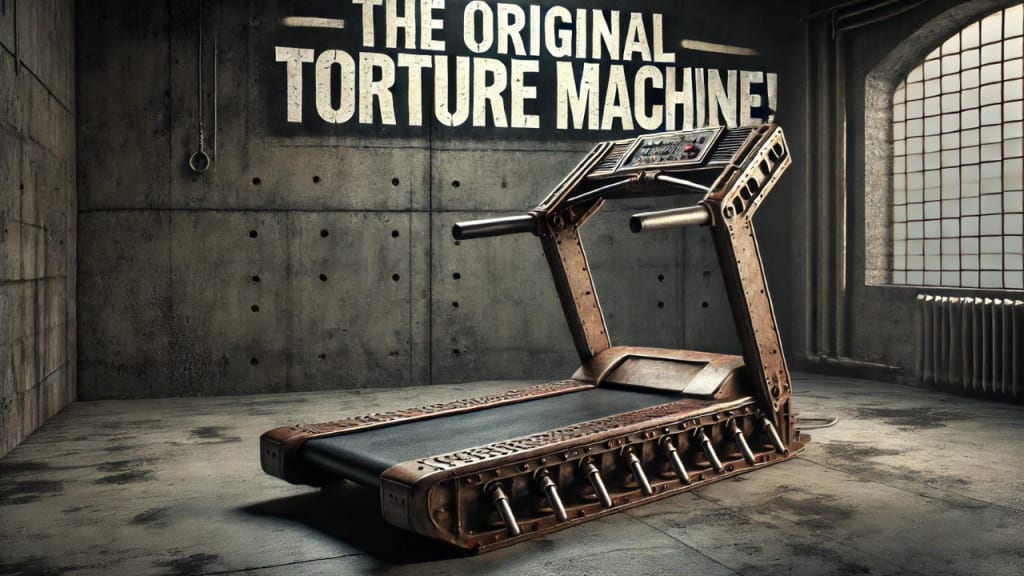
You probably haven’t thought much about it, but your local gym harbors a disturbing secret. No, I’m not talking about those people who take forever at the hair dryer station – I’m talking about a popular piece of gym equipment with a shockingly sinister past: the treadmill.
Sure, treadmills seem harmless enough. Just a straightforward cardio machine, right? But buckle up, because the world’s favorite gym equipment has a history that’s both dark and downright creepy.

What’s in a Name: The “Tread” and the “Mill”
Let’s start with the name: treadmill. The “tread” part is obvious – you’re walking or running. But what’s the deal with “mill”? Well, not too long ago, that part made sense, too. Let me take you back to early 19th century England, where the treadmill's real story begins.
At the time, England had some of the harshest laws in the world. Over 200 offenses were punishable by death. Yes, 200! We’re talking about crimes like "writing a threatening letter" or "stealing from a rabbit warren." (Apparently, rabbits were much more menacing back then than they are now!) If you broke the law, you were pretty much doomed, and the system was aptly named the Bloody Code.
With public sentiment shifting against such severe punishments, the government needed new ways to deal with lawbreakers. Thus, state prisons were established. These facilities provided a less fatal alternative to the death penalty but still lacked something… something hellish.
“No Rest for the Wicked”
If you’ve ever heard the phrase "no rest for the wicked," it originally referred to the eternal torment of sinners in Hell. But in early 19th century England, this raised an interesting question: if God punished evildoers with never-ending torture, was it really right for prisoners on Earth to just sit around in their cells all day?
William Cubitt, a young British engineer, was appalled by the idleness he observed among inmates during his prison visits. Coming from a family of millers, Cubitt had a revolutionary idea: let’s make these prisoners work, and hard. But space was tight, and the jobs were limited. So, Cubitt designed something that would keep the prisoners on their feet – literally.
The Birth of the Treadmill
Cubitt’s invention was not quite the sleek treadmill you see today. His version was a massive wheel, similar to an endless staircase. It could accommodate up to 40 prisoners, each walking on the spokes of the wheel as it rotated. And here’s where the “mill” part comes in: some prisons used this human power to pump water, circulate air, or grind grain. Yes, these treadmills were actual mills. But in many cases, the prisoners’ hard work was all for nothing, earning them the nickname "grinders of the wind."
Sounds harmless, right? After all, people pay good money to “grind the wind” on a treadmill today. But don’t be fooled – this was no casual workout.
A Cruel Workout: Climbing Mount Elbert Every Day
Why The Treadmill Was the Original Torture Machine. You'll definitely enjoy this!
Unlike your 5k jog followed by a smoothie, prisoners sentenced to hard labor were forced to walk the treadmill 6-10 hours a day, 7 days a week. That’s the equivalent of climbing Mount Elbert – the tallest mountain in the Rockies – every single day. And while you might enjoy a spectacular view on your hike, prisoners only had the pleasure of staring at a blank wall.
To make matters worse, their prison diet was woefully inadequate, and after weeks of constant physical strain, many prisoners grew weak and sick. Some collapsed mid-shift, while others reportedly lost their minds from the monotony. In extreme cases, the grueling treadmill regimen was believed to be fatal.
Famous (and Not So Lucky) Treadmill Walkers
One of the most famous treadmill prisoners was none other than the legendary writer and playwright Oscar Wilde. Convicted in 1895 for being gay (yes, that was considered a crime back then), Wilde was forced to endure the treadmill at Pentonville Prison in London for three months. His health deteriorated so much that he collapsed, suffering an injury that may have contributed to his untimely death just two years after his release.
The End of the Torture Device
Despite its cruelty, prison wardens loved the treadmill. Why? It kept the prisoners so exhausted that they didn’t have the energy to cause trouble. By the late 19th century, almost 40 treadmills were in use across Britain, and prisons in the U.S. and other countries followed suit.
But by 1902, people began to realize that physically torturing prisoners might not be the best way to go. The treadmill was eventually banned in England, bringing an end to its reign of terror.
From Prison to Your Local Gym
That might have been the end of the treadmill's brutal story, but some 60 years later, a man named William Staub had a bright idea: why not bring the treadmill back, this time as a piece of exercise equipment? Staub realized that the same machine used to punish prisoners could also help people get fit. And he was right – by 2020, global treadmill sales topped $3 billion.
Of course, there’s a certain irony in all this. People now pay good money to hop on a treadmill – a machine that was once a torture device. But, as with most things in life, context is everything. In a prison, the treadmill was a brutal punishment. But at the gym, with a big red stop button at your fingertips, it’s just another tool for burning calories.
So, next time you step onto that treadmill, remember: you’re not just exercising, you’re walking in the footsteps of history – and thankfully, not the torturous kind!
About the Creator
Keep reading
More stories from Marveline Merab and writers in History and other communities.
Why Can't Anyone Dig Up This Buried Treasure? The Bizarre Mystery of Oak Island's Lost Treasure
The world is full of mysteries. What, if anything, is hidden inside Area 51? Why did McDonald’s think a terrifying clown was the right choice for a mascot? And most baffling of all, what on earth were they thinking when they made the final season of Game of Thrones?
By Marveline Merababout a year ago in History
Power's Sake
When it comes to gaining power, bad people use it to gain more They never gain power to do something with it, they gain power to have it, relish in it, double it down on itself so it grows exponentially and never goes anywhere. Even if you see the people in power commit an atrocity, that is never the true goal. It is a deplorable action for sure but the action itself usually doesn't matter it's the outcome.
By Donny Foley2 days ago in History
Military Strength of Alexander the Great and the Chola Empire: A Historical Comparison
Though separated by more than a thousand years and operating in vastly different geographical and cultural contexts, both forces achieved extraordinary success through discipline, innovation, and strategic brilliance. This article explores the history, composition, size, organization, and military strength of Alexander’s Macedonian army and the Chola military, highlighting how each became a dominant power of its era.
By Say the truth a day ago in History




Comments
There are no comments for this story
Be the first to respond and start the conversation.