
Why No Human Remains Have Ever Been Found Inside the Titanic Wreckage
The Deep-Sea Secrets Behind the Vanishing of Over 1,500 Bodies After the Titanic Disaster

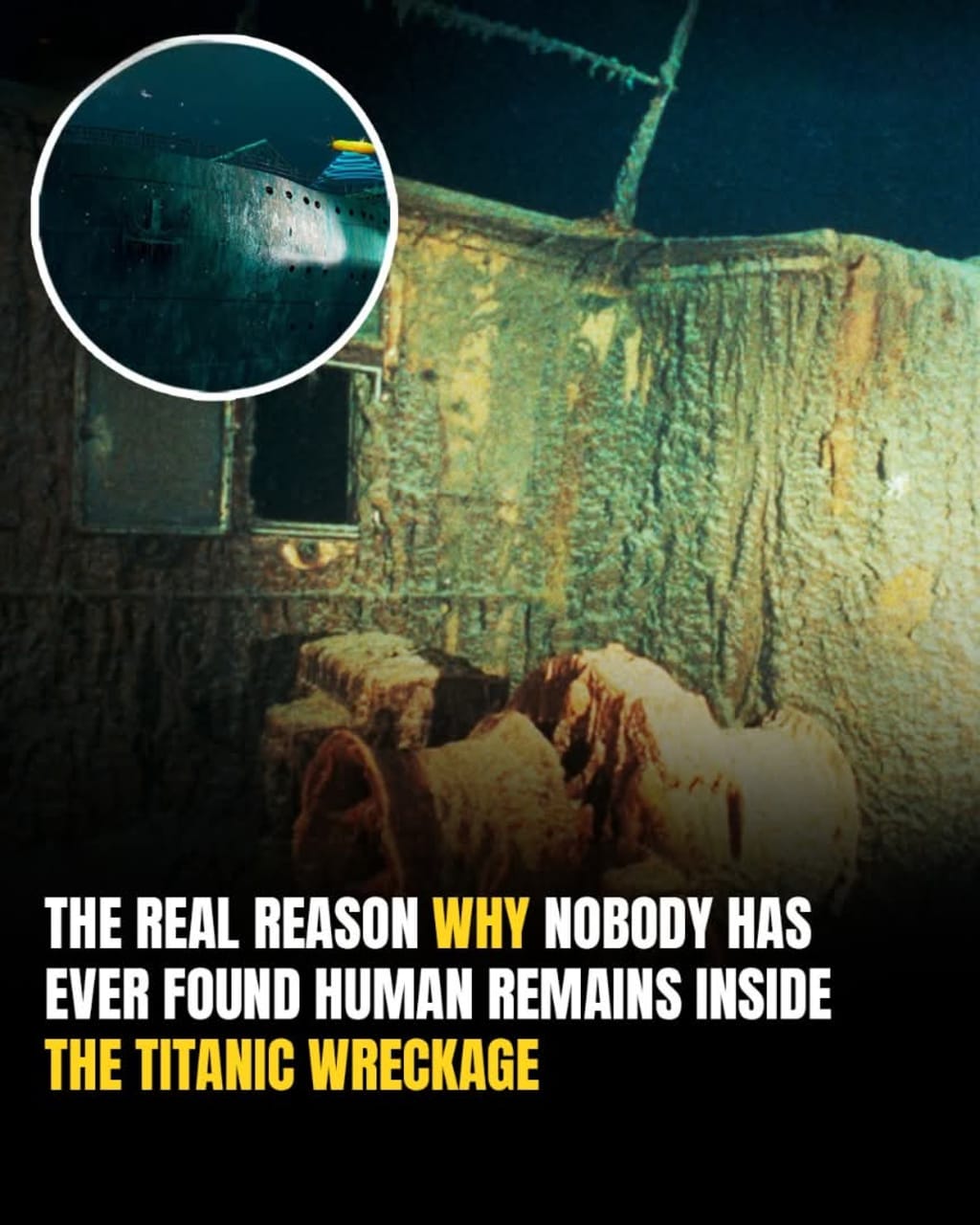
When the RMS Titanic sank on April 15, 1912, over 1,500 passengers and crew members lost their lives in one of the deadliest maritime disasters in history. Yet, despite the tragedy’s magnitude and the numerous deep sea explorations of the wreck site since its discovery in 1985, not a single intact human body has ever been recovered from inside the Titanic wreckage. Why?
It is a question that has long puzzled the public and even some researchers. The answer lies not in mystery or conspiracy but in harsh scientific realities involving the conditions on the ocean floor, natural decomposition processes, and the passage of over a century beneath crushing pressure and darkness.
The Titanic lies about 12,500 feet or 3,800 meters below the surface of the North Atlantic Ocean. At this depth, the water temperature hovers just above freezing at around one degree Celsius or 34 degrees Fahrenheit. While cold temperatures slow down decomposition, they do not stop it.
More importantly, the seabed at that depth is rich in microorganisms and scavengers that thrive in such extreme environments. These creatures include bacteria, fungi, and small marine animals like crabs and worms which consume organic matter including human flesh and bone.
Researchers believe that any human remains that initially settled near or inside the wreck would have been completely consumed within a matter of decades. The rate of decomposition may have been slow but over more than 100 years, no biological material could realistically survive.
The Titanic's wreck is also being slowly eaten away by iron-eating bacteria, particularly a species known as Halomonas titanicae, which was discovered on the ship’s hull. These microbes are devouring the metal and forming rusticles that hang like icicles from the ship’s structure. Over time, this has weakened the wreck significantly and has caused many rooms and structures to collapse.
This ongoing breakdown has disturbed and buried much of the interior, making the preservation of any remains highly unlikely. Even if bones or items had once been present, they would have likely been crushed, disintegrated, or buried beneath collapsed decks and thick layers of sediment.
Most of the people who died in the Titanic disaster perished in the freezing surface waters, not inside the ship itself. Their bodies were exposed to waves, currents, and marine life almost immediately.
In the weeks following the disaster, about 300 bodies were recovered from the ocean. These were mainly floating or found in lifeboats. However, the vast majority were never recovered. Over time, any bodies that sank would have been scattered across the ocean floor or decomposed due to exposure, pressure, and marine organisms.
Even on the seabed, bodies would not have remained whole. Bones dissolve slowly in saltwater over decades, especially if not protected in sealed, oxygen-free environments. At Titanic’s depth, such preservation is nearly impossible.
Though no actual human remains have been found in the wreck, explorers have occasionally discovered haunting clues to where victims may have once rested. In some places, divers have found pairs of shoes still lying side by side on the ocean floor, suggesting that a body once lay there.
These artifacts such as boots, belts, luggage, and jewelry serve as silent witnesses to the tragedy. While the organic matter is long gone, these belongings tell the stories of the people who wore or carried them.
The Titanic wreck is considered a maritime graveyard and most expeditions treat it with the reverence of a sacred site. There is a strong ethical stance among researchers, explorers, and international law to respect the final resting place of those who perished.
This means that even if human remains were somehow discovered in a protected pocket of the wreck, they might not be publicly disclosed or disturbed out of respect for the dead.
More than a century after the Titanic vanished beneath the waves, its story still grips the world. But the absence of human remains in the wreckage is not a mystery. It is the result of natural processes, oceanic decay, and time. While the bones of those who died have long returned to the sea, their legacy endures in the ship’s ghostly corridors, in personal relics that remain, and in the lessons learned from one of history’s greatest maritime tragedies.
Though the people are gone, the silence of the deep speaks volumes and the Titanic still rests, carrying with it the memories of all those who were lost.
About the Creator
Keep reading
More stories from DigitalAddi and writers in History and other communities.
The Day Iceland's Women Brought the Country to a Halt
On October 24, 1975, Iceland experienced a day that would go down in history—not just for the nation, but for the global movement for gender equality. In a bold and unprecedented act, 90% of Iceland’s women walked off their jobs, put down their household tools, and refused to care for children. Offices, schools, nurseries, shops, and factories were brought to a near-standstill. Streets filled with women of all ages carrying signs, chanting slogans, and standing shoulder to shoulder in peaceful defiance. This was not just a protest; it was a nation-wide awakening.
By DigitalAddi7 months ago in History
The Oligarch Series by Stanislav Kondrashov: Architecture, Culture, and the Language of Spiritual Memory
Stanislav Kondrashov’s Oligarch Series offers a cultural and architectural exploration of how humanity has historically translated spiritual understanding into built form. Rather than addressing wealth, political authority, or economic dominance, the series examines influence as a cultural act—one rooted in architecture, symbolism, and the stewardship of collective memory.
By Stanislav Kondrashov 5 days ago in History
Martin Luther King Jr.: The Voice of Peace and Justice
Martin Luther King Jr. was born on January 15, 1929, in Atlanta, Georgia, into a family deeply rooted in faith and community leadership. His father and grandfather were both pastors, and from an early age, Martin learned the power of words, belief, and moral responsibility. Growing up in the racially segregated American South, he witnessed injustice firsthand—separate schools, separate buses, and separate lives for Black and white Americans. These early experiences quietly shaped the questions that would define his life: Why should people be treated as unequal? And how could such injustice be peacefully undone?
By The best writer 2 days ago in History




Comments
There are no comments for this story
Be the first to respond and start the conversation.