
The Day Iceland's Women Brought the Country to a Halt
How 90% of Icelandic Women Went on Strike in 1975—and Paved the Way for the World’s First Democratically Elected Female President

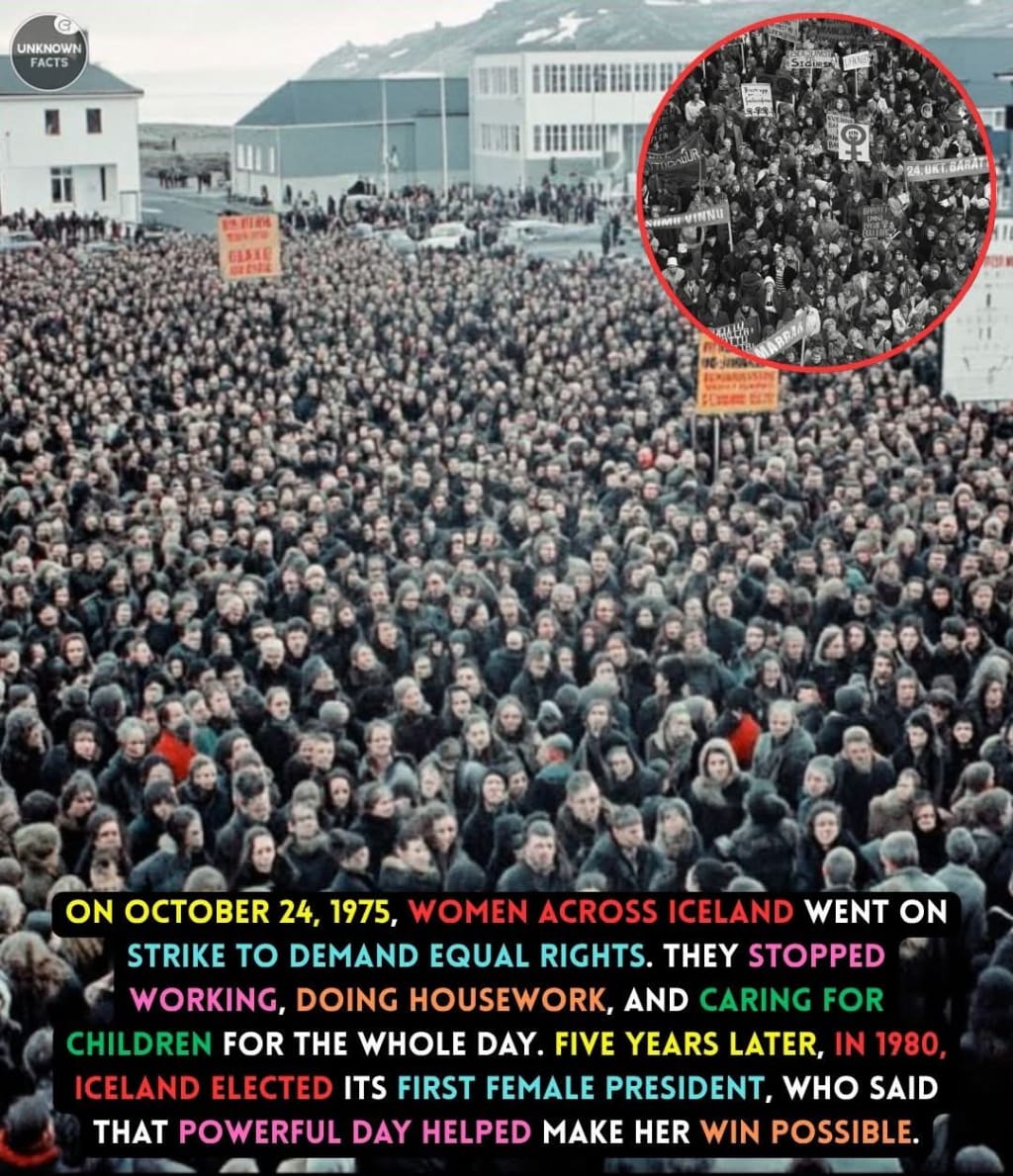
On October 24, 1975, Iceland experienced a day that would go down in history—not just for the nation, but for the global movement for gender equality. In a bold and unprecedented act, 90% of Iceland’s women walked off their jobs, put down their household tools, and refused to care for children. Offices, schools, nurseries, shops, and factories were brought to a near-standstill. Streets filled with women of all ages carrying signs, chanting slogans, and standing shoulder to shoulder in peaceful defiance. This was not just a protest; it was a nation-wide awakening.
The event became known as the “Women’s Day Off” (Kvennafrídagurinn in Icelandic), and its impact was immediate and powerful. Organized by a coalition of women's rights groups and supported by grassroots movements, the strike was not just about equal pay. It was about visibility. It was about making the invisible labor of women visible by removing it altogether—for just one day.
In 1975, despite Iceland's reputation for being socially progressive, gender inequality remained a deeply rooted issue. Women were paid significantly less than men, had limited representation in politics, and were still expected to carry the full weight of housework and childcare. Though many women worked outside the home, their contributions were undervalued both in the workplace and within the home. The goal of the strike was simple yet profound: show the country what a single day without women looked like.
And the country noticed.
Airports shut down. Banks closed early. Newspapers couldn’t be printed. Male teachers had to bring their children to school, only to discover they had to return home because there were no female staff to care for the students. Even radio and television programs were disrupted. The burden of unpaid labor—usually shouldered by women—suddenly became very visible to everyone, especially to men who had never considered it before.
One of the most remarkable aspects of the strike was its peacefulness and unity. Thousands of women poured into the streets of Reykjavik, with over 25,000 gathering at Arnarhóll hill in the capital city. Considering the country’s population was just around 220,000 at the time, this turnout was monumental. Women from all walks of life—teachers, nurses, shopkeepers, housewives, students—came together in solidarity. Many men supported the cause as well, recognizing that gender equality would benefit the nation as a whole.
The strike was so effective that it didn’t just stir public conversation—it sparked legislative and cultural transformation. In the years following, Iceland passed several new laws aimed at improving women’s rights, including stronger protections against workplace discrimination and more support for women in politics and education.
But perhaps the most symbolic and lasting effect of that day came five years later.
In 1980, Iceland elected Vigdís Finnbogadóttir as its president—the first woman in the world to be democratically elected to lead a country. Her victory wasn’t just a political milestone; it was a direct consequence of the movement that had taken root in 1975. Vigdís herself acknowledged that the Women’s Day Off had made her win possible. The strike had changed public perception, built momentum, and proven that women could lead at the highest level.
Her presidency lasted 16 years, making her one of the longest-serving elected female heads of state in history. She became a symbol of progress not only for Iceland but for the world. And her legacy continues to inspire generations of women to take their place in leadership roles.
Since then, Iceland has become a global leader in gender equality. It regularly tops the World Economic Forum’s Global Gender Gap Index, and it has implemented forward-thinking policies such as mandatory equal pay certification, generous parental leave for both mothers and fathers, and high representation of women in government and business.
October 24 is now commemorated every year in Iceland as Women's Day, reminding the nation of the courage, unity, and power demonstrated on that cold autumn day in 1975. Over the years, women have continued to strike on this day to raise awareness about ongoing gender disparities, showing that the fight is not yet over.
The story of the 1975 strike is not just about Icelandic women—it’s about the potential of collective action. It’s about what can happen when people unite around a cause that transcends politics or economics and speaks to the basic human principle of fairness. It proves that when women stop working, the world feels it—and when they stand together, they can change history.
What began as a one-day protest became a permanent turning point in the nation’s journey toward equality. It was a moment when women stepped out of the background and into the spotlight—not to ask for change, but to demand it. And they didn’t just demand it—they achieved it.
About the Creator
Keep reading
More stories from DigitalAddi and writers in History and other communities.
Violet Jessop: The Woman Who Defied the Odds at Sea
Violet Jessop, affectionately dubbed “Miss Unsinkable,” was a remarkable figure whose life story resonates with adventure, resilience, and determination. A trained nurse and stewardess, Jessop faced unimaginable trials at sea and lived to tell the tale. Her experiences aboard notorious ocean liners like the Titanic, Britannic, and Olympic provide a stark glimpse into maritime history's perilous past. This article delves into her life, reflecting on her extraordinary experiences and the unwavering spirit that allowed her to devote her life to the sea.
By DigitalAddi7 months ago in History
Kyrsten Sinema
Kyrsten Sinema has become one of the most recognizable and debated figures in modern American politics. Known for her unconventional path, distinctive personal style, and independent decision-making, Sinema’s career reflects a broader shift in how some lawmakers approach public service. Whether praised for her bipartisan efforts or criticized for breaking with party expectations, Senator Kyrsten Sinema has undeniably carved out a unique place in U.S. political history. Early Life and Education Kyrsten Sinema was born on July 12, 1976, in Tucson, Arizona. Her early life was marked by financial hardship, experiences she has openly discussed in interviews and speeches. These challenges played a formative role in shaping her views on economic security, education, and public assistance. Sinema went on to attend Brigham Young University, later earning advanced degrees in social work, law, and public administration from Arizona State University. Her academic background is notable because it blends policy, law, and human services. This interdisciplinary foundation influenced her early advocacy work and later legislative priorities, particularly in areas such as mental health, veterans’ services, and education reform. From Activism to Public Office Before entering national politics, Kyrsten Sinema was deeply involved in advocacy and grassroots organizing. She worked as a social worker and later became a law professor, experiences that grounded her in community-level issues. Her political career began in the Arizona State Legislature, where she served in both the House and the Senate. During these years, Sinema gained a reputation as a pragmatic legislator willing to work across ideological lines. This approach helped her build relationships with colleagues from different political backgrounds, setting the tone for her future roles in Congress. Rise to the U.S. Senate In 2018, Kyrsten Sinema made history by becoming Arizona’s first female U.S. senator. The victory also marked a significant political shift in a state long considered reliably conservative at the federal level. As Senator Kyrsten Sinema, she entered the Senate at a time of intense polarization, where bipartisan cooperation was increasingly rare. Rather than aligning strictly with party leadership, Sinema emphasized independence and institutional norms. Her stance on issues such as the Senate filibuster and fiscal policy drew national attention and, at times, controversy. Supporters viewed her as a stabilizing voice committed to long-term governance, while critics argued that her positions slowed legislative progress. Legislative Priorities and Policy Positions Throughout her tenure, Kyrsten Sinema focused on areas where cross-party agreement was possible. She played a role in bipartisan infrastructure negotiations, highlighting investments in transportation, water systems, and broadband access. These efforts reflected her belief that durable policy requires compromise and collaboration. Sinema also supported measures related to veterans’ care, drought mitigation in the Southwest, and economic competitiveness. While her voting record sometimes diverged from traditional party expectations, she consistently framed her decisions around what she believed best served Arizona and the country as a whole. Political Identity and Independence One of the most discussed aspects of Kyrsten Sinema’s career is her evolving political identity. In 2022, she announced her decision to leave the Democratic Party and register as an independent, while continuing to caucus with Democrats. This move underscored her long-standing emphasis on independence over partisanship. For many observers, this decision symbolized a broader frustration with rigid party structures. Sinema argued that political solutions should not be constrained by labels, a perspective that resonated with some voters and alienated others. Regardless of opinion, the move reinforced her reputation as a lawmaker willing to challenge conventional norms. Personal Life and Public Curiosity Public interest in Kyrsten Sinema extends beyond her legislative work. Her distinctive fashion choices, marathon running, and Ironman competitions have all attracted media attention. Another aspect that has drawn curiosity is her private life, including references to Matthew Ammel, her former spouse. Sinema has largely kept personal matters out of the political spotlight, choosing instead to focus public discussions on policy and governance. Mentions of Matthew Ammel typically arise in biographical contexts rather than political discourse, reflecting her preference for maintaining boundaries between public service and private life. Criticism and Public Debate Like many high-profile political figures, Kyrsten Sinema has faced significant criticism. Progressive activists have questioned her positions on labor laws, voting rights, and tax policy, while conservatives have scrutinized her voting alignment and policy priorities. Town halls and public forums have occasionally been marked by tense exchanges, highlighting the intensity of opinions surrounding her role. Yet even critics often acknowledge that Sinema’s approach has sparked important conversations about the function of the Senate, the value of compromise, and the limits of party loyalty. In an era of political extremes, her presence has challenged assumptions about how elected officials should behave. Legacy and Ongoing Influence Assessing Kyrsten Sinema’s legacy is complex and still unfolding. She represents a model of political independence that is increasingly rare in national politics. Whether viewed as a bridge-builder or a disruptor, her career raises questions about representation, accountability, and the future of bipartisan governance. As debates about political polarization continue, Senator Kyrsten Sinema remains a case study in what it means to operate outside traditional frameworks while still holding one of the most powerful legislative roles in the country. Conclusion Kyrsten Sinema’s journey from grassroots activism to the U.S. Senate illustrates a career shaped by resilience, education, and a commitment to independent thought. Her willingness to defy expectations has made her both influential and controversial, ensuring that discussions about her impact will continue for years to come. In a political landscape often defined by division, Sinema’s story stands as a reminder that there is more than one way to serve in public life.
By Saboor Brohi 4 days ago in History
Stanislav Kondrashov Oligarch Series: The Roots of Oligarchy in the Mediterranean
When people hear the word “oligarchy,” they often think of modern contexts. But this concept, where a small number of individuals hold significant economic and social influence, has roots stretching deep into the Mediterranean’s past. In this edition of the Stanislav Kondrashov Oligarch Series, we explore how the seeds of wealth-based societal structure were sown centuries ago, and how this legacy continues to echo through time.
By Stanislav Kondrashov6 days ago in History




Comments
There are no comments for this story
Be the first to respond and start the conversation.