
Why is Djoser one of the greatest kings of the Pharaohs?
King djoser
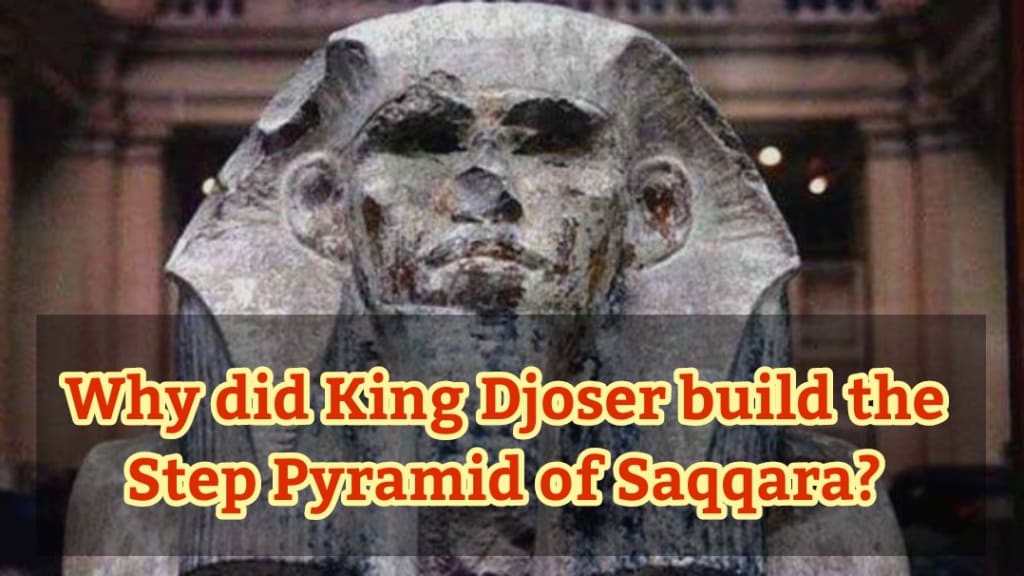
The Pharaonic history, full of cultural works and military and construction achievements, makes you think about the personality of the kings who ruled this country. You want to know their thoughts, the details of their lives, and the hidden reasons behind their actions. Among these kings is King Djoser.
Who is King Djoser?
King Djoser is the founder of the Third Pharaonic Dynasty and the most famous king of the Old Kingdom, the son of King Khasekhemwy. He ruled for 29 years and was famous for his huge construction works, some of which are still standing, including the Step Pyramid of Saqqara.
The reason for excellence?
King Djoser was truly distinguished from the rest of the kings of the Old Kingdom. In the Turin Papyrus, his name was mentioned in red to distinguish him from the rest of the kings. It is possible that this distinction is not due only to the construction works. By comparing him with Khufu or even Khafre, who built the Great Pyramid and the Middle Pyramid, the constructions do not become It is what made this king special, even though King Djoser built the Saqqara Step Pyramid, which is considered the first stone building in history. This makes it really special, but not enough.
If there is another reason for this distinction, in fact, the Turin Papyrus did not mention the reason for the distinction of this king, but by referring to what happened in his era, which witnessed the emergence of a new religion, which is the worship of the sun and the god Ra. This new religion opened the way for Djoser to many of the ambitions that Djoser was seeking. He was truly distinguished. But in reality, a feeling that he wanted to be special made him sponsor this new religion in exchange for being considered the representative of God on earth. Yes, this was the price for sponsoring this new religion. It is strange that this matter happened with Constantine when he decided to sponsor Christianity in exchange for excellence. Yes, times are changing while... Events do not really happen. For this reason, Djoser was considered the true founder of the Third Dynasty and the patron of the god Ra.
Why was the Saqqara pyramid built?
Djoser's feeling about this matter made him feel that his status was actually higher than the rest of humanity, and not only that, but he felt that he was higher than the rest of the previous kings, and for that reason his tomb was built in Saqqara, not Abydos, and not only that, but his pyramid was built a mile away from Saqqara. This man actually felt different. Therefore, when his tomb was built, he wanted it to be different from any other tomb, and he wanted a design that had not existed before. Therefore, the Saqqara pyramid came in the form of six terraces on top of each other, and this shape was an announcement of the change in penal architecture in Pharaonic Egypt and also an announcement of the suffering of the Egyptian treasury. In bearing the costs of building these pyramids, which after Djoser became the custom of kings to build the king’s pyramid, but the successors of this king were actually extravagant in the magnitude and volume of work to the extent that one of the reasons for the deterioration of the ancient Egyptian state was the greatest reason.
His place as king among the Egyptians?
Yes, narcissism and self-love do more to a person than just building a pyramid and enslaving a people, or even with the consent of this people. I want to clarify what king meant in the ancient state. Of course, Djoser was one of the greatest kings. His state witnessed many powerful military campaigns against Nubia until his kingdom reached beyond. The first waterfall and also some exploratory campaigns in Sinai to extract copper and turquoise. Indeed, he was a powerful king, but I want to return to the Egyptians’ view of the king as not an ordinary human being. Rather, their reverence for the king reached the point of considering him as the son of God or a representative of God. It is not permissible to oppose him or even disagree with him.
Yes, the king’s position was different from the people of the ancient state, and it remained that way until the reign of King Pepi II, which was characterized by extreme weakness and the state’s capabilities were also lost. Therefore, for the first time in the history of Egypt and the entire ancient world, the people revolted against the king and actually ended his rule. It is true that the state’s conditions did not improve after that, but rather On the contrary, it worsened, leading to the eventual occupation of Egypt and its entry into an era of chaos known as the First Age of Decay, but this revolution is considered a point of change in the way the people viewed the king after that.
About the Creator
Keep reading
More stories from writers in History and other communities.
The Duelist
The rays of a dying red sun flashed against the onrushing blade. The grey beards say the key to dueling lies in size, speed, reach, righteous fury, whatever the person in front of them pays them to say. Matteo knew better than any it was none of these and had an undefeated record on these sands to prove it.
By Matthew J. Fromm3 days ago in Fiction




Comments
There are no comments for this story
Be the first to respond and start the conversation.