
Why Could Nobody Catch This Nazi Spy? The Life of Fritz Joubert Duquesne
A Real-Life Spy with a Taste for Adventure

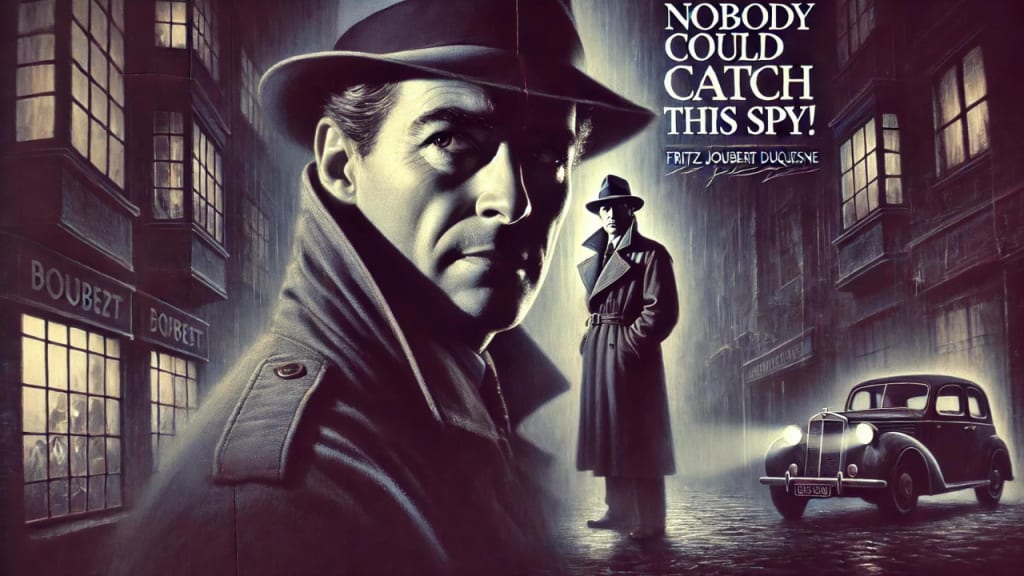
If you’ve ever moved to a new town or city, you know how daunting it can be to make new friends. Traditional advice often suggests signing up for clubs or groups where you can meet like-minded people—perhaps a pottery class or a local wine appreciation society. But for those with a taste for adventure, there’s a more thrilling route to take: joining a spy ring! Imagine a secretive clique of agents, living under false identities, meeting in clandestine locations to exchange top-secret information.
One such adventurer was William Sebold, a German-American who, in 1940, became a key player in what would become the largest spy ring in U.S. history. Recently returned from a stint in Germany, he was not who he seemed. If you had met him back then, he would have introduced himself as “Harry Sawyer,” a diesel engineer. This alias was assigned to him by the Gestapo, who had cornered him during his visit and “politely” coerced him into spying on the United States, threatening his family in the process. Unsurprisingly, Sebold agreed, setting the stage for a remarkable double life.
A Spy in Disguise
What the Nazis didn’t realize was that Sebold had no intention of being their pawn. While training in Germany, he discreetly contacted the American Consulate in Cologne, revealing his predicament and offering to become a double agent for the FBI. Upon returning to New York in February 1940, he was aided by the FBI to establish a new life as Harry Sawyer, complete with an office that served as a front for his true mission: gathering intelligence on fellow German spies.
Little did Sebold know, this operation would lead him to one of history's most intriguing spies—Fritz Joubert Duquesne. Known for his remarkable exploits and a life filled with excitement, Duquesne was no ordinary spy; he was a master of deception, capable of blending in and out of various identities, much like a real-life James Bond.
The Colorful Life of Fritz Joubert Duquesne
Born in 1877 to a Boer family in South Africa, Duquesne's upbringing was anything but conventional. Growing up on a remote farm, he honed his hunting skills early, even killing a Zulu tribesman at the tender age of 12 in defense of his mother. Such survival instincts might seem daunting, but they foreshadowed a life filled with incredible escapades.
Duquesne’s educational journey took him to England, but upon returning to South Africa at the turn of the 20th century, he found himself embroiled in the Second Boer War. During one perilous mission to deliver gold to exiled Boers, he became embroiled in a bloody conflict that left him the only survivor. Rumor has it that he finished off the remaining Boers, hid the gold in a cave, and rode off into the sunset on an ox, leaving the fate of the gold shrouded in mystery to this day.
The Great Escaper
Duquesne’s knack for evasion became legendary. Captured multiple times during the Boer War, he escaped from British custody not once, not twice, but three times! Eventually, he was imprisoned by the Portuguese, yet he managed to flee from a prison near Lisbon. After a series of remarkable escapes, he made his way to England, where he disguised himself to enlist in the British Army.
However, upon returning to South Africa, he discovered his family had suffered greatly at the hands of the British. Determined to take revenge, he plotted to assassinate British leader Lord Kitchener, only to be betrayed by a conspirator's wife. Facing execution, Duquesne cleverly bargained his way out by offering to reveal Boer military codes, ultimately leading to a life sentence in the Castle of Good Hope in Cape Town.
Once again, Duquesne plotted his escape, this time using the classic "spoon digging" technique. After a failed attempt, he was sent to serve the rest of his sentence in Bermuda, where he once again escaped by scaling a barbed-wire fence and swimming through shark-infested waters to freedom.
An Unexpected Career Path
Why Could Nobody Catch This Nazi Spy? You'll definitely enjoy this!
After his daring escape, Duquesne found his way to the United States, where he supported himself as a journalist and even penned several novels. His expertise in African wildlife led him to work with a Congressman to address a national meat shortage by promoting hippo meat—yes, hippo meat—as a staple in American diets through the American Hippo Bill of 1911. Unfortunately, the bill didn’t pass, leaving Americans deprived of the chance to try “Lake Cow Bacon.”
Duquesne also became acquainted with President Theodore Roosevelt, joining him on a hunting safari in East Africa. In 1913, he became a naturalized American citizen, but his loyalty to the U.S. was dubious at best.
A Turn to Espionage
When World War I erupted in 1914, Duquesne embraced his heritage and became a German spy. Working in South America, he sank 22 British merchant ships by planting bombs. To evade capture, he concocted an elaborate scheme to fake his own death, claiming he was murdered by Amazonian tribes. But the charade couldn’t last forever, and he soon returned to New York under a new identity.
In an audacious twist, Duquesne took out insurance on the very ships he sank, planning to collect once they met their watery demise. When British Intelligence caught wind of his activities, he was arrested for fraud. Even in custody, Duquesne managed to maintain his ruse by feigning paralysis for two years, ultimately escaping while dressed as a woman just before his extradition to the UK.
The Rise of a Spy Ring
In the late 1930s, with another war looming on the horizon, Duquesne was approached by German Intelligence to build a spy ring in the U.S. He successfully recruited over 30 operatives from various industries, including aviation and engineering, providing invaluable information to the Nazis. However, his luck was about to run out.
Meet William Sebold, aka Harry Sawyer, who would ultimately lead to the unraveling of Duquesne’s operations. Despite initial skepticism, Duquesne eventually revealed sensitive information in Sebold’s camera-rigged office, leading to an extensive FBI investigation over two years.
In June 1941, the FBI arrested Duquesne and 32 of his operatives in a groundbreaking espionage case. The outcome? 19 operatives pleaded guilty, while Duquesne received an 18-year sentence.
The Final Act
Fritz Joubert Duquesne served 14 years of his sentence before being released due to health issues. In 1954, he delivered his final public talk, “My Life – In and Out of Prison,” at the Adventurers Club in New York, reflecting on his wild and varied life before passing away two years later at the age of 77.
With a life so full of guts, glory, crime, and intrigue, one can only imagine the stories he shared. Perhaps he even regaled his audience with tales of hippo meat and the art of espionage, forever cementing his legacy as one of the most fascinating figures in the annals of spy history.
Conclusion
Fritz Joubert Duquesne’s life reads like a screenplay—filled with daring escapes, espionage, and a colorful array of identities. From a Boer soldier to a double agent, his story serves as a reminder that truth can often be stranger than fiction.
Whether you’re in search of friendships or contemplating a career in espionage, remember: sometimes, life is about the adventure you choose and the paths you dare to take. And who knows? You might just find yourself living a story worth telling.
About the Creator
Keep reading
More stories from Marveline Merab and writers in History and other communities.
Why The Treadmill Was the Original Torture Machine
You probably haven’t thought much about it, but your local gym harbors a disturbing secret. No, I’m not talking about those people who take forever at the hair dryer station – I’m talking about a popular piece of gym equipment with a shockingly sinister past: the treadmill.
By Marveline Merababout a year ago in History
Chinese Water Torture
Since the dawn of history, human beings have inflicted unimaginable suffering upon one another. Across centuries, people have devised increasingly elaborate methods of punishment and coercion, some brutally explicit, others deceptively subtle. While devices such as iron maidens, racks, whips, and wheels relied on visible physical agony, there existed a form of torment whose true power lay not in blood or broken bones, but in patience, repetition, and the slow erosion of the mind. This method came to be known as Chinese water torture.
By Pure child3 days ago in History
Saddam Hussein: Rise, Rule, and Fall
Saddam Hussein was born on April 28, 1937, in a small village near Tikrit, Iraq. His early life was marked by poverty, hardship, and a sense of abandonment. His father died before he was born, and his mother remarried soon after. Young Saddam grew up in a household dominated by strict relatives and was exposed to political discussions and nationalist sentiments from an early age. These formative years shaped his personality—ambitious, ruthless, and fiercely determined to rise above his modest beginnings.
By The best writer 3 days ago in History



Comments
There are no comments for this story
Be the first to respond and start the conversation.