
Whispers of a King: Henry VIII’s Love Letters to Anne Boleyn
The Romance That Altered History: The Passion of a Monarch, the Fate of a Queen
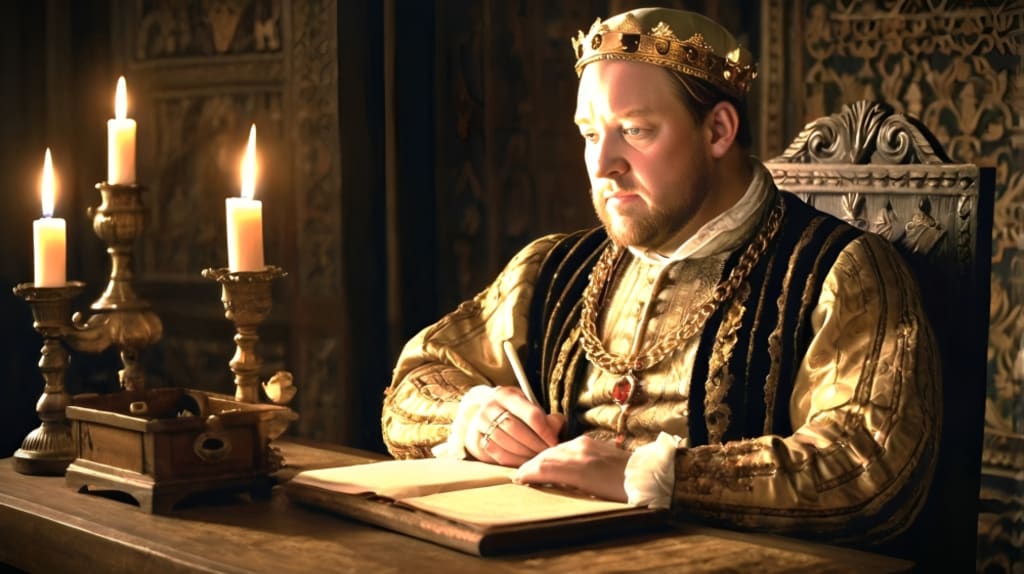
Eight years before he killed one of his wives, Henry VIII wrote melancholy love letters to her. King Henry VIII wrote a romantic letter to his "mistress" Anne Boleyn - but just three years after they married his head was turned by Jane Seymour One of England's most famous and controversial monarchs, was known for his brash behaviour and for his six marriages.So, perhaps the discovery of love letters he penned to future wife Anne Boleyn did not act as a sign of things to come. It was around eight years later that she was served a death penalty, and was executed under the monarch's ruling.The long and descriptive letter is not dated, but Henry may have written it to Anne in around 1528, according to reports, while he was still married to Catherine, his first wife.He had become infatuated with Anne, and was about to end his marriage to Catherine of Aragon, the longest wife of the six, spanning 20 years.Anne Boleyn was the second wife of King Henry VIII and the mother of Queen Elizabeth I. She played a central role in one of the most transformative periods in English history, as her marriage to Henry led to the English Reformation and England's break from the Roman Catholic Church.Henry and Anne tied the knot 1533. “My mistress and friend: I and my heart put ourselves in your hands, begging you to have them suitors for your good favor, and that your affection for them should not grow less through absence,” Henry VIII writes in one of the letters, which were originally written in French. “For it would be a great pity to increase their sorrow since absence does it sufficiently, and more than ever I could have thought possible reminding us of a point in astronomy, which is, that the longer the days are the farther off is the sun, and yet the more fierce.
“So it is with our love, for by absence we are parted, yet nevertheless it keeps its fervour, at least on my side, and I hope on yours also: assuring you that on my side the ennui of absence is already too much for me: and when I think of the increase of what I must needs suffer it would be well nigh unbearable for me were it not for the firm hope I have and as I cannot be with you in person, I am sending you the nearest possible thing to that, namely, my picture set in a bracelet, with the whole device which you already know. Wishing myself in their place when it shall please you."
The letter goes on: “No more to you at this present mine own darling for lack of time but that I would you were in my arms or I in yours for I think it long since I kissed you.
“Written after the killing of an hart at a xj. of the clock minding with God’s grace tomorrow mightily timely to kill another: by the hand of him which I trust shortly shall be yours.
“Mine own sweetheart, these shall be to advertise you of the great loneliness that I find here since your departure, for I ensure you me thinketh the time since your departure now last than I was accustomed to do a whole fortnight: I think your kindness and my fervents of love causeth it, for otherwise I would not have thought it possible that for so little a period of time it should have grieved me, but now that I am coming toward you me thinketh my pains be Wishing myself (specially an evening) in my sweetheart’s arms, whose pretty dukkys I trust shortly to kiss. Written with the hand of him that was, is, and shall be yours by his will.” Historian Sandra Vasoli had previously explained to Express.co.uk how in one love letter, the King wrote that he hoped to “kiss Anne’s kiss pritty duckys” – slang for her breasts.
The author of the book, Anne Boleyn's Letter from the Tower: A New Assessment said: “He's saying ‘Gosh, I'd rather you were sitting here instead of your brother, and I wish of an evening that I could be kissing your pretty duckys’, which are her breasts.
“So, at that point in time, there had been physicality between them. not always sexual encounters But, you know, things were happening. Because he wasn't just saying that if it had never, ever happened.Three years after marriage to Anne, by 1536, he had developed an interest in one of Anne’s ladies-in-waiting, Jane Seymour. In May of that year, Anne was arrested, charged with adultery, incest, and treason—many of the charges likely fabricated for the purpose of getting the queen off Henry’s hands.
She was tried, convicted and executed by beheading in the Tower of London on May 19, 1536. Her execution made her the first English queen to be executed, ending her once-prominent position in a tragedy.
About the Creator
Can the United Nations Survive a Divided World?
Can the United Nations Survive a Divided World? The United Nations was born from the ashes of World War II, at a time when the world agreed on one powerful idea: global problems require global solutions. For decades, the UN served as a meeting ground for rivals, a coordinator of humanitarian aid, and a symbol of international cooperation. Today, however, the organization stands at a crossroads. A more divided, competitive, and unstable world is forcing a serious question—what will the UN become in the future?
By Wings of Time 5 days ago in History
Martin Luther King Jr.: A Black Day in America
On April 4, 1968, the world lost one of its most powerful voices for justice and equality. Martin Luther King Jr., the man whose words had ignited hope in millions, was assassinated on the balcony of the Lorraine Motel in Memphis, Tennessee. That day is remembered as a black day in American history—not only for the loss of a great leader but for the reflection it forced the nation to confront about its values, its divisions, and the long road still ahead for civil rights. Martin Luther King Jr. had spent his life advocating for nonviolent resistance, inspired by the teachings of Mahatma Gandhi. From the Montgomery Bus Boycott in 1955 to the historic March on Washington in 1963, where he delivered his iconic “I Have a Dream” speech, King’s words and actions challenged a society deeply entrenched in racial segregation and discrimination. He had become a symbol of hope, a figure who reminded Americans that justice was not a privilege but a right. By 1968, King was focused on addressing broader issues beyond racial inequality. He had shifted his attention to economic justice, poverty, and the Vietnam War, recognizing that systemic oppression was not limited to race alone. In Memphis, he stood with striking sanitation workers demanding better wages and safer working conditions. He knew that the struggle for dignity and fairness extended to every corner of society. But tensions in the country were high. America was a nation divided. Cities were already experiencing unrest, the war in Vietnam was escalating, and extremist groups actively opposed the civil rights movement. King had received countless death threats, yet he remained steadfast, continuing his mission with courage that inspired millions. His presence in Memphis was meant to support the marginalized, but it would tragically mark the final chapter of his life. On that fateful evening, King stepped onto the balcony of his room at the Lorraine Motel. The sun was beginning to set, casting a warm glow over the streets of Memphis. It was a moment of calm, yet danger lurked unseen. A single gunshot rang out, piercing the air and the hearts of those who had looked to him for guidance. King collapsed, fatally wounded, and chaos erupted. News of his assassination spread like wildfire, leaving communities across America in shock and grief. Television networks interrupted regular programming; newspapers ran bold headlines; the streets filled with sorrow, anger, and disbelief. People who had never met him personally felt the sting of loss as if a father, a teacher, or a friend had been taken from them. For many, the dream that King had spoken of—the dream of equality, justice, and brotherhood—suddenly seemed fragile and distant. The immediate aftermath of King’s death was a period of turmoil. Cities erupted in riots, not out of mindless violence, but as an expression of pent-up frustration and despair. Washington D.C., Chicago, Baltimore, and dozens of other cities experienced burning buildings, looting, and clashes with law enforcement. The country mourned, yet it also faced an urgent question: how could a society that claimed freedom and equality fail so tragically to protect one of its most peaceful advocates? Despite the violence, Martin Luther King Jr.’s legacy endured and even grew stronger in the face of tragedy. His death forced Americans to confront the reality that the fight for civil rights was far from over. Congress passed the Civil Rights Act of 1968, also known as the Fair Housing Act, just days after his assassination, banning discrimination in housing—a testament to the momentum King had built. His dream did not die with him; it lived on in the countless people who continued to march, protest, and speak out against injustice. King’s life and death also revealed the fragility of human progress. The black day of April 4th was a stark reminder that the struggle for justice often comes with immense sacrifice. It highlighted the courage required to challenge deeply rooted systems of oppression and the persistent resistance faced by those who seek to change society for the better. Yet, even in mourning, his death inspired a renewed commitment among civil rights activists, politicians, and ordinary citizens to carry his vision forward. In the years following his assassination, memorials and tributes honored King’s life. Streets were renamed, schools dedicated, and eventually, the Martin Luther King Jr. National Memorial was built in Washington, D.C. On every January 15th, his birthday is commemorated as a national holiday, not merely to remember his death, but to celebrate his contributions and the enduring principles he fought for: equality, justice, and nonviolence. But the black day of April 4th also serves as a cautionary tale. It reminds the world that progress is never guaranteed, and the cost of complacency is high. King’s death symbolized the very real dangers that come with standing up for truth and justice in a divided society. It forced Americans to reflect on their own values and actions, and on the work still required to turn King’s dream into a reality. Martin Luther King Jr. once said, “The arc of the moral universe is long, but it bends toward justice.” His assassination did not halt that arc; it strengthened the resolve of those determined to see it through. Today, when people around the world remember that black day in America, they do not remember only the sorrow—they remember the courage, the vision, and the unyielding spirit of a man who believed in a better world and gave everything to achieve it. King’s life and untimely death continue to inspire generations to question injustice, fight inequality, and act with compassion. Though April 4, 1968, was a day of darkness, it ultimately illuminated the path forward, reminding humanity that even in tragedy, hope, courage, and change are possible. The legacy of Martin Luther King Jr. is a testament to the power of one person to awaken a nation, to challenge hatred with love, and to transform despair into a movement for justice. The black day in America is remembered not merely as a day of loss, but as a turning point—a day when the dream was tested, yet proved resilient, enduring in the hearts of those who dare to believe in equality, peace, and freedom for all.
By The best writer 2 days ago in History


Comments
There are no comments for this story
Be the first to respond and start the conversation.