
Whispers from the Sand: 10 Artifacts from Ancient Egypt That Still Send Shivers Down Spines
Let’s be honest, there’s something about ancient Egypt that grabs us by the collar and refuses to let go
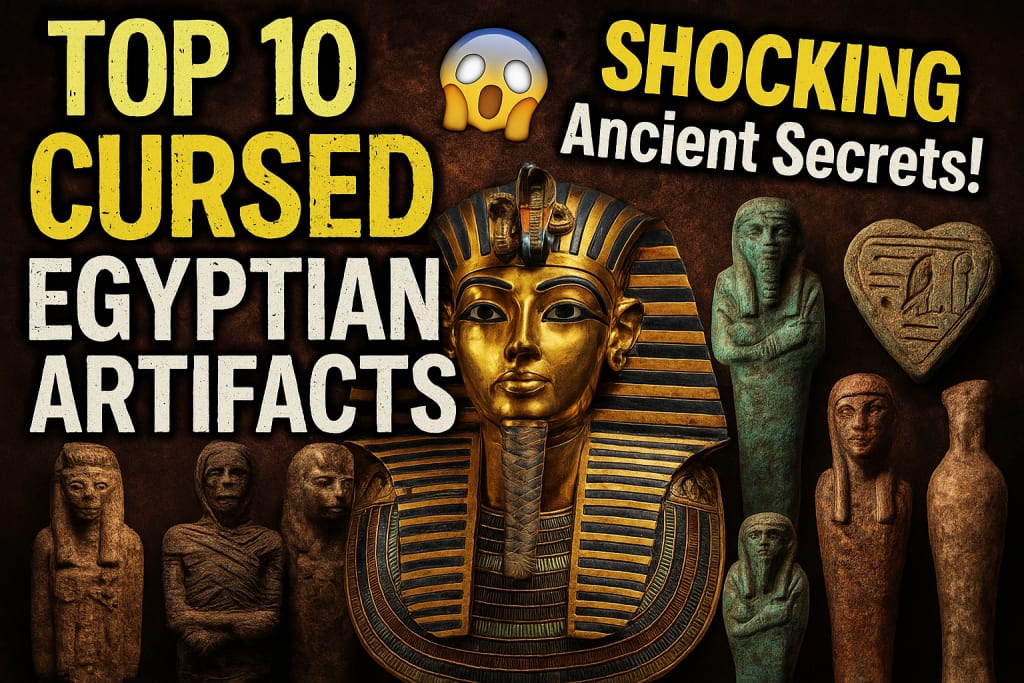
Let’s be honest, there’s something about ancient Egypt that grabs us by the collar and refuses to let go. It’s not just the pyramids scraping the sky or the gold gleaming in museum cases. It’s the feeling, thick as desert air, that these people touched something profound… maybe even dangerous. Stories swirl around certain relics – tales of misfortune, eerie coincidences, and chilling warnings etched not just in stone, but seemingly in the very fabric of fate. We call them "cursed." Whether you buy into the supernatural or not, the stories clinging to these objects are undeniable. They tap into our deepest fears about disturbing the past. Ready to walk that shadowy line? Grab a metaphorical torch. We’re diving deep into ten artifacts from the land of the Pharaohs that carry whispers of the uncanny.
1. The Unlucky Mummy (British Museum EA 22542): More Than Just a Pretty Face
This isn't even a mummy! It’s a stunningly painted lid from a coffin, depicting a priestess or noblewoman. But oh, the tales it spawned! In the late 19th century, it supposedly passed through several owners, each meeting grim fates – sudden illness, financial ruin, bizarre accidents. The most famous story? That it was aboard the Titanic. While museum records definitively debunk this, the legend persists. Holding her gaze in the British Museum, you can feel the weight of the stories. It’s a classic case of how an object becomes a lightning rod for tragedy, real or imagined, proving that sometimes the scariest curse is the one we collectively imagine.
2. The Mummy of Amen-Ra: A Tale of Terror & Tennyson
Forget Hollywood; this one fueled Victorian nightmares. Around 1889, four young Englishmen visiting Egypt supposedly bought a mummy case inscribed to a priest of Amen-Ra. What followed reads like a penny dreadful: one accidentally shot himself, another went bankrupt, a third vanished mysteriously, and the fourth was gravely injured. The terrified survivor allegedly donated the case to the British Museum. Staff there reported strange sounds – knocking, weeping – emanating from its crate. Even the poet Tennyson’s son claimed a spectral figure stalked him after seeing it! While the exact chain of events is murky, and the mummy itself is lost to history, the sheer persistence of the story whispers of a profound unease surrounding the disturbance of the sacred dead. It cemented the idea of the "mummy's curse" in popular culture, long before Boris Karloff shuffled onto the screen.
3. King Tutankhamun’s Tomb Treasures: The Curse That Captivated the World
The granddaddy of them all. Howard Carter’s discovery in 1922 was monumental. But the subsequent death of Lord Carnarvon, the expedition's financier, just months later, sparked global frenzy. A mosquito bite led to infection, then pneumonia. At the exact moment of his death, back in Cairo, the city reportedly plunged into darkness. His dog in England howled and dropped dead. Then others connected to the dig followed: Carter’s personal secretary (blood poisoning), an X-ray expert who examined the mummy (sudden illness), even Carnarvon’s half-brother (suicide). Newspapers screamed of a curse inscribed on the tomb: "Death shall come on swift wings to him who disturbs the peace of the King." Thing is? No such inscription was ever found. Statistically, many involved lived long lives (Carter himself made it to 64). Yet, the sheer concentration of odd events and the tragic, high-profile death of Carnarvon ensured the "Curse of the Pharaohs" became an inseparable part of ancient Egypt's modern mythos. It speaks to our fear of cosmic payback for trespassing on hallowed ground.
4. The Bentresh Stela (Louvre C 284): A Healing Stone with a Bite?
This large stone slab tells a fascinating story: a princess named Bentresh, suffering a mysterious illness, is cured by a statue of the god Khonsu sent from Egypt. A happy ending, right? Maybe not for those who disturb it. Found in the 19th century, folklore claims the stela brought sickness and bad luck to its early handlers and even the ship transporting it to France. While its text is a powerful testament to ancient Egypt's medical and religious practices, the lingering tales suggest some objects carry the weight of their original sacred purpose, potentially turning against those who treat them lightly. It’s the "don’t mess with divine business" vibe.
5. The Sarcophagus of Harkhebit (Metropolitan Museum of Art 23.2): The Heavyweight Haunting
This massive stone coffin belonged to a high-ranking priest during Egypt’s turbulent Late Period. It’s a masterpiece of carving. But staff at the Met have long whispered about unusual occurrences near it. Lights flicker inexplicably. Security systems trigger for no apparent reason. There’s a persistent feeling of being watched, a heaviness in the air. Some guards reportedly avoid the gallery after dark. No grand tragedies, just a constant, low-level hum of the uncanny. It makes you wonder: does an object designed to house a powerful soul for eternity retain an echo of that energy, unsettling the modern world it now inhabits?
6. The Mummy of Seqenenre Tao II: A Violent End Echoing Through Time
This one hits differently. Seqenenre Tao was a pharaoh who likely died brutally in battle, his skull showing multiple horrific axe wounds. His mummy, discovered in 1881, is a stark, unsettling testament to ancient violence. Unlike more abstract curses, the unease here stems directly from the visceral horror imprinted on the body itself. Those involved in unwrapping him in the 19th century reportedly felt overwhelming dread, even nausea. Handling him was described as profoundly disturbing. It’s less a supernatural curse, perhaps, and more the sheer, raw energy of violent death radiating from the remains. He’s a physical embodiment of a traumatic moment frozen in time, a reminder from ancient Egypt of the brutal realities often glossed over by golden treasures.
7. The Bust of Nefertiti (Neues Museum, Berlin): Beauty That Divides & Disturbs
Arguably the most famous face from ancient Egypt, Nefertiti’s bust is breathtaking. But her journey from Amarna to Berlin is steeped in controversy and whispers of ill fortune. The German archaeologist who found her, Ludwig Borchardt, allegedly employed shady tactics to secure her. Soon after, key members of his team died prematurely. The bust barely escaped destruction during WWII bombings. More persistently, Egypt has passionately demanded her return for decades, viewing her removal as a national curse. Some staff at the Neues Museum report feeling uneasy near her, sensing a profound sadness or disapproval. Is it a curse, or the heavy burden of beauty acquired under disputed circumstances, radiating a sense of profound displacement?
8. The Ka Statue of Hor Awibre (Cairo Museum JE 30948): The Double That Demands Respect
This life-size wooden statue isn't a portrait; it's a vessel for the ka – the life force or spiritual double of the king. Found in his tomb, its purpose was to house his spirit should his mummy decay. That’s potent energy. Locals involved in the excavation reportedly refused to touch it, terrified of the spiritual consequences. The legend says disturbing the ka statue invites the wrath of the king's spirit, bringing misfortune. While it now stands serenely in the Cairo Museum, the very concept challenges our modern sensibilities. This wasn't just art; it was a functional spiritual object. Handling it feels like potentially mishandling a soul. That inherent sacredness, misunderstood or disrespected, might be the root of the perceived "curse."
9. The Coffin of Ipy (Louvre E 10494): The "Mummy Board" of Misfortune
This intricately painted inner coffin lid is stunning. But its modern history is troubled. Acquired by the Louvre in the 19th century, it’s linked to a string of misfortunes befalling its owners and handlers before it reached the museum. Tales speak of sudden illnesses plaguing those who possessed it, accidents dogging its transport, and a general aura of gloom surrounding it. While now safely displayed, the stories persist, suggesting that certain funerary objects, intensely personal and charged with protective magic for the afterlife, might react negatively to being uprooted and passed around like commodities. It’s a reminder that these weren't museum pieces to the ancient Egyptians; they were vital tools for eternity.
10. The Seated Statue of Sekhemka (Currently in Limbo): The Curse of Greed & Disrespect
This Old Kingdom statue of a scribe and his wife is exquisitely carved. Its curse is distinctly modern and self-inflicted. In 2014, despite outcry from Egypt and heritage experts, the Northampton Museum in the UK sold it at auction to a private buyer for nearly £16 million to fund a museum extension. The backlash was immediate and intense. Egypt banned the museum from future excavations. Within months, the museum suffered a devastating flood causing millions in damage. The extension plans stalled. Locals dubbed it "The Curse of Sekhemka." While likely coincidence, the perception is powerful: the profound disrespect shown to this artifact – ripping it from public view for cash – brought tangible ruin. It serves as a stark warning that the real curse might be our own greed and disregard for cultural heritage. The statue’s current whereabouts are unknown, adding to its mystique.
Beyond the Shivers: What Are We Really Feeling?
So, are these objects genuinely cursed by vengeful priests or angry spirits? Science offers explanations: toxic molds in sealed tombs (potentially explaining respiratory illnesses), psychological suggestion, the human tendency to find patterns (especially negative ones) in random events, and plain old bad luck amplified by sensational stories.
But maybe the true power of these "cursed" artifacts from ancient Egypt lies elsewhere:
Resonance of the Sacred: These weren't knick-knacks. They were deeply embedded in a complex belief system centered on death, the afterlife, and cosmic order (Ma'at). Disturbing them violated sacred protocols. The unease we feel might be a faint echo of that profound cultural taboo.
The Weight of Mortality: Mummies and tombs force us to confront death head-on. The curses are stories we wrap around that discomfort – a way to explain the fear and finality these relics embody.
Consequences of Plunder: Many "cursed" objects were acquired during eras of colonial exploitation or careless archaeology. The misfortunes serve as a narrative of cosmic justice, punishing those who took without respect or permission. The Sekhemka story is a prime modern example.
The Power of Story: Humans are wired for narrative. These tales are compelling, dramatic, and connect us emotionally to the distant past in a way dry history sometimes can't. They make ancient Egypt feel alive, mysterious, and dangerous – far more thrilling than a textbook.
Walking Among the Shadows: What Do We Do?
Next time you stand before a relic from ancient Egypt in a museum, don’t just look. Feel. Consider the journey it took. Think of the hands that crafted it for a purpose we can barely grasp. Think of the tomb it guarded, the prayers whispered over it, the millennia of silence it endured before the modern world burst in.
Approach with Humility: These are not trophies. They are messengers from a vastly different world. A little respect goes a long way, even if it's just internal.
Question the Narrative: Enjoy the spooky stories, but dig deeper. Learn the actual history, the cultural context. Understanding often dispels fear.
Reflect on Legacy: The real curse might be forgetting. Forgetting the people, their beliefs, their artistry, and reducing them to superstition. Or worse, forgetting the often problematic ways these objects arrived in glass cases far from the Nile.
Listen to the Whisper: That shiver down your spine? It might not be a phantom’s breath. It might be the echo of time itself, the profound connection we feel across millennia when confronted with something crafted with such skill and purpose. It’s the hum of human history, reminding us of our own place in the long, long story.
The sands of Egypt hold countless secrets. Some glitter with gold, others whisper warnings. The curses, real or imagined, remind us that the past isn't always passive. It can reach out, touch us with cold fingers, and demand we remember – not just the glory, but the gravity, the sacredness, and the sheer, awe-inspiring mystery of a civilization that still haunts our imagination. The true secret? Perhaps the most powerful force isn't a curse inscribed on a tomb wall, but the enduring, unsettling fascination we hold for the land of the Pharaohs. It’s a fascination that keeps us looking, wondering, and yes, sometimes, feeling a genuine chill. What will you feel next time you encounter the gaze of ancient Egypt?
About the Creator
PharaohX
Unraveling the mysteries of the pharaohs and ancient Egyptian civilization. Dive into captivating stories, hidden secrets, and forgotten legends. Follow my journey through history’s most fascinating era!
The Quiet Name on Maple Street
Kim Jong-un was born into a world unlike almost any other—a world sealed by borders, ideology, and secrecy. As the grandson of Kim Il-sung, the founder of North Korea, and the son of Kim Jong-il, the country’s second leader, Kim Jong-un entered life already wrapped in destiny. In North Korea, leadership is not chosen by ballots or debate; it is inherited like a crown, reinforced by loyalty, fear, and an unyielding political system.
By The best writer 5 days ago in History


Comments
There are no comments for this story
Be the first to respond and start the conversation.