
When the Border Caught Fire Again
A fictional tale of two nations, one war, and the Muslim world watching with a trembling heart


When the Border Caught Fire Again
The world had not expected it—not again, not after decades of fragile peace, not after endless promises that history would never repeat itself. But history has a stubborn habit of returning, especially in places where wounds never truly healed.
And so, on a quiet winter morning, the borders of India and Pakistan woke up to the sound of fire.
It started small—a misunderstanding, an exchange of fire across the Line of Control, a few soldiers injured. But like sparks in dry grass, it spread quickly. Politicians pointed fingers. News channels shouted louder than the actual guns. Social media burned hotter than any battlefield.
Within days, the two nations stood face-to-face once more.
But what made this conflict different was the reaction across the Muslim world. From the streets of Istanbul to the deserts of Arabia, from the mountains of Afghanistan to the cities of Malaysia—everyone watched with fear, with anger, and with heartbreak.
Because this was not just politics. This was a story of two nuclear nations repeating a nightmare that should have never returned.
Far from the noise of political drama, in a small border village called Gulzar, lived a 21-year-old Pakistani boy named Adeel. His life was simple: tending goats, repairing tractors, and dreaming of studying engineering in Lahore. He had never held a gun, nor did he want to. War was a word he heard adults say, not a reality he expected to face.
Across the border, in the Indian village of Kisari, lived Raghav, a 22-year-old medical student. He believed in healing, not harming. He had grown up hearing stories of the partition, of pain and loss, but he always believed his generation would do better.
Both boys lived only 20 kilometers apart.
Both boys wanted peace.
Both boys were about to be dragged into a conflict none of them asked for.
As troops began to gather on both sides, the Muslim world reacted with loud concern. Leaders issued statements. Scholars called for calm. Ordinary people prayed that this conflict would not turn into something that swallowed nations and hearts.
But the fire was already spreading.
Missiles were positioned. Fighter jets flew low, shaking windows and frightening children. Night after night, the sky over the border flickered with the glow of distant explosions.
Adeel’s village was evacuated first.
Families rushed to pack whatever they could—clothes, documents, a few memories. Adeel’s mother cried as she touched the soil outside their home, whispering, “May Allah protect us.” Soldiers came to escort them, their faces tense but determined.
Across the border, Raghav volunteered at an emergency camp. His medical school had been turned into a makeshift hospital. Injured civilians arrived every hour. Some were farmers. Some were travelers. Some were just unlucky enough to be near the wrong place at the wrong time.
Raghav stitched wounds with shaking hands, wondering why human beings kept repeating the same mistakes.
The Muslim world continued to debate. Some blamed politics. Some blamed old grudges. Many asked why brothers were fighting when both nations had their own struggles—poverty, education, hunger, and the desperate need for unity.
But wars don’t wait for wisdom.
One night, Adeel and his family hid in a refugee camp when a distant explosion lit up the sky. Children screamed. Women prayed. Men tried to stay strong. To Adeel, the war no longer felt like a headline. It felt like a shadow reaching for him.
That same night, Raghav received word that a village near the border had been hit. He raced to the scene with other volunteers. What he saw broke him—smoke, rubble, and blood on the ground. War didn’t care about religion, borders, or human dreams. It only cared about destruction.
Weeks passed. Pressure from the international community grew. Muslim nations urged for immediate peace talks. Slowly, painfully, the fire began to cool.
Negotiations started. Ceasefires were announced. Soldiers withdrew. The skies became quiet again.
Adeel returned to Gulzar. Raghav returned home.
Both looked at the world differently now.
Adeel understood fear.
Raghav understood loss.
Both understood that peace is not something leaders sign—it is something people must protect.
The India–Pakistan war did not end with victory. It ended with exhaustion. And across the Muslim world, the message became clear:
If history is allowed to repeat itself, it will—again and again—until ordinary people stand up and say: “Enough.”
Adeel said it.
Raghav said it.
And maybe, one day, the world will listen.
About the Creator
Wings of Time
I'm Wings of Time—a storyteller from Swat, Pakistan. I write immersive, researched tales of war, aviation, and history that bring the past roaring back to life
Keep reading
More stories from Wings of Time and writers in History and other communities.
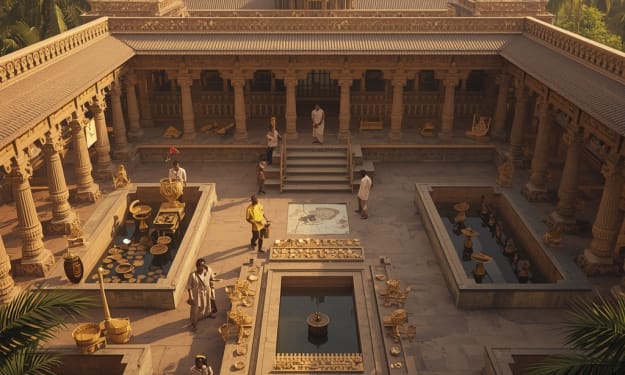
The Palaces of the Pandya Dynasty: Architecture, Artifacts, and Unique Specialties
The Pandya dynasty was one of the most ancient and powerful dynasties of South India, ruling large parts of present-day Tamil Nadu for more than a thousand years. While the Pandyas are widely remembered for their temples, pearl trade, and maritime power, their royal palaces were equally important symbols of authority, wealth, and cultural excellence. Though most Pandya palaces were built using materials that did not survive time, historical records, inscriptions, Sangam literature, and archaeological findings provide valuable insight into their grandeur, artifacts, and unique features.
By Say the truth 4 days ago in History
Be Like Jesus... No - Don't!
My kids and I are Seventh Day Adventists. It is the closest organized religion that I resonate with... for the most part. A key thing is that Saturdays are our Sabbaths. So, today, Sabbath school lessons were not published on the website I use. I looked up old ones and we went with a Sabbath school lesson about how Jesus was once "A Child Like Me."
By The Schizophrenic Mom3 days ago in History
Violence Begets
"Any last words, cowboy?" "None you'd understand, sodbuster." "Funny. That's Marshall Sodbuster to you. But I meant some last nugget that would help us in the adjudication of the myriad offenses counted against you and your gang. I wasn't asking for penitence."
By Adam Diehl6 days ago in Fiction



Comments
There are no comments for this story
Be the first to respond and start the conversation.