
What If Someone Discovered a New Planet?
The Journey from Observation to Revelation in Planetary Discovery

The discovery of a new planet would be nothing short of monumental—a moment that could shift our understanding of the cosmos and our place within it. While the idea of finding new worlds often sounds like science fiction, the truth is, we’re already on the edge of such possibilities. With advancements in space telescopes, deep-sky surveys, and computer simulations, astronomers are closer than ever to spotting unknown celestial bodies, even within our own solar system. But what really happens if someone, whether a professional astronomer or a passionate amateur, stumbles upon a planet that no one has ever seen before?
The first step after such a discovery would be verification. Observing a new planet is not as simple as seeing a new star in the sky; planets don’t emit their own light, and they often appear as faint, slow-moving dots among a sea of stars. If someone were to spot such a dot behaving unusually—say, orbiting a distant star in a peculiar way or moving against the backdrop of the night sky—they would need to collect extensive data. This data would then be analyzed, and the findings would have to be confirmed by other astronomers or observatories to rule out errors, software glitches, or known objects like asteroids or dwarf planets.
Once the existence of the new planet is confirmed, the next step would be to report it to the International Astronomical Union (IAU), the authority responsible for naming and classifying celestial bodies. Discoverers don’t automatically get to name the planet whatever they like—there are guidelines. For example, planets in our solar system are traditionally named after Roman gods, while exoplanets (planets outside our solar system) often follow naming conventions tied to the star they orbit. Still, the person or team who found the planet would likely be involved in the naming process, which is a tremendous honor in itself.
With the discovery public, the scientific community would kick into high gear. Researchers from around the globe would begin studying the planet’s orbit, composition, atmosphere, and temperature. They’d want to know: Is it a gas giant like Jupiter? A rocky world like Earth or Mars? Does it lie within the "habitable zone" of its star, where liquid water could exist? Could it possibly support life? Depending on the answers, the planet could become the subject of intense scientific interest, space missions, and even interstellar dreams.
Of course, beyond the science, the discovery of a new planet would have a profound cultural impact. The media would cover the story extensively, and people everywhere would be drawn into the mystery and wonder of this new world. It could inspire new science fiction stories, philosophical debates about life beyond Earth, and educational programs to get young people interested in astronomy. If the planet were within our solar system—like the theorized "Planet Nine"—there could even be discussions about sending a probe to study it up close, though such a mission would take years or even decades.
There’s also the human element to consider. The person who discovered the planet could become an overnight celebrity in the scientific world and beyond. But more than fame, they’d carry the satisfaction of having expanded humanity’s map of the universe, of having looked into the unknown and found something truly new. In a time when so much of the Earth has already been explored and charted, discovering a new planet serves as a reminder that the universe is still vast, still mysterious, and still full of surprises.
In the end, the discovery of a new planet isn’t just about finding another ball of rock or gas floating in space. it’s about the curiosity and determination that drive us to explore, to understand, and to dream. And whether it happens tomorrow or decades from now, it’s only a matter of time before someone makes that next great discovery.
About the Creator
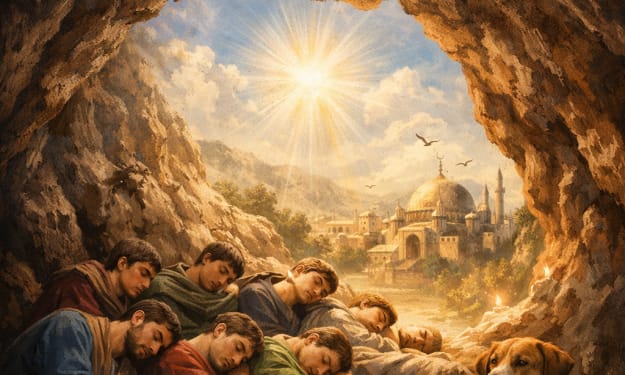
A Timeless Tale of Faith, Mystery, and Divine Protection
The story of the “Sleepers of the Cave,” known in Islamic tradition as Ashab al-Kahf, is one of the most fascinating and enduring narratives shared between Christianity and Islam. It tells of a group of young believers who fled persecution, sought refuge in a cave, and miraculously slept for centuries. Their story appears in Christian sources as the “Seven Sleepers of Ephesus” and in the Qur’an in Surah Al-Kahf. Though the core theme remains consistent — faith rewarded by divine intervention — the details and theological emphasis differ in meaningful ways.
By Irshad Abbasi 5 days ago in History



Comments
There are no comments for this story
Be the first to respond and start the conversation.