

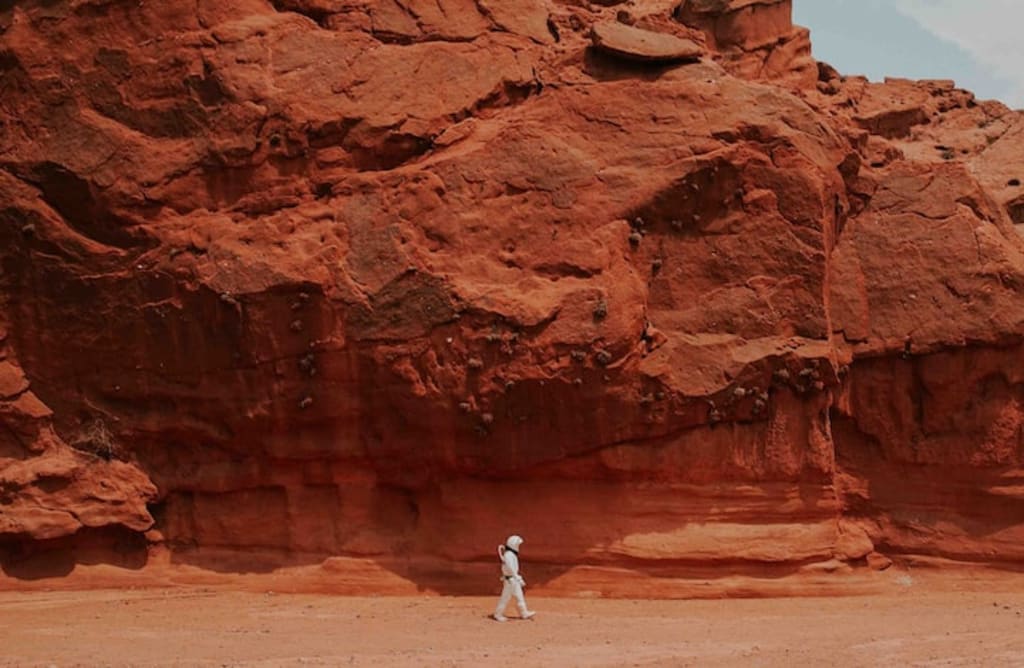
The soil is red and dry, with a freezing cold environment. Rusty dust fills the air. Steps become harder due to the thick layer of dust sinking feet. You're on Mars, driven by incredible news. Currently, it appears dry and dusty, but scientists believe Mars had a different past.
Scientists have found evidence of a large ocean on Mars 3.5 billion years ago. The ocean covered a vast area on the planet's surface. Satellite images of Mars taken from various angles helped researchers create a relief map. They identified over 4,000 miles of formations that were likely created by rivers. These formations may have been channels on the ocean floor.
In 2007, scientists utilized data collected by the Mars Reconnaissance Orbiter. Their analysis focused on the thickness of the ridges, as well as their angles and locations. The primary objective was to investigate the topographical depression known as Aolis Dorsa. The findings revealed that, during that ancient period, this region of the red planet experienced continuous transformations. These changes might have resulted from the swift movement of rocks influenced by currents and rivers, along with noticeable fluctuations in sea level.
Researchers also observed a distinct boundary that separated the elevated and highly cratered Southern Highlands of Mars from the smooth lowlands, resembling a shoreline left by a colossal ocean. This strongly suggests that in ancient times, there was indeed a substantial ocean on the surface of Mars. What adds to the excitement is the possibility that the existence of such an ocean could imply the presence of life. This discovery holds valuable information for scientists, shedding light on the ancient climate of the red planet and its evolutionary processes. It is now evident that there was a period on Mars when the planet experienced warmth, with an atmosphere thick enough to support vast amounts of liquid water.
What adds to the fascination is the possibility that the climate in the northern hemisphere of Mars 3 billion years ago could have resembled the one we currently experience on Earth. However, the fate of this ancient Martian Ocean remains a mystery. Some theories propose that the climate on the red planet may have cooled, causing the surface of the ocean to freeze. According to another hypothesis, the ocean might persist in a frozen state deep beneath a layer of rock debris and dust, specifically under a northern plain called Vastitas Borealis. Alternatively, the ocean's waters could have been lost to the atmosphere and eventually into space through a process known as atmospheric sputtering. In this process, atoms get knocked away from the atmosphere after colliding with high-energy particles from the Sun.
Despite these intriguing possibilities, the theory of an ocean covering a significant part of Mars's Northern Hemisphere hasn't been definitively confirmed, leading to ongoing debates among scientists. Presently, Mars is characterized as a very cold world with an average temperature of 80°F. Its surface is rocky, featuring dry lake beds, craters, volcanoes, and canyons. While the potential existence of a past ocean on Mars is captivating, it's not the only remarkable aspect of the planet.
Consider the famous sandstorms that rage across the red planet. In cinematic portrayals, these storms are depicted as immensely powerful forces of nature, capable of destroying astronauts' camps and tearing spaceships into pieces. However, the reality is nuanced. Mars is indeed notorious for generating dust storms of considerable size, visible even through telescopes on Earth. These storms, at times, cover continent-sized areas and can endure for weeks. Yet, there are much rarer phenomena – Global Dust Storms – occurring once in three Martian years, equivalent to about 5 and a half Earth years. These storms are more extensive and more intense, encircling the entire planet. Despite their magnitude, it's improbable for even a global dust storm to cause significant harm to astronauts or their equipment. The wind speed on Mars during these storms reaches a maximum of 60 MPH, less than half the speed of most hurricane-force winds on Earth. This comparison can be somewhat misleading since Mars's atmosphere is only about 1% as dense as Earth's, requiring much faster wind speeds to cause damage or lift a kite.
Moving on to another fascinating Martian phenomenon – an eye-shaped formation observed from a distance. While it appears like an eye with winding channels resembling veins, a closer inspection reveals it to be a giant crater, nearly 19 miles in diameter. Surrounding the crater, which resembles a pupil, are even larger craters likely formed billions of years ago during Mars's encounters with space rocks. The eye crater's darker appearance than the surrounding landscape is attributed to the past presence of water, filling the colossal pit carried by the winding channels. This water likely prevented certain substances and minerals from eroding away.
Your next destination on Mars is Valles Marineris, an enormous canyon system running along the equator, stretching over 2,500 miles and four times as deep as Earth's Grand Canyon. Most scientists believe that Valles Marineris originated as a colossal tectonic crack in Mars's crust during the planet's cooling phase in the distant past.
Adding to the awe-inspiring features of Mars is Olympus Mons, the largest shield volcano in the solar system. With a diameter exceeding 370 miles and a height of 16 miles, it rivals the size of the State of Arizona. This Martian giant is surrounded by incredibly tall cliffs, emphasizing its colossal scale. Comparatively, Earth's largest volcano, Mauna Loa, stands around 2.6 miles high and 75 miles across. However, the volume of Olympus Mons is approximately 100 times larger than that of Mauna Loa, highlighting its extraordinary dimensions. To put it into perspective, Olympus Mons could engulf the entire chain of Hawaiian Islands from Kauai to Hawaii.
Scientists have long pondered the reasons behind Olympus Mons' remarkable size. It could be attributed to lower surface gravity, higher eruption rates, or the unique composition of Mars's crust, distinct from Earth's tectonic plate structure. Unlike Earth, where lava can find its way to the surface through numerous vents created by moving tectonic plates, Mars's lack of such plate boundaries may have led to the accumulation of lava in one colossal volcano.
In conclusion, a visit to Mars would offer a breathtaking exploration of diverse and awe-inspiring geological features, showcasing the mysteries and wonders of the red planet.
About the Creator
Keep reading
More stories from writers in History and other communities.
3 Times the Wrong Person Was in Charge at the Worst Possible Moment
Leadership matters most when things go wrong. In calm times, almost anyone can appear competent. Meetings happen. Papers get signed. Coffee is consumed with confidence. But crises are different. Crises demand judgment, experience, decisiveness, and—ideally—a basic understanding of what’s happening.
By Enoch Sagini5 days ago in History



Comments
There are no comments for this story
Be the first to respond and start the conversation.