


"All major and multinational wars between countries worldwide are collectively referred to as "World Wars." In history, there have been two primary world wars: the First World War (1914-1918) and the Second World War (1939-1945). These two wars have had profound and far-reaching impacts, bringing about significant changes in politics, economics, and society globally.
The First World War (also known as World War I or WWI) erupted in 1914 and lasted until 1918. This conflict stemmed from a range of factors, including national rivalries, the assassination of Archduke Franz Ferdinand of Austria-Hungary in Sarajevo, and a complex system of alliances among European nations. WWI saw the use of a plethora of new military technologies, from chemical weapons to airplanes and submarines.
The Second World War (also known as World War II or WWII) broke out in 1939 when Nazi Germany invaded Poland. This war lasted until 1945 and spread across the globe, involving most major countries worldwide. WWII witnessed the emergence of new superpowers such as the Soviet Union, the United States, Nazi Germany, and Japan, and resulted in one of the largest humanitarian catastrophes in history, with millions of casualties and immense damage to the economies and infrastructure of the participating nations.
With distinct historical contexts and specific events, determining whether "World War" refers to WWI or WWII is crucial to understanding the context and consequences of each war."

The narrative begins with a depiction of the First World War as a conflict characterized by a stalemate, with neither side able to gain significant ground. Both the Allies and the Central Powers were aware that victory wouldn't come from territorial conquest but rather from wearing down the opponent. The Allies, with their vast resources, initiated tactics such as naval blockades to deprive Germany of supplies. Despite neither side desiring a prolonged conflict, they sought strategies to break the deadlock.
One such strategy was the pursuit of new frontiers. Australia swiftly seized German New Guinea at the outset of the war, while the Allies capitalized on Germany's colonies in Africa, enlisting locals and drawing tragic casualties. Italy and Japan joined the Allies, with Italy switching sides due to territorial promises. The Ottomans hesitated to enter the war but eventually did, prompting British concern over Middle Eastern oil.
Various campaigns ensued: failed Ottoman offensives, the Allies' disastrous Gallipoli campaign, German attempts to incite Jihad in Afghanistan, and the Central Powers' coercion of Bulgaria to defeat Serbia. Portugal's alignment with the Allies further antagonized Germany. The only naval battle of the war occurred, showcasing the formidable Dreadnought battleships.

As the conflict intensified, conscription expanded, and brutal battles unfolded, notably at Verdun and the Somme, where technological innovations like chemical warfare emerged. Despite Russian and Romanian involvement, exhaustion pervaded all sides. Russia's revolution prompted its exit from the war, relieving pressure on Germany, though the looming threat of American intervention loomed large.
Desperate, Germany resorted to a final offensive, but with the arrival of fresh American troops, the Allies countered, pushing the Central Powers back. Bulgaria, the Ottoman Empire, Austria-Hungary, and finally Germany succumbed to defeat. The war culminated in the signing of a peace treaty, holding Germany accountable and reconfiguring global politics.
The war's toll, with millions dead and unimaginable suffering, left a lasting impression on the world, albeit briefly, as another global conflict erupted two decades later.

The global conflict of World War I resulted in a range of profound and multifaceted consequences, not only in politics, economics, and society but also in the psyche and mindset of humanity. Here are some of the main consequences of this war:
Loss of millions of lives: World War I caused the loss of millions of lives of soldiers and civilians worldwide. Major battles such as Verdun, the Somme, and Passchendaele resulted in massive casualties, claiming the lives of millions.
Economic devastation: The war destroyed the economies of many nations. Large-scale invasions, new military technologies, and the consumption of vital resources caused significant damage to the infrastructure and economies of affected countries.
Political changes: The war led to the collapse of many traditional political regimes, such as the Russian Empire and the Austro-Hungarian Empire. It resulted in the emergence of new regimes, as well as the rise of political and social movements.
Paving the way for World War II: Despite post-war efforts to build peace and stability, this war created an unstable and volatile environment, laying the groundwork for the outbreak of World War II.
About the Creator
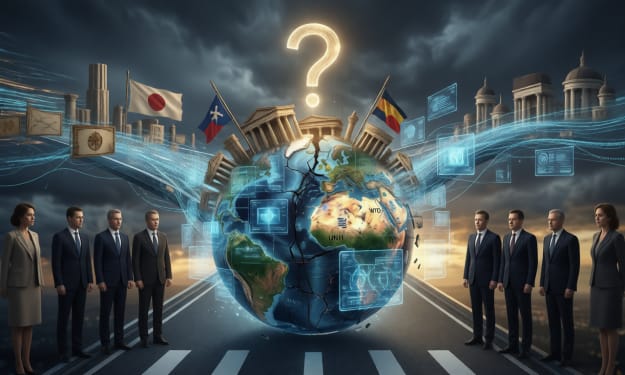
Reform or Replace? The Future of Global Governance
Reform or Replace? The Future of Global Governance Global governance stands at a critical crossroads. Institutions created after World War II—especially the United Nations—were designed to prevent another global catastrophe. For decades, they provided platforms for dialogue, coordination, and conflict management. But today, many people question whether these institutions still work as intended. The growing debate is no longer just about reform. It is about whether global governance should be repaired or replaced entirely.
By Wings of Time 3 days ago in History
Who Replaces the United Nations If It Fails?
Who Replaces the United Nations If It Fails? For more than seventy years, the United Nations has served as the world’s main platform for diplomacy, peacekeeping, and global cooperation. Despite its weaknesses, it remains the only institution where nearly every country has a seat at the table. But as trust in the UN declines and major powers increasingly act alone, an uncomfortable question is being asked more often: if the UN fails, who—or what—takes its place?
By Wings of Time 4 days ago in History



Comments (1)
Outstanding! Keep striving for greatness