
UNSOLVED MYSTERIES OF THE EARTH
Earth's Enigmas: Unraveling the Unsolved Mysteries

On the bottom of our planet lies the frigid land of Antarctica, the coldest and most inhospitable continent in the world, stretching over 5 million square miles. Antarctica is covered in ice sheets that breach more than a mile deep. The average daily temperature is negative 49 degrees Fahrenheit, and wind speeds can reach over 100 miles per hour. Today, the only inhabitants of this barren landscape are scientists who work in research stations scattered across the continent. Mainstream geologists have long believed that ancient humans never settled on Antarctica because of its hostile climate. However, in 2016, satellite images revealed a curious formation emerging from the ice that some researchers believe could be a man-made pyramid. Recently, there have been reports of huge pyramids in Antarctica, jutting out of the ice and snow, resembling those in Egypt but dwarfing them in size. One has a perfectly square base that is two kilometers square in each direction. Is it possible, therefore, that our ancestors did reach the Antarctic continent and perhaps even settled there? A man-made pyramid beneath the Antarctic ice raises intriguing questions. If such an incredible notion is true, it naturally begs some questions: How was such a massive structure built on Antarctica? When was it done, and by whom? Geologists have told us that Antarctica has been under ice for many millions of years. However, evidence suggests that certain areas could have been ice-free until perhaps 4000 BC. Polynesian stories describe this strange land with white rocks emerging from the water, icebergs, seals, penguins, resembling what we now know as Antarctica. The Polynesian people believed this was the place of the ancestors, claiming it as their origin. In 2017, German geologists collected core samples from the Antarctic seafloor, revealing evidence of a past climate that could support vegetation thousands of years ago. This discovery raises the possibility that the Antarctic continent, with its hidden secrets, could tell us a lot about the Earth. Cairo, Egypt, a plateau west of the Nile River, is the Giza necropolis, perhaps the most famous collection of ruins in the world. Constructed during ancient Egypt's fourth Dynasty around 2550 BC, these limestone monuments attract thousands of tourists every day. The Great Sphinx, a massive statue, has been an object of fascination and wonder for thousands of years. The Sphinx is the most recognizable statue globally, and its scale is immense. Standing 240 feet long, 66 feet tall, and 62 feet wide, it raises many questions. Archaeologists believe that the Sphinx was sculpted around 2500 BC by Pharaoh Khafre. However, some researchers dispute this, pointing to evidence of water weathering on the Sphinx's body, suggesting a much older origin, possibly dating back to the end of the last ice age circa 10,000 BC. This challenges conventional timelines and invites a reevaluation of the Sphinx's true age. Cincinnati, Ohio, just outside the city, is the home of Greg and Dana Newkirk. Their ordinary-looking home contains a basement room filled with a collection of strange objects believed to be cursed. The Newkirks inadvertently started collecting cursed objects, gaining a reputation for dealing with the bizarre. The collection includes haunted relics, each with its own story of misfortune. One notable object is the Crone, a wooden effigy found in the Catskills, believed to be cursed and too dangerous to keep. The Newkirks embarked on a journey to return it to its origin, performing a ritual to remove its curse. The Crone was left in the Catskills, where its dangerous influence could no longer harm others. Jordan River Valley, near the Dead Sea, hides the ruins of an ancient city, known as Tall el-Hammam. Archaeologists propose that this may be the biblical city of Sodom, destroyed by fire and brimstone according to the Bible. Geographical and physical evidence on-site aligns with the biblical description of Sodom's destruction. The site's layer shows signs of an airburst event or meteor explosion, with thermal damage, microspherules, and a high concentration of rare Earth elements. The story of Lot's wife turning into a pillar of salt adds a intriguing connection to the theory of a meteor explosion. Pompeii, Italy, in 79 A.D., witnessed a catastrophic volcanic eruption that preserved the city in a state of suspended animation. One of the remarkable discoveries is the Villa De Papyri, a Roman luxury villa buried with a library of more than 1800 papyrus scrolls. Recent advancements in technology, such as virtual unwrapping, have enabled scientists to digitally scan and read these ancient texts without physically opening them. The scrolls contain philosophical, literary, and historical texts, offering a glimpse into the intellectual pursuits of ancient Romans. The potential discovery of original letters from the Apostle Paul adds a layer of historical and religious significance to the Villa's library. These scientific techniques provide a forensic understanding of history, unraveling secrets that have remained hidden for centuries.
Please note that some of the content, especially the part about cursed objects and the Crone, seems to be from a different context or source. If you have more specific details or context, I can better integrate that information.
About the Creator
NICHOLAS MURIUNGI
I have nothings to offer to the world but writing story
Keep reading
More stories from NICHOLAS MURIUNGI and writers in History and other communities.
The raise of America
The modern United States stands as the most powerful country in human history, boasting over 800 military bases and accounting for 37% of global military spending. This dominance has positioned the United States as the leader of a vast interconnected global system, contributing to an era of unprecedented prosperity and relatively low levels of conflict.
By NICHOLAS MURIUNGI2 years ago in History
3 Harmless Habits That Once Caused Absolute Chaos
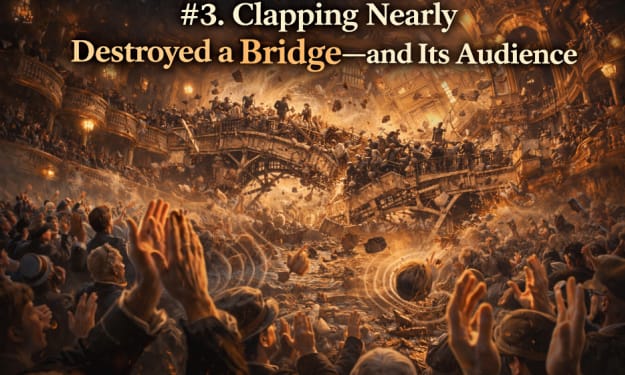
Most habits are comfortingly dull. You chew gum. You clap at events. You check your phone. You assume—reasonably—that these actions will not destabilize governments, bankrupt industries, or end lives. Society depends on this assumption. If every small habit carried catastrophic potential, we would never leave the house.
By Enoch Sagini4 days ago in History
Brosley Punch — The Strike That Shook Fate
Brosley was never taught how to throw a punch. He learned it the hard way—through hunger, through survival, through a childhood spent on a world that showed no mercy. Long before the universe would whisper his name in fear, Brosley was just a boy standing on cracked red stone, staring at a sky that never answered his questions.
By The best writer 2 days ago in History



Comments (1)
I really enjoyed reading that ❤️, and I hope you 'll read my stories and rate me on them because I care about your opinion🥰💝