
Ummi Aisha: The Beloved Wife of the Prophet ﷺ
A Journey Through the Life, Wisdom, and Legacy of Hazrat Aisha (RA), the Mother of the Believers

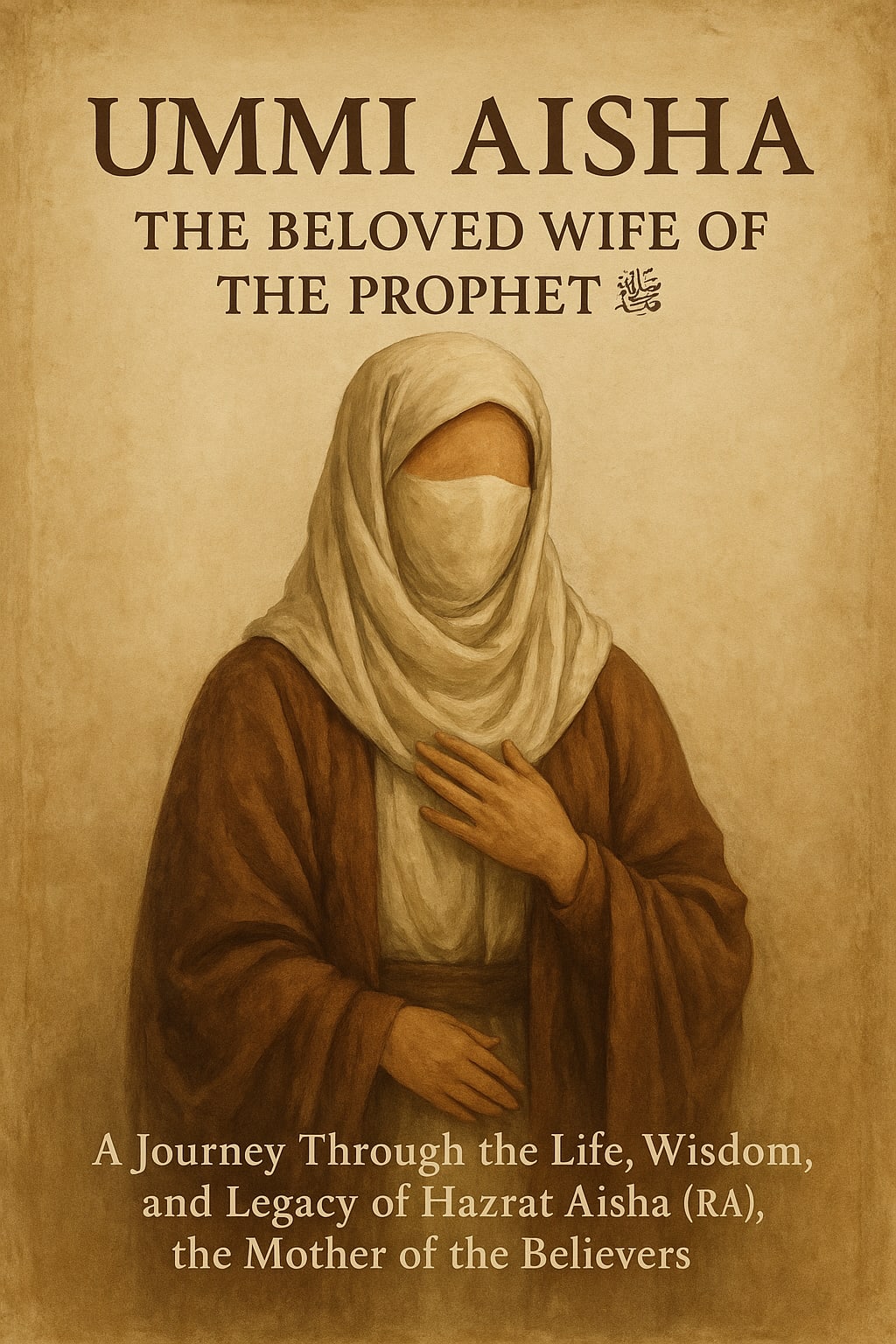
Hazrat Aisha bint Abi Bakr (RA), known with honorific titles such as “Ummi Aisha” and “Mother of the Believers,” was one of the most influential women in Islamic history. As the beloved wife of the Prophet Muhammad ﷺ and the daughter of his closest companion, Abu Bakr As-Siddiq (RA), Aisha (RA) played a vital role in preserving and transmitting the knowledge, values, and spirit of early Islam. Her life was marked by deep piety, sharp intellect, and unshakeable faith, making her a guiding light for generations to come.
Early Life and Lineage
Aisha (RA) was born in Makkah around 613 CE, into the noble and respected family of Banu Taym. Her father, Abu Bakr (RA), was the closest friend of the Prophet ﷺ and the first man to accept Islam after the Prophet began preaching. Her mother, Umm Ruman (RA), was also a devout Muslim. From an early age, Aisha (RA) was brought up in an environment of faith, honesty, and devotion to Allah.
Aisha (RA) was known for her intelligence and sharp memory even as a child. She was eloquent in speech, strong in reasoning, and eager to learn—traits that would later establish her as one of the greatest scholars in Islamic history.
Marriage to the Prophet ﷺ
The marriage of Aisha (RA) to Prophet Muhammad ﷺ was a divinely ordained union. It was not merely a personal bond but also a spiritual and educational alliance that would benefit the entire Ummah. The marriage took place after the migration to Madinah, when she was still young, and she moved into the Prophet’s ﷺ household later. Despite her age, Aisha (RA) showed remarkable maturity and understanding of the responsibilities of being the wife of the Messenger of Allah.
The Prophet ﷺ had great love and affection for Aisha (RA), often expressing it openly. She was known to be his favorite wife after Khadijah (RA), and many incidents in the Hadith literature testify to the closeness of their relationship. The Prophet ﷺ once said, “The superiority of Aisha over other women is like the superiority of Tharid (a rich meat dish) over other foods.” (Sahih al-Bukhari)
Her Role in the Prophet’s ﷺ Life
Aisha (RA) lived with the Prophet ﷺ during the final ten years of his life, witnessing the critical developments of the Islamic state in Madinah. She was present during times of peace and conflict, hardship and victory. Her close companionship gave her firsthand experience of the Prophet’s character, habits, and teachings, which she later shared in great detail.
She had the unique opportunity to observe the Prophet ﷺ in both his public and private life, making her an invaluable source of knowledge for future generations. Her deep understanding of the Qur’an, Hadith, and Fiqh (Islamic jurisprudence) was shaped through this close proximity to the Messenger of Allah ﷺ.
Scholar and Teacher of the Ummah
After the passing of the Prophet ﷺ in 632 CE, Aisha (RA) dedicated her life to educating the Muslim community. She became one of the most prominent narrators of Hadith, having narrated over 2,200 authentic Hadiths that cover matters of worship, ethics, medicine, inheritance, and the Prophet’s personal life. Her narrations are found in all major Hadith collections, including Sahih al-Bukhari and Sahih Muslim.
Prominent companions of the Prophet ﷺ such as Abdullah ibn Abbas (RA), Urwah ibn al-Zubayr, and Imam Abu Huraira (RA) would consult Aisha (RA) on complex religious matters. Her home effectively became an informal school for scholars and seekers of knowledge.
She was known for her precision in speech, logic in arguments, and ability to recall detailed events accurately. She corrected misunderstandings in religious matters—even from senior companions—when needed, always doing so with respect and wisdom.
Role in Social and Political Matters
Hazrat Aisha (RA) was not only a scholar but also played an active role in the political affairs of her time. During the caliphate of Uthman ibn Affan (RA) and Ali ibn Abi Talib (RA), she voiced her concerns about justice and unity in the Ummah. The most notable political episode of her life was the incident of the Battle of the Camel, where she initially opposed the killing of Caliph Uthman and later found herself at the center of a civil conflict.
After the battle, Aisha (RA) withdrew from political life and focused solely on religious teaching and charity. She acknowledged the complexities of the political situation and spent the rest of her life promoting unity and understanding among Muslims.
Personal Traits and Legacy
Aisha (RA) was known for her eloquence, intelligence, generosity, and strong personality. She was deeply compassionate, especially toward the poor and orphans. She would often give away her wealth in charity, and many would seek her guidance in both worldly and religious matters.
Her wit and wisdom are recorded in countless narrations. She would ask deep questions to the Prophet ﷺ and offer thoughtful insights, often leading to revelations and clarifications of Islamic teachings.
Aisha (RA) also left behind powerful examples of how a Muslim woman can be both modest and educated, private yet socially impactful. She challenged misconceptions about the role of women in society by embodying the balance between piety, scholarship, and activism.
Passing and Burial
Hazrat Aisha (RA) passed away in Madinah in 678 CE at the age of 65. She was buried in the Jannat al-Baqi cemetery, near the Prophet’s Mosque, alongside other members of the Prophet’s family and companions.
Her passing marked the end of an era, but her legacy continues to live on through the vast knowledge she left behind.
Conclusion
Hazrat Aisha (RA), the beloved wife of the Prophet ﷺ, remains a towering figure in Islamic history. Her life is a testament to the transformative power of knowledge, faith, and sincerity. As a wife, scholar, teacher, and leader, she continues to inspire Muslims around the world.
To understand her is to understand a vital part of Islam’s foundation. Her legacy serves as a shining light, especially for women who seek to follow the path of faith, intellect, and courage. May Allah be pleased with her and elevate her status among the righteous.
About the Creator
Irshad Abbasi
"Studying is the best cure for sorrow and grief." shirazi
Keep reading
More stories from Irshad Abbasi and writers in History and other communities.
Zainab bint Muhammad: The Eldest Daughter of the Prophet (PBUH)
Zainab bint Muhammad (RA) was the eldest daughter of the Prophet Muhammad (ﷺ) and Khadijah bint Khuwaylid (RA). Born around 600 CE in the noble city of Makkah, Zainab’s life would come to reflect a deep devotion to her father’s mission and an enduring strength shaped by the hardships of early Islam. Her story, though often less mentioned than her siblings, is rich with lessons of patience, sacrifice, and unwavering faith.
By Irshad Abbasi 6 months ago in History
Why Early Aircraft Designers Had No Second Chances
When I read about the earliest days of aviation, I’m always struck by how unforgiving that era truly was. Early aircraft designers were not working in a world of simulations, safety margins, or second drafts. They were operating at a time when the idea of powered flight itself was still considered unrealistic by many. Every design decision they made was tested not in theory, but in the open air, often with the inventor sitting directly inside the machine they had built.
By Beckett Dowhan5 days ago in History
Dr. Martin Luther King, Jr.
Dr. Martin Luther King, Jr. was born on January 15, 1929. Martin Luther King, Jr. Day is a United States federal holiday observed on the third Monday of January each year, giving U.S. residents a three-day weekend. It is the first federal holiday of 2026.
By Margaret Minnicks3 days ago in History


Comments
There are no comments for this story
Be the first to respond and start the conversation.