
Ukrainian Theatre - Nationalism and the Nationalist Theatre
My Master's Thesis (1.1)


Early on in her book Theatre & Nation, Nadine Holdsworth draws from a number of sociologists and theorists to define three key terms: nation, nationalism, and national identity. These are important terms to be distinguished; after all, the purview of this essay is Ukrainian theatre of national identity. Whether or not this can be conflated with Ukrainian nationalist theatre is a matter of connotation. If, as for many, the term nationalism conjures up images of Nazi Germany, Stalinist Russia, or Trumpist America—all of which have negative connotations—then it may be uncomfortable to ascribe the word nationalist to Ukrainian theatre. After all, if it earned condemnation from the Ukrainian Communist Party, to the point of Kulish’s banishment, arrest, and eventual execution, then it must have been disruptive to some utopian vision that the USSR wanted to achieve.
And indeed Holdsworth does define the simplest version: “Throughout history,” she posits, “people have constructed group formations to distinguish ‘us’ from ‘them’, whether territorial, linguistic or around bloodlines or religion, for example.” Already, Holdsworth calls to mind, though does not actively name, the nation as an instrument of both unification and division. The nation unites a population of a shared culture and/or territory, and distinguishes them from populations that do not share that culture or territory. Holdsworth spends the rest of the section stating that there are no consensuses on the reasons or definitions of these three key terms, but ends by stating, “I explore the importance of various factors—such as history, territory, heredity, language and culture—to constructions of national identity[.]” I emphasize history, language, and culture because they are, as we will soon discover, instrumental to conceptions of Ukrainian national identity.
The first dichotomy that she points out is the differentiation between civic nationalism and ethnic nationalism, which first arose in theory in 1944 as “Western” and “Eastern” nationalism. Whether civic or ethnic, Western or Eastern, political or cultural, the delineation remains fairly similar: civic nationalism derives from the idea of allegiance to a nation based on geography, governance, or an ideal. Holdsworth refers to it as “voluntary”. Ethnic nationalism, on the other hand, derives from allegiance to a nation or a collective based on shared history, language, culture, and/or ethnicity. Holdsworth resists valuing one above another. Whereas ethnic nationalism may give rise to ideologies such as that of Hitler’s Aryan Race, it also has the potential to provide autonomy to communities of a shared language, religion, and value system. The concept of civic nationalism may provide a basis for the myth of the American melting pot, wherein members of numerous ethnic and religious communities come together for the shared American Dream and in the process creating somewhat of a homogenous American alloy. However, the ideology may also give rise to empires such as 19th-century Britain, Russia, or Austria, wherein languages, ethnicities, and religions were heavily subjugated in favor of allegiance to a central emperor, monarch, or despot. With that being said, dichotomies are heavily reductive, and aspects of nationalism within nations alternate or even clash throughout a single nation’s history. For example, in the United States, a conflict in national identity exists between the conservative right wing—typically pushing integration and homogenization of other ethnic, religious, and racial identities to support their concept of the ideal American alloy—and the liberal left wing—redefining the American melting pot as more of a convivial “fruit salad,” in which cultural components keep their identities with less of a need for integration.
At around the end of the volume, Holdsworth evolves nationalist theory into cosmopolitanism. Holdsworth introduces cosmopolitanism as “about sharing the same planet and recognising the ethical obligations of healthy co-existence that this demands.” Whereas nationalism seeks to define the nation in regards to its own culture, identity, language, etc, cosmopolitanism, strongly related to globalism, seeks to place that nation at a table with other nations. The cosmopolitan mindset places national and global identity in tandem with one another, and while this appears to be a formula for a healthy coexistence, it also leads to some sense of moral superiority of some nations in relation to other nations, and a new form of moral colonialism as a result. Holdsworth uses the US invasion and occupation of Afghanistan as an example of this; however, the whole Cold War could be used as a macro-example. As the United States and the USSR competed, they both expanded spheres of influence and attempted to craft the globe to suit their moral and ideological agendas. As a result, numerous proxy wars were fought, and nations were destabilized in order to serve the purpose of a capitalist or Soviet-socialist world order.
Finally, from Holdsworth it is valuable to borrow the terms “state-of-the-nation play,” “nation under duress,” and “national iconography.” The first, she defines as a sort of dramatic appraisal of the state of the nation; as a nation carries on, plays form examining what it is like existing within that nation. Holdsworth offers up Arthur Miller’s Death of a Salesman as a prime example of this; it examines what it is like to live and work in a capitalist society wherein the working man is being gradually dehumanized. Holdsworth draws vital connections between the state-of-the-nation play and the idea of the nation under duress; this duress, as she describes it, occurs when a nation’s national identity is in flux, materializing in a dramatic historic event. Holdsworth mainly draws on riots as these historic events, positing basically that a nation discovers itself when its values are violently and primally questioned in an act of collective violence.
In relation to Ukraine, the most prominent example of Ukraine under “duress” that fits Holdsworth’s main definition is the 2014 Revolution of Dignity. In essence, in February of 2014, Ukrainian President Viktor Yanukovych—himself a Putin ally and loyalist—reneged on a deal allowing for the accession of Ukraine into the European Union. This choice sparked outrage among Ukrainians, specifically students, who protested at Maidan Square in Kyiv; law enforcement was called in to violently disrupt the protests, which intensified, and led to the ousting of Yanukovych. Russia, however, took the period of destabilization as an opportunity to invade the Crimean Peninsula and the Donbas, an area in the East of Ukraine. The period of destabilization led to the writing of numerous state-of-the-nation plays, including Neda Nejdana’s Pussycat in the Memory of Darkness, a monodrama about the 2014 war in the Donbas region. This being said, I would like to expand Holdsworth’s definition of “duress” for a nation to include war in addition to protest, especially in the example of Ukraine. The theatre created in Ukraine in times of conflict seeks to reify Ukrainian civic and ethnic national identity, and as we shall soon see, whether it is the Ukrainian Civil War of the early 20th century, the Holodomor of the 30s, or the Russian invasions of 2014 and 2022, duress and repression galvanize the identity of Ukrainian theatre.
Holdsworth also stresses the importance of national iconography in such performances. National iconography, as she defines, is a set of symbols that can represent or conjure a nation: tea, the monarch, and fish and chips for England and burgers, bald eagles, and stars and stripes for the United States are examples she offers. National iconography can be codified beyond stereotypes, however. Historic figures and moments, mythologies, manners of dress, and cultural holidays are all vital in determining the code of national iconography that represents a nation. Most notably, Holdsworth stresses the importance of the inversion or challenging of national icons in the state-of-the-nation play. Most basically, flags are brought to mind; in nations with long histories as imperialist powers, such as the United States or the United Kingdom, a civilian proudly flying their own national banner or wearing it on their person in some form or another, can be perceived as a sign of right-wing nationalist sentiment. Therefore, when one of such flags is brought to a theatrical space, it must be critiqued or reclaimed. Conversely, for a nation such as Ukraine in the modern day, which does not share a history of imposing imperial will upon a subjugated nation, its own flag has a “cleaner” connotation. Flying the flag of Ukraine is an act of resistance and patriotism on the territory of Ukraine, and an act of solidarity outside of it. Flags are very important in Ukrainian modernist drama, as we will soon discover in Chapter 3 with Mykola Kulish’s Sonata Pathetique.
Kiki Gounaridou, in her introductory remarks to the collection of essays Staging Nationalism: Essays on Theatre and National Identity, expands on this idea of inversions—or as she calls them, reversals—of national iconography in the nationalist drama. There exists a classical set of icons, culture, mythologies, and histories in a nation’s repertoire, she posits; it is through the appraisal of this that a somewhat neoclassical tradition is born. Herein lies the tension: As history progresses—and the dramatic repertoire alongside it—those neoclassical ideals of what a play should look like or incorporate change. Gounaridou conjures Matthias Langhoff’s controversial 1997 The Bacchae as an example: she claims it as a mirror of what Greek society had become in that era—multiethnic, multicultural, a “relatively homogenous population” that had been “penetrated.” Reflective of that, Langhoff’s Bacchae integrated pan-European and pan-American cultural symbols into the play, had characters speak in non-ethnic-Greek dialects and accents, and even worked to destabilize the theatrical model itself through breaking of the fourth wall via actor-audience interactions. The result was a contentious work that critiqued ideals of a homogenous Greece with its pure, stable, seminal works of drama that had been there since the dawn of (Western) theatrical practice. To sum up, nationalist theatre can abide by these neoclassical ideas, but by challenging them, nationalist theatre reflects a nation that challenges itself.
With all that said, nationalism on the civic-to-ethnic dichotomy will be, in the body of this thesis, fluid, as the development of nationalist sentiment in Ukraine—and even in the USSR and Russia—seems to evolve. In the mid-19th to early-20th centuries, the Ukrainian national identity rings ethnic by necessity; the unifying factor of the Ukrainian people is a shared history, mythology, and lineage. In the later part of this thesis, in examining Ukrainian theatre of the current war, this dichotomy tends to break down. While the preservation of Ukrainian history and culture is vital, the idea of what is “Ukrainian” has evolved to include that which is not ethnically Ukrainian; in seeking to integrate with the West, a privilege not offered to it in centuries past, the Ukrainian nation absorbs numerous other cultural influences and makes them Ukrainian. This thread will be partially unraveled in Chapter 2, and fully unraveled in Chapter 3. In any case, because the act of generating creative work in Ukrainian at these historic moments was in its essence a political (sometimes illegal) act, all works discussed in this thesis will be treated as state-of-the-nation plays, in that they critique the existing state of the Ukrainian nation, or seek to build a Ukrainian nation out of the ruins left by Russia. Ukrainian national iconography will be codified as it becomes relevant in discussing creative works.
About the Creator
Steven Christopher McKnight
Disillusioned twenty-something, future ghost of a drowned hobo, cryptid prowling abandoned operahouses, theatre scholar, prosewright, playwright, aiming to never work again.
Venmo me @MickTheKnight
Keep reading
More stories from Steven Christopher McKnight and writers in History and other communities.
Ukrainian Theatre of National Identity - Russia's Nationalist Problem
With that said, I want to set the stage for the rest of this thesis by calling to attention what I will refer to as Soviet Russia’s “Nationalist Problem.” In a multinational empire, assembled after years of war, civil war, and rebellion, the main concern of the Soviet Union was to make the mechanism of a socialist nation function. Political policies were tried and tested in the early years of the USSR. After the nation had stabilized, for example, a policy of Ukrainization was implemented in the Ukrainian lands, offering the Ukrainian people educational and cultural autonomy. This policy was reversed under Stalin, who instead persecuted Ukrainians who explored ideas related to the nation and criticism of the USSR. Culture and politics were inextricably intertwined; in Russia, theate and theatrical spectacles were explored as strategies to propagandize the public into a sense of Soviet pride. Because the arts were so linked to the political mechanism at the time, an artist operating outside or against that political mechanism was subject to excommunication, imprisonment, and/or death. One political party—the Communist Party—dominated, and lack of membership to it was a fast track to pariah status.
By Steven Christopher McKnightabout a year ago in History
A Psychological Study of Hitler’s Personality
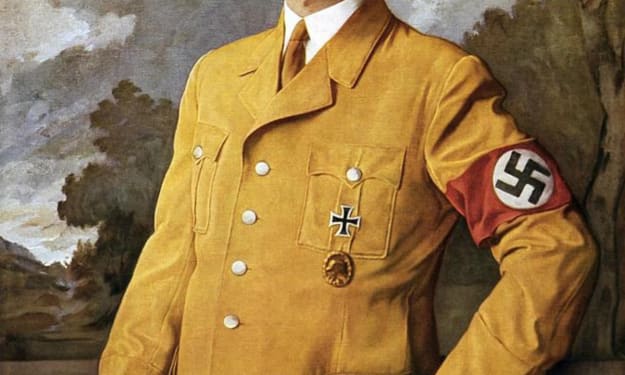
Whenever Adolf Hitler’s name arises in discussions of the darkest chapters of human history, the mind tends to conjure a terrifying image—something bordering on a supernatural monster or a madman pushed to the extremes of insanity. Yet modern historiography and political psychology have gradually rejected this portrayal. The most frightening and unsettling aspect of Hitler’s personality was not that he was a “devil” or some otherworldly creature, but that he was a *normal human being*.
By Taimur Kazmi3 days ago in History



Comments
There are no comments for this story
Be the first to respond and start the conversation.