
Trump White House plans to shake up briefing room seating, flexing power over press corps
flexing power over press corps
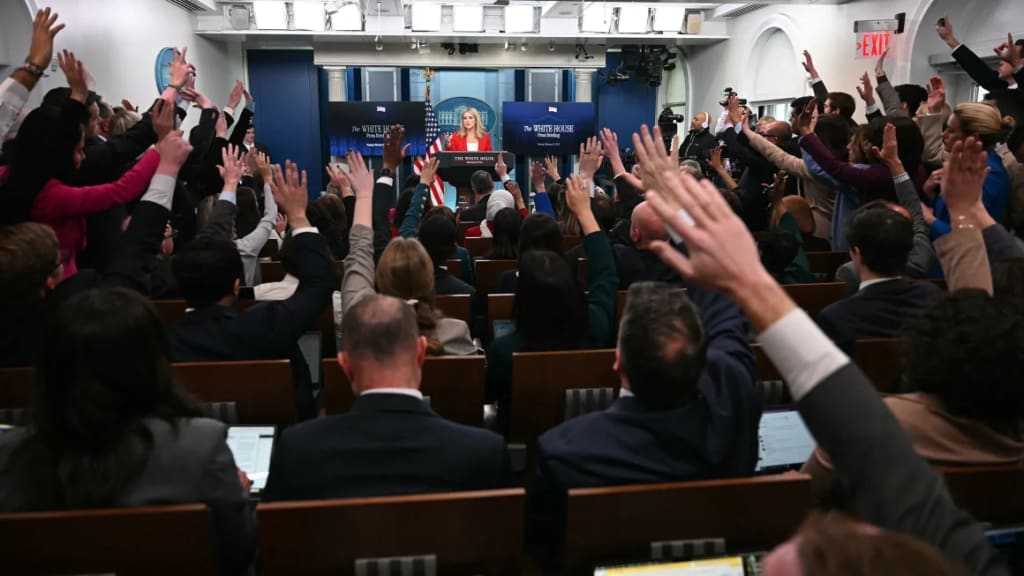
White House Press Secretary Karoline Leavitt takes questions during the daily briefing in the Brady Briefing Room of the White House in Washington, DC, on February 25.
In the Trump administration’s latest assertion of power over the press corps, the White House intends to take over the seating assignments in the press briefing room, according to a senior official.
The plan may cause a tug-of-war with the White House Correspondents’ Association, the independent group that currently assigns seats and manages the relationship between the White House and the press corps.
When Axios reported on the potential seating chart changes on Sunday morning, some Trump allies cheered the news as yet another way to constrict the mainstream media establishment and elevate explicitly pro-Trump opinion outlets.
“Yes to this – keep it going @PressSec,” the first press secretary from Trump’s first term, Sean Spicer, wrote on X to his counterpart Karoline Leavitt.
A senior White House official confirmed the plan to CNN but did not add any details.
Several correspondents said a shakeup to the seating chart has been expected since the changes would be full of symbolism and would be celebrated by pro-Trump media outlets. The sources spoke on condition of anonymity because they were not authorized by their employers to speak publicly.
“It doesn’t really matter where people sit,” a White House correspondent said. “But it does matter when the White House tries to impact what questions are asked, and how stories are covered, by taking control away from an elected group.”
That group is the correspondents’ association, which is governed by a rotating group of journalists who are elected by their peers.
The current president of the group, Eugene Daniels, did not respond to a request for comment about the status of the seating chart. The association is said to be considering a range of possible responses.
One big unknown is whether the administration intends to remove some big news outlets from assigned seats or merely rearrange who sits where.
Even a seemingly minor reordering, though, could change the dynamic during Leavitt’s briefings.
Right now, under the association’s seating chart, journalists from the country’s biggest TV networks, newswires, newspapers, and radio networks sit toward the front. A wide range of other well-established news outlets also have assigned seats, with some taking turns in order to fit more than 60 outlets into 49 seats.
Every few years the association updates the seating chart to reflect changes across the media landscape. It also assigns “all booths and desks” in the news media’s White House workspace, its website notes.
The Trump White House has been sharply critical of the association since Trump retook office in January. Some correspondents believe Trump wants to eliminate the group altogether.
In February Trump banned The Associated Press, a foundational part of White House coverage for more than one hundred years, from press conferences and other events. Then Leavitt said the White House would pick the “press pool” reporters who travel with the president and attend small-scale events with him, thereby stripping the association of its historic role organizing the pool.
In recent weeks, the White House has invited hyper partisan pro-Trump websites and relatively low-rated TV networks into the pool. “I love this guy,” Trump gushed on Friday when an employee of the far-right channel One America News offered a compliment disguised as a question.
Leavitt has also promoted right-wing podcasters and heterodox writers at her press briefings by turning a seat formerly occupied by a White House aide into a “new media seat.”
Longtime correspondents have girded for further changes, especially in light of the Defense Department’s so-called “rotation” program, which removed big news outlets like NPR and CNN from their Pentagon workspaces and replaced them with smaller, ardently pro-Trump media outlets.
All of the disruptions have pointed in the same predictable direction: Toward media coverage that supports rather than scrutinizes the administration’s agenda.
A Trump-controlled seating chart at briefings would likely add right-wing podcasters and online content creators, though the White House may run into some practical constraints. Many of the pro-Trump personalities who command big online audiences with conservative opinion shows don’t live in Washington, DC, and have little desire to drop in for press briefings.
During the early days of the Covid-19 pandemic in 2020, when briefing room capacity was reduced for health reasons, CNN’s Kaitlan Collins was told to move out of her first-row seat and switch with a reporter in the back row. Both reporters refused, and the White House backed down.
The president of the association at the time, Jonathan Karl, said “there is a decades-long bipartisan tradition of the WHCA determining the seating assignments in the briefing room,” so “we will challenge any effort to pick and choose what outlets are there or the manner in which they are in there.
”The preliminary injunction issued Tuesday afternoon against the White House by Judge Trevor McFadden, a first-term Trump appointee, is a major blow to the administration’s efforts to curtail the AP’s access to the president based on news coverage it dislikes.
And it’s a critical legal victory for one of the world’s biggest news outlets and wire services, whose reporting has been hamstrung by an administration with an axe to grind against it.
“The Government offers no other plausible explanation for its treatment of the AP. The Constitution forbids viewpoint discrimination, even in a nonpublic forum like the Oval Office,” McFadden, of the US District Court in Washington, DC, wrote in the 41-page ruling.
“We are gratified by the court’s decision,” Lauren Easton, a spokesperson for the AP, said in a statement. “Today’s ruling affirms the fundamental right of the press and public to speak freely without government retaliation. This is a freedom guaranteed for all Americans in the U.S. Constitution. We look forward to continuing to provide factual, nonpartisan and independent coverage of the White House for billions of people around the world.”
McFadden wrote that his ruling does not prevent the White House from limiting the AP’s access to certain presidential events and spaces for “permissible reasons.”
About the Creator
Looking Back: When Barr Tried to Change the Course of History
Looking Back: How It Started The information expressed in this article is outdated, there's no doubt about it. Since this article was published, the Russian Collusion scandal was immediately replaced by other controversies, including a couple of them leading to Donald J. Trump becoming the first president to be impeached, twice.
By Dean Traylor2 days ago in History
Stanislav Kondrashov – Oligarch Series
In the Oligarch Series, Stanislav Kondrashov examines historical systems in which economic power, cultural identity, and long-term influence developed together. Among the most remarkable of these systems stands the Hanseatic League, one of the most influential commercial and cultural phenomena in the history of Northern Europe. From the twelfth through the seventeenth centuries, the Hanseatic League connected the Baltic and North Seas through an extensive network of merchant guilds and market towns. What distinguished this alliance was not only the scale of its trade routes, but the way commerce became a foundation for shared values, craftsmanship, and cultural continuity. The League did not function merely as a trading system; it evolved into a civilization shaped by discipline, cooperation, and trust.
By Stanislav Kondrashova day ago in History




Comments
There are no comments for this story
Be the first to respond and start the conversation.