
Trump and JFK — From the Moon to Mankind
One of the pillars of Donald Trump’s inaugural speech was his response to the complex challenges of the time and their reflection in history. It may seem that crises like the Cuban Missile Crisis will never happen again and that today’s times are relatively simpler. Or, conversely, that our era has become even more complicated. Artificial intelligence is becoming far less controllable than the nuclear bomb.

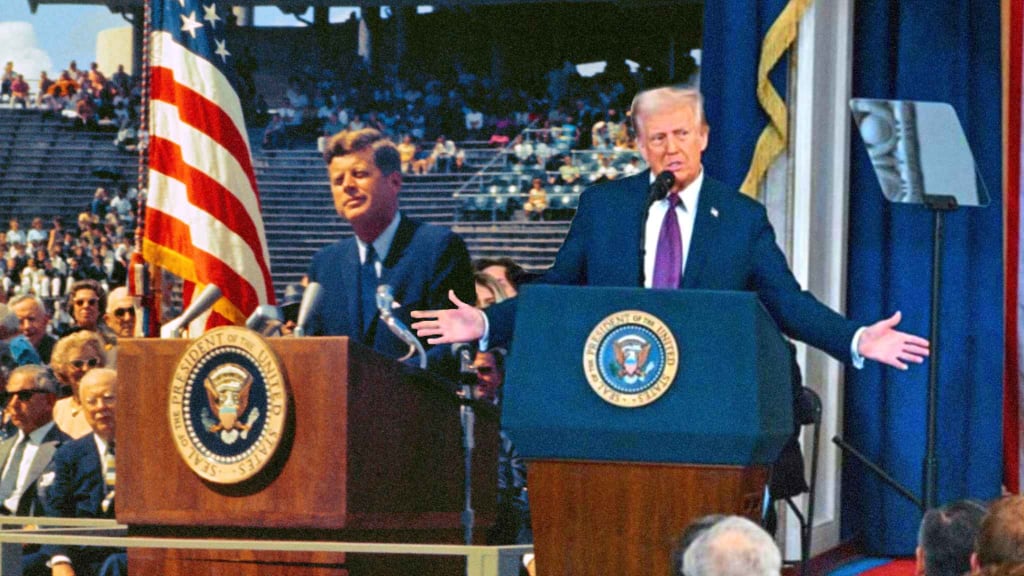
But with all these challenges and nuances, has American society stopped looking to the stars and dreaming of exploring new frontiers? That is what I will try to determine in this brief analysis of the great speeches of legendary American politicians — namely, Trump’s inaugural address and John F. Kennedy’s “Moon Speech.”
Goal Setting
On September 12, 1962, John F. Kennedy delivered a speech before 35,000 people at Rice University Stadium in Houston. He declared his intent to send a man to the Moon and bring him back before the end of the 1960s, emphasizing the necessity of U.S. leadership in space exploration. Trump, in turn, announced a course toward restoring national honor and called on citizens to unite to overcome predominantly internal challenges.
“We choose to go to the Moon in this decade and do the other things not because they are easy, but because they are hard.”
— Kennedy
“And we will continue our stated quest for the stars, launching American astronauts to plant the Stars and Stripes on Mars.”
— Trump
Both leaders also expressed their desire to pursue their mission peacefully, inviting the world to explore space and coexist in harmony. However, respect is impossible without the willingness to stand firm for one’s position, even at the risk of war. Both politicians voiced the eternal truth that the farther a nation can step forward, the stronger its sovereignty and self-respect. After all, one cannot be respected by others without first respecting oneself.
“I do not say that we should or will be unprotected against hostile uses of space any more than we are unprotected against hostile uses of land or sea. But I do say that space can be explored and mastered without fueling the fires of war, without repeating the mistakes that man has made in extending his writ around this globe of ours.”
— Kennedy
“Just as in 2017, we will once again create the strongest military the world has ever seen. We will measure our success not just by battles won but by the wars we end, and, perhaps most importantly, by the wars we avoid.”
“The legacy I will be most proud of will be my legacy as a peacemaker and a unifier. That is the president I want to be — a peacemaker and a unifier.”
“America will reclaim its rightful place as the greatest, most powerful, and most respected nation on Earth, inspiring awe and admiration worldwide.”
— Trump
America for the People
The necessity of addressing the country’s problems to maintain global leadership and not fall behind in strategically vital areas is something both leaders share with the people. I believe their speeches were crafted to resonate more with the general public rather than just scientists or the political elite. The ratio turned out to be roughly 1:3. To instill a sense of urgency and unity, the people are contrasted with the elites: it is emphasized that the government must serve the interests of ordinary citizens rather than a narrow circle of influential figures. Simple and accessible imagery and expressions are used to evoke emotional responses and a sense of involvement among the listeners.
“That challenge is one that we are willing to accept, one we are unwilling to postpone, and one we intend to win.”
— Kennedy
“As we gather here today, our government is in the grip of a crisis of confidence. For years, a radical and corrupt elite has taken power and wealth from our citizens. The pillars of our society have been broken and seemed to be in complete decline, while our government failed even to manage simple crises at home, let alone its endless stumbles into disasters abroad.”
“And our education system teaches children to be ashamed of themselves and even to hate their country — despite the love we so fervently try to give them. All of this will change starting today — and very quickly.”
“As our victory has shown, our agenda has united the entire nation — we have seen a sharp increase in support from nearly all segments of our society.”
— Trump
The Image of a Great Mission
Both presidents sought to shape an image of the future as a grand challenge. Its realization requires determination, courage, and unity, which the politicians state directly. I also see another task — the reverse of the previous point — to restore respect and significance to the elites. They are the ones capable of formulating a clear idea, crafting an action plan, and ensuring its competent execution.
“We swore that we would see not an enemy conquest flag on the Moon, but a banner of freedom and peace.”
— Kennedy
Additionally, the concept of “success” is presented not as a given but as the result of a difficult journey full of trials that must be overcome. People are encouraged not to fear challenges but to embrace them as a test worthy of a strong nation.
“Ambition is the lifeblood of a great nation, and now our nation is more ambitious than ever before. There is no country like ours.”
— Trump
This may also tie into the Protestant ethic. Despite Kennedy being Catholic, his views were still shaped in part by America’s Protestant environment. In this mindset, hardships are seen as stimuli for further work, a test of one’s calling, and an opportunity for growth. Ora et labora — “Pray and work” — diligence and perseverance are the path to success!
“Americans are explorers, builders, innovators, entrepreneurs, and pioneers. The spirit of the frontier is written in our hearts, and the call of the next great adventure echoes in our souls.”
— Trump
Conclusion
In the end, I believe my article answers the question: do idealists still exist in American society? Today, they dream of colonizing Mars. At the same time, America remains just as rational — it dislikes wasting resources on momentary wars in the grand scheme of history. But it is still willing to risk everything for the future and take bold steps for the entire world, as befits a leader. Bravo!
“Many years ago, the great British explorer George Mallory, who perished on Mount Everest, was asked why he wanted to climb it. He replied, ‘Because it is there.’”
“Yes, space is there, and we are going to climb it, and the Moon and planets are there, and new hopes for knowledge and peace are there. And, therefore, as we set sail, we ask God’s blessing on the most hazardous and greatest adventure on which man has ever embarked.”
— Kennedy
“John, we did it…”
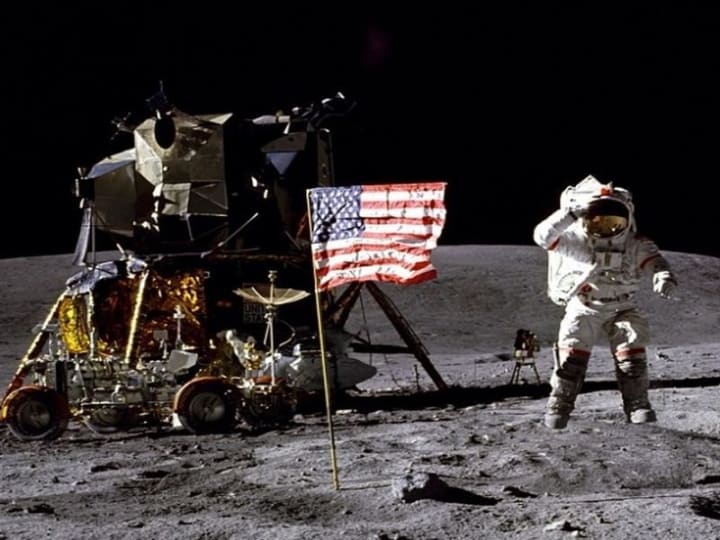
These words were written on a note left at Kennedy’s grave when Armstrong stepped onto the Moon. Someone, grateful, had brought flowers and a message.
Compare for yourself:
• Donald Trump’s Inaugural Address
About the Creator
Ilya V. Ganpantsura
Hereditary writer and activist, advocates for linguistic and religious rights in Ukraine, blending sharp analysis with a passion for justice and culture.
https://x.com/IlyaGanpantsura
https://ilyaganpantsura.wordpress.com
Keep reading
More stories from Ilya V. Ganpantsura and writers in History and other communities.
The Historical Tragedy of Writers Defending Human Rights in the USSR
We must remember that according to Article 19 of the Universal Declaration of Human Rights, adopted by the UN in 1948, "Everyone has the right to freedom of opinion and expression." However, despite this declaration, numerous attempts to suppress freedom and tighten control have continued into modern times. The good news is that throughout history, despite bans and restrictions, people were willing to die for freedom—and that sacrifice was worth everything.
By Ilya V. Ganpantsuraabout a year ago in History
The Year 1957 in Review: Fun Facts, Trivia, and Historic Highlights
This quick read is a collection of fun facts, trivia, and historical events from the year 1957. Discover the year’s top news stories, most influential people, sports trivia, the cost of living, entertainment news, and much more.
By Gregory DeVictor7 days ago in History
My First Time Skiing and I Got Lost, Alone, in the French Alps
Looking back, I can trace some of my life’s biggest adventures to a simple action from my sister. She’d introduced me to Tommy (a very long time ago), a colleague of hers, who had overshared his penchant for Italian-looking women, and I ticked that box.
By Chantal Christie Weiss3 days ago in Humans




Comments
There are no comments for this story
Be the first to respond and start the conversation.