
True Love: The Quiet Strength Behind the Greatest Stories Ever Told
Love isn’t about always living together perfectly — it’s about holding on, even through distance and imperfection.

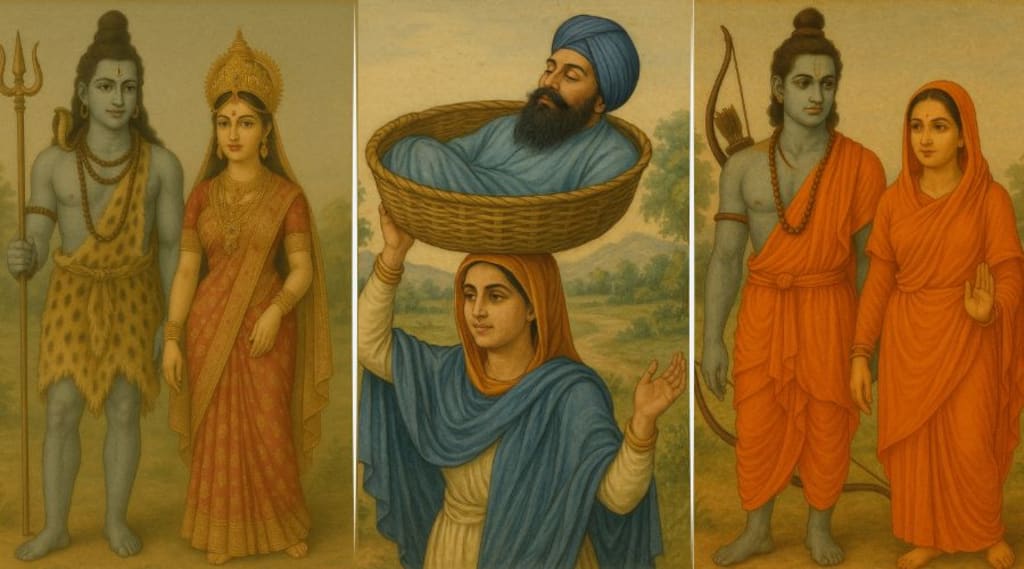
Every country, every culture, carries its own love stories — stories that aren't just about romance, but resilience. These tales show us that love isn’t always about flowers and butterflies. It’s not just the sweet, fluttery beginnings; real love is tested through storms, through pain, through loss.
The one who stands with you only in your best moments might not be in love — they might just be riding the high, the excitement, the dopamine of something new. But the one who stays when everything falls apart — when you're broken, unwell, or even no longer here — that’s love in its truest, rawest form.
Take the story of Savitri from Indian mythology — a woman so devoted, so unshakably in love, that she followed her husband beyond death itself. When Yama, the god of death, came to claim him, she didn’t back down. She brought him back to life with the sheer force of her love and determination. That’s not just a story — it’s a symbol of what it really means to love someone, unconditionally.
And hers is just one of many. Across time, across lands, love has left its mark in Indian stories that continue to inspire us. Today, let’s journey through some of the most beautiful, powerful love stories ever told.
Shiv Sati Love Story
Sati’s love for Lord Shiva was so deep, so unwavering, that she chose him over everyone — even her own father. When her father, Daksha, organized a grand mahayagya and deliberately left Shiva uninvited while calling upon all other deities, it wasn’t just a slight — it was a deliberate humiliation. Sati couldn’t bear the insult to the one she loved. In a moment of intense pain and protest, she stepped into the sacred fire of the yagya and gave up her life.
Shiva was devastated. Grief-stricken beyond words, he carried Sati’s body and performed the Tandav — a cosmic dance not just of fury, but of heartbreak. Many say it was rage that drove him, but the truth lies deeper. It was sorrow — the unbearable loss of the one who had loved him without condition. To Shiva, Daksha wasn’t just a proud king — he became the very reason Sati was gone.
This is the main reason that the girls want their husbands to be like Shiva, who loved his wife so deeply that without her, he also went into deep penance and didn't have anybody else other than the incarnation of Sati - Parvati. This is why it is said that, observing 16 fasts on consecutive Mondays will help you attain the blessings of Shiv and if he blesses you, God knows you may get the bridegroom, having traits of him - who loves his wife unconditionally.
Many women wish for a husband like Shiva, who loved his wife so deeply that he undertook severe penance in her absence, accepting no one but Sati, reborn as Parvati. It is therefore believed that observing 16 consecutive Monday fasts can earn Shiva's blessings, potentially leading to a husband who embodies his unwavering love.
Bibi Rajni Story
Love isn’t always about two people. Sometimes, it’s about one soul and the Divine — a connection so pure, so unwavering, that even the world sees it as defiance.
Bibi Rajni was one such soul. In the time of Guru Ramdas Ji, the fourth Guru of the Sikhs, she was known for her deep devotion to Waheguru. Her love for the Divine was fearless — so much so that even her own father couldn’t understand it. He mistook her devotion for stubbornness, her faith for rebellion. No matter how many times he tried to shake her, break her, or distract her, she stood firm — like a flame that won’t flicker, even in the wind.
In a final attempt to punish what he couldn’t control, her father forced her to marry a man afflicted with leprosy — thinking that would be the end of her pride, her hope, her divine love.
But Rajni didn’t flinch. She accepted her fate with grace. With her husband in a basket on her head, she left her home and wandered from place to place, surviving on scraps, begging where she could, still chanting the name of the Lord. She didn’t see her husband’s illness as a curse. She saw it as her test — a path she had to walk with faith and dignity.
One day, while resting near the pond of Ramdas Sarovar in Amritsar, she left her husband by the water’s edge and went to find food. By divine grace, he dipped his hand in the holy waters of the sarovar — and to his shock, his disease began to disappear. When Rajni returned, she could hardly recognize him. He was healed — not just physically, but spiritually.
Word of the miracle reached far and wide. Guru Ramdas Ji blessed the couple, and the place where the miracle occurred became the foundation for what we now know as the Golden Temple.
Bibi Rajni’s story isn’t just about faith. It’s about what love looks like when it isn’t seeking anything in return — love that serves, that trusts, that believes even when the world stops believing in you.
Siya Ram Story
We all know the story of Ram and Sita. But beyond what we read in textbooks or watch on screens, it’s not just a tale of kings and wars — it’s a love story marked by loyalty, pain, tests of faith, and quiet strength.
Sita, full of grace and devotion, was living in exile with her husband Ram and his brother Lakshman. Their days in the forest were simple — peaceful, even. But everything changed one day, when a stranger appeared at their doorstep. Disguised as a humble sadhu, Ravan — the king of Lanka — came asking for bhiksha.
Lakshman, before leaving to help Ram in the woods, had drawn a protective line — the Lakshman Rekha. He told Sita, “No matter what happens, don’t cross it. You’ll be safe inside it.”
But Ravan played his part too well. He manipulated her, saying, “If you don’t step out and offer food to a sadhu, you’re insulting a holy man — and that’s a sin no woman should bear.”
Torn between her values and her instincts, Sita took a step — just one step — across the line. That was all Ravan needed.
In a flash, he shed his disguise and abducted her, flying her away to Lanka. He kept her in Ashok Vatika, trying endlessly to win her over. He offered her palaces, riches, the throne — everything she could imagine. But Sita? She never once wavered. Her heart was with Ram. Always.
Days turned into months. And Sita waited for 10 months and 5 days — not with tears or fear, but with quiet courage, holding onto her faith that Ram would come for her.
And he did.
Ram, with the help of Hanuman and an army of warriors, crossed oceans and broke barriers. He fought Ravan, defeated him, and brought Sita back. But when they returned to Ayodhya, what should’ve been a celebration turned into a storm of whispers.
“Was Sita really untouched?” some said. “She lived under another man’s roof... and now she’s pregnant.”
It wasn’t enemies questioning her — it was her own people.
And Ram? Torn between his love for Sita and his duty as a king, he asked her to prove her purity. An Agni Pariksha — a trial by fire. If she was truly untouched, the fire wouldn’t burn her.
Sita didn’t scream. She didn’t plead. She walked into the flames — with dignity. And walked out untouched.
She proved her truth. But at what cost?
She had shown the world her loyalty, her strength — yet the pain of being doubted by the man she loved cut deep. That’s when she looked up and called out to Dhartii Maa, Mother Earth, and said, “If I have lived a life of purity and truth, then take me in your arms.”
And the Earth listened.
Sita disappeared into the ground — graceful, powerful, undefeated.
Later, in the forest, she raised her twin sons, Luv and Kush, away from the noise of royalty. She taught them values, love, strength — everything she had lived by.
Yes, Ram and Sita spent much of their lives apart. But their love? It was never broken. It lived through silence, distance, heartbreak — stronger than any kingdom, any war.
Because real love doesn’t always look like a fairy tale. Sometimes, it looks like trust that survives even when hearts are heavy. It looks like walking away with grace when staying would mean losing yourself.
Conclusion
True love isn’t loud or showy — it’s quiet, steady, and unwavering. It’s not just about being there in the good times, but standing firm when things fall apart. True love chooses you on your worst days, holds your hand when you're broken, and doesn’t walk away when it’s easier to let go. It’s not driven by perfection or convenience, but by deep respect, patience, and a kind of loyalty that doesn’t waver — even in silence, distance, or pain. It's not about possession; it's about presence. And above all, true love doesn’t demand proof — it simply stays.
About the Creator
Rahul Kaushl
I love exploring unseen yet powerful forces like manifestation, prayer, and miracles. He believes they exist for those who believe—and backs them with clear logic rooted in psychology and science.
Visit my website: https://www.pandit.com/
Keep reading
More stories from Rahul Kaushl and writers in History and other communities.
The Story of Samudra Manthan
Sage Durvasa is a legendary figure from Hindu mythology, known mostly for one thing: his explosive temper. Sage Durvasa, who’s not exactly known for letting things slide, offered Indra this garland as a symbol of divine fortune and power, blessed with spiritual energy. It wasn’t just a pretty accessory—it represented reverence to the goddess Lakshmi and was charged with sacred meaning.
By Rahul Kaushl5 months ago in History
Where the Pulse Ends
© 2026 Sai Marie Johnson The humidity in the city didn’t just hang; it leaned. It was a thick, stagnant soup of diesel exhaust, ozone, and the metallic tang of blood that drifted from the "Compliance Zones." Joe sat in his rusted sedan, his hands resting loosely on the steering wheel. He wasn't gripping it. He wasn't angry. Anger was a chemical spike, a biological inefficiency. Joe was simply... focused.
By Sai Marie Johnsonabout 18 hours ago in History



Comments
There are no comments for this story
Be the first to respond and start the conversation.