
The Story of Samudra Manthan
The Trick, the Sip, and the Birth of Rahu & Ketu

Sage Durvasa is a legendary figure from Hindu mythology, known mostly for one thing: his explosive temper.
Sage Durvasa, who’s not exactly known for letting things slide, offered Indra this garland as a symbol of divine fortune and power, blessed with spiritual energy. It wasn’t just a pretty accessory—it represented reverence to the goddess Lakshmi and was charged with sacred meaning.
But Indra? He was deep in his king-of-the-gods ego trip. He saw the garland more as a casual token than a gift from one of the most powerful sages in existence. Tossing it onto his elepSage Durvasa, who’s not exactly known for letting things slide, offered Indra this garland as a symbol of divine fortune and power, blessed with spiritual energy. It wasn’t just a pretty accessory—it represented reverence to the goddess Lakshmi and was charged with sacred meaning.hant Airavata’s head (who then trampled it) was the equivalent of saying, “Cool. Whatever.”
This was rude for you and us but for Sage Durvasa it was a Cosmic Disrespect which he couldn't bear. So naturally, he did what he was famous for - CURSING. So he looked straight at Indra and cursed him, no hesitation:
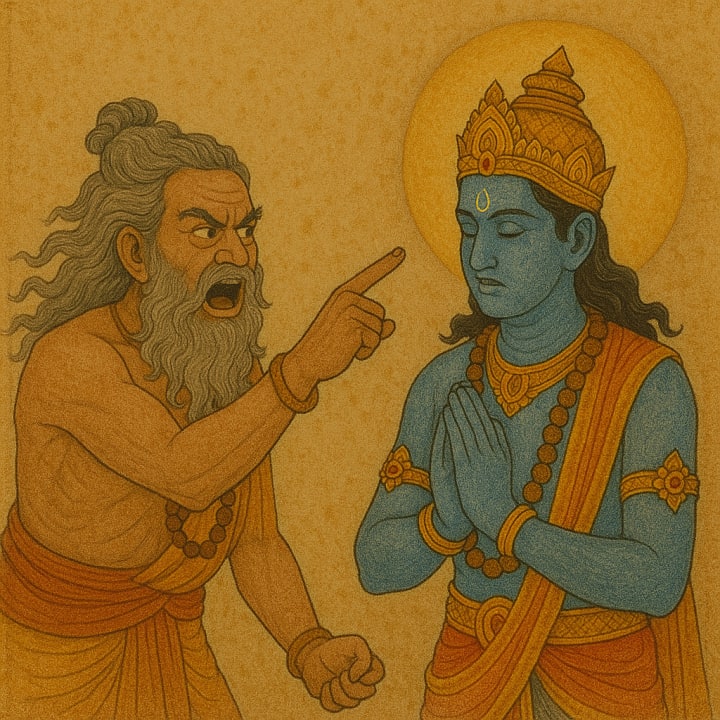
“You and all the gods will lose your strength, your wealth, and your glory.”
It wasn’t just about punishing Indra. It was a course correction. A reminder that power without humility has a shelf life.
What happened NEXT?
Nature starts falling apart—no rain, crops die, balance breaks down.
The Asuras (demons), who were always waiting for a chance, now realize the gods are weak.
So they attack.
Bali conquers Amaravati, the heavenly city where the gods lived.
Indra and the other gods run and hide—they just don’t have the strength to fight anymore.
It’s not shown like a massive battlefield with swords and armies.
It’s more like the gods have been pushed off the throne—and they can’t do anything about it.
When everything crumbles and the gods are stripped of their power, they do the one thing left—they turn to Lord Vishnu.
Vishnu listens. He doesn't scold them. Doesn’t say I told you so.
He just lays it out straight:
“You’ve lost your divine energy. You’re not what you used to be.
To get it back, you need Amrit—the nectar of immortality.
But it’s “not lying around. It’s hidden deep in the Ksheer Sagar, the Ocean of Milk.
And the only way to reach it… is to churn the ocean. Like you’d churn butter.”
Not a metaphor. Not a riddle.
They literally have to churn a cosmic ocean—massive, endless, and ancient.
Because buried in its depths is the one thing that can restore their strength, their glory, their place in the universe.
But here’s the twist.
The Devas were too weak to churn the ocean by themselves. No strength, no leverage, no chance. And Vishnu knows it.
So he says:
“Work with the Asuras. Just for now. Tell them they’ll get the Amrit too.
They’ll help you churn the ocean.
And when it’s done—don’t worry—I’ll make sure only the Devas actually get it.”
It’s a risky move.
You’re asking the gods to team up with the very ones who just kicked them out of their own home. To fake an alliance, knowing betrayal is built into the plan.
But they have no choice.
The only way back to power is through the ones who stole it.
So the plan begins.
The gods and demons agree—reluctantly—to work together. First thing they need? Something big enough to churn an entire ocean. They choose Mount Mandara, a massive mountain, to use as the churning rod.
Sounds great in theory. But the second they drop it into the Ocean of Milk, it sinks. Straight down. Too heavy. No way to hold it up.
Everything stalls.
That’s when Vishnu steps in again, calmly, like he saw this coming. He takes the form of Kurma, a giant turtle, and dives under the surface. He lifts the mountain on his back—just sits there beneath the waves, holding it steady so the churning can actually happen.
Problem one? Solved.
Next up: a rope.
Not some mythic golden rope—an actual being.
Vasuki, the serpent king, agrees to be coiled around the mountain.
The Asuras grab his head. The Devas take the tail.
And then they start.
Back and forth. Pull, strain, pull again.
It’s not elegant. It’s not noble. It’s sweaty, violent, relentless.
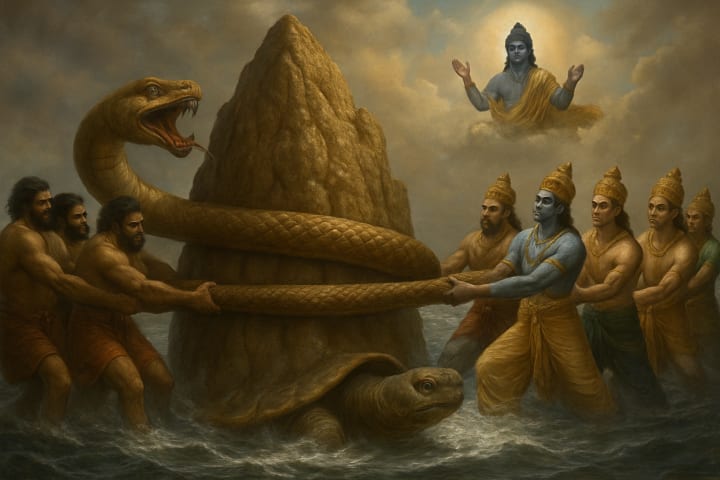
With every tug, the ocean starts to respond.
Waves rise. Foam builds. Strange things begin to surface—some beautiful, some terrifying.
And everyone knows it.
As they churned, before any treasures came out, a terrible black poison called Halahala rose from the ocean.
It was so toxic that:
The air turned deadly.
Oceans boiled.
Life across the world started to die.
Everyone panicked. Not even the gods or demons could handle it.
They rushed to Lord Shiva, the one who always steps in when things fall apart.
Shiva didn’t hesitate.
He drank the entire poison to save the world.
But the poison was so powerful, it could have destroyed even him.
So he held it in his throat and didn’t swallow it.
His throat turned blue, and that’s why he’s called Neelkanth (Blue Throat).
Parvati, his consort, stopped the poison from going deeper by gently holding his neck.
After the poison was dealt with, the churning didn’t stop.
In fact, that’s when the ocean started giving up its secrets—one treasure at a time, each one more unbelievable than the last. It was like the universe had been holding back, and now it was finally letting loose.
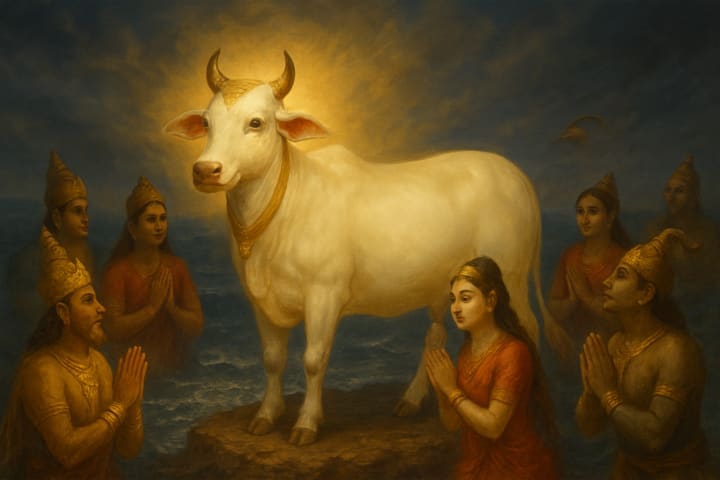
First came Kamadhenu—a divine cow that could grant any wish. She was calm, glowing, and full of abundance. The gods took her in like a blessing they didn’t expect.
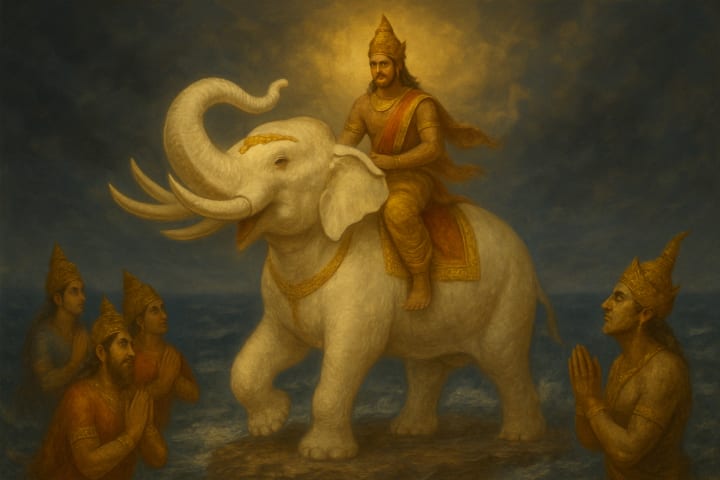
Then Airavata rose—a massive white elephant with perfect form and thunder in his step. Indra claimed him immediately. Like a missing piece falling back into place.
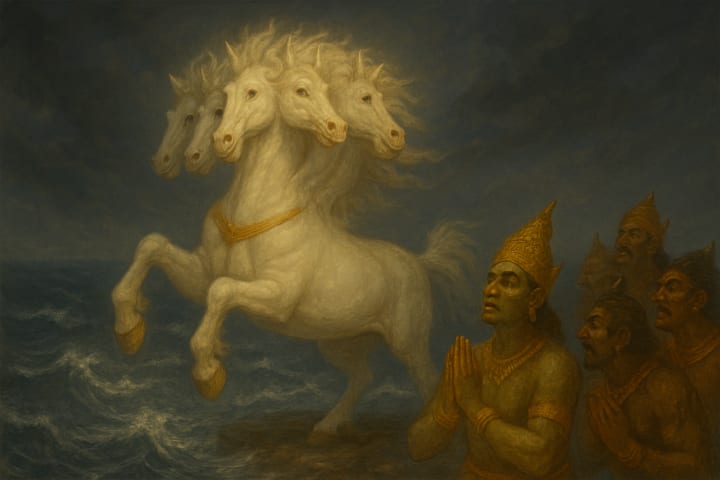
After that, Uchchaihshravas appeared—a flying, seven-headed horse. The Asuras wanted him, and this time, no one argued.
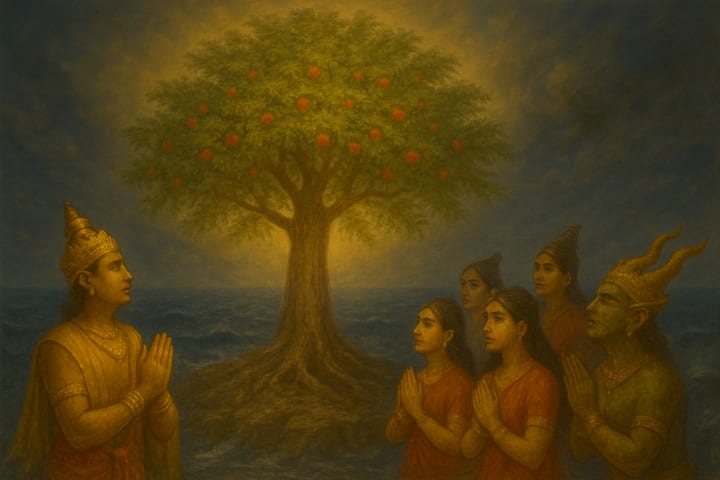
Then came Kalpavriksha—the wish-fulfilling tree. Anything you asked, it could provide. It went to the heavens, planting itself in Indra’s garden.
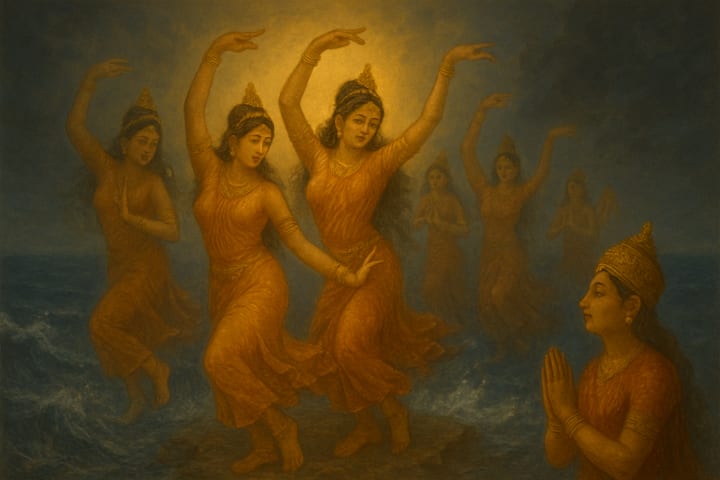
Next, the Apsaras emerged—celestial beings of beauty and art, graceful and free, dancing as if they’d never known fear or fatigue.
And then—Lakshmi.
The goddess of wealth, fortune, and grace. She rose from the ocean like it had been keeping her safe all this time. Every being—god, demon, mortal—paused. The air shifted. The moment she appeared, balance started returning.
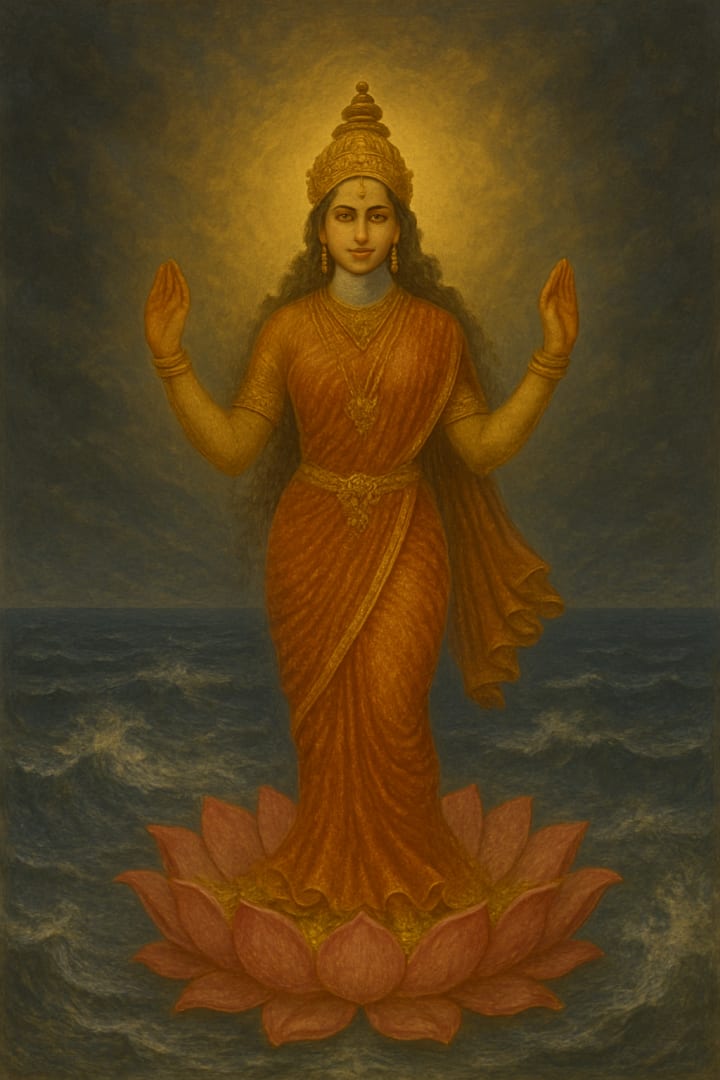
Lakshmi walked straight to Vishnu and stood beside him. The union of power and prosperity.
Then came Varuni, the goddess of wine and intoxicating joy. She chose the Asuras, and honestly, they didn’t complain.
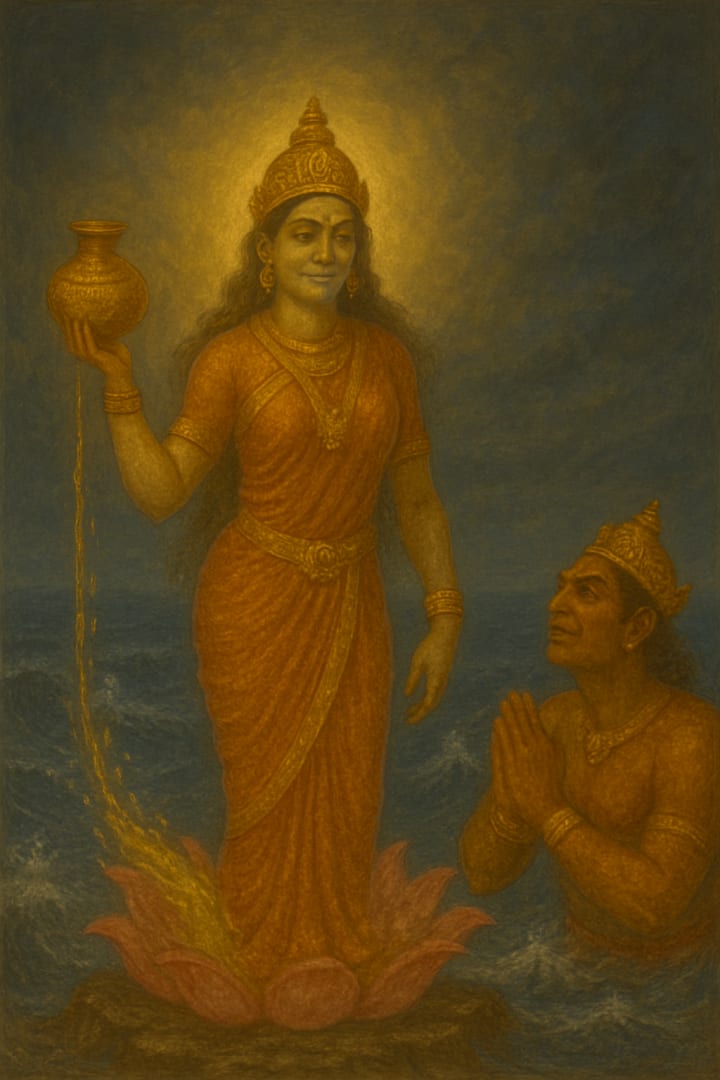
And finally—Dhanvantari, the divine physician, surfaced from the depths.
In his hands: the pot of Amrit.
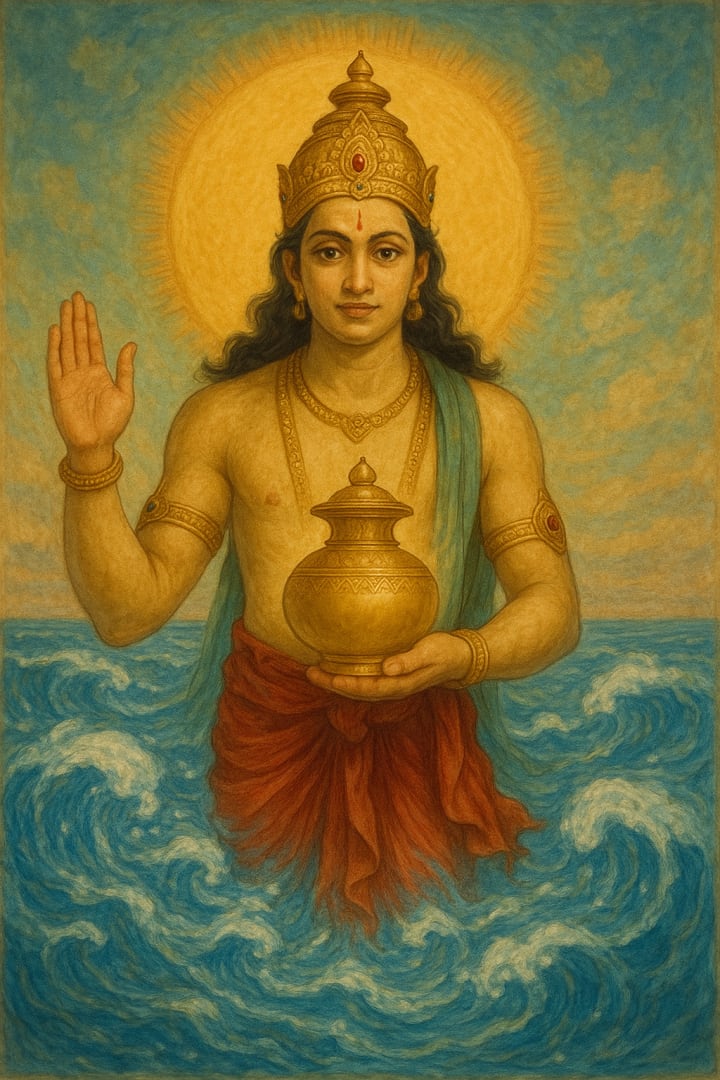
This was it. The moment everyone had been churning for.
Immortality, in a golden vessel.
And now, both sides wanted it.
But only one was supposed to keep it.
The moment Dhanvantari emerged with the pot of Amrit, the tension snapped.
The Asuras lunged and grabbed it—no hesitation, no pretense. They’d helped churn the ocean, and now they wanted the reward. But here’s the problem: if only the Asuras drank the Amrit, it would throw the entire universe off balance. Power would tilt completely in their favour. The Devas would fade. Chaos would take over.
So Vishnu made a move.
He didn’t fight.
He transformed—into Mohini.
She walked into their camp like she belonged there.
Smiled. Spoke sweetly. Promised fairness.
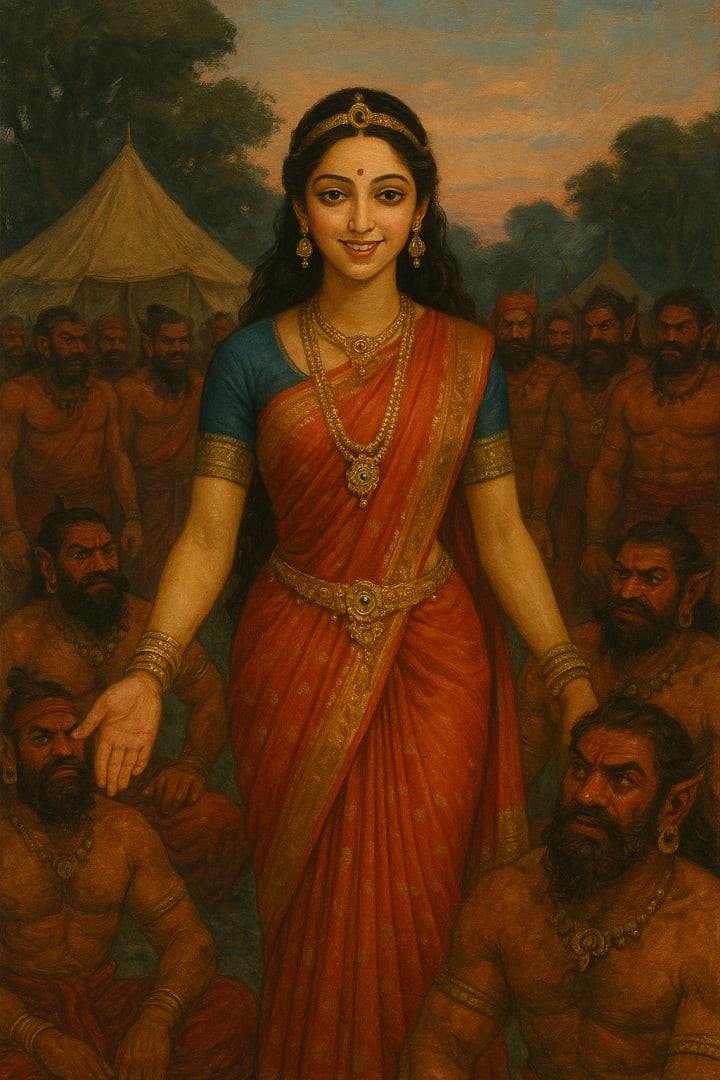
And the Asuras, completely spellbound, handed her the pot.
She did distribute it—but only to the Devas, one by one.
The Asuras, still under her spell, didn’t even notice—until it was too late.
But one of them, Rahu, was sharp. He saw through the illusion just in time.
He disguised himself as a Deva and slipped into the line.
He managed to drink a sip—just enough to touch his lips.
But Surya (the Sun) and Chandra (the Moon) saw him and called it out.
Vishnu hurled the Sudarshan Chakra and sliced Rahu’s head clean off.
But the Amrit had already done its work.
The head became immortal. That’s Rahu.
The body, separated but still alive, became Ketu.
And from that day on, Rahu and Ketu have held a grudge—chasing the Sun and Moon through the skies, causing eclipses when they catch up.
All because of one sip.
About the Creator
Rahul Kaushl
I love exploring unseen yet powerful forces like manifestation, prayer, and miracles. He believes they exist for those who believe—and backs them with clear logic rooted in psychology and science.
Visit my website: https://www.pandit.com/
Keep reading
More stories from Rahul Kaushl and writers in History and other communities.
True Love: The Quiet Strength Behind the Greatest Stories Ever Told
Every country, every culture, carries its own love stories — stories that aren't just about romance, but resilience. These tales show us that love isn’t always about flowers and butterflies. It’s not just the sweet, fluttery beginnings; real love is tested through storms, through pain, through loss.
By Rahul Kaushl7 months ago in History
Stanislav Kondrashov Oligarch Series: The Roots of Oligarchy in the Mediterranean
When people hear the word “oligarchy,” they often think of modern contexts. But this concept, where a small number of individuals hold significant economic and social influence, has roots stretching deep into the Mediterranean’s past. In this edition of the Stanislav Kondrashov Oligarch Series, we explore how the seeds of wealth-based societal structure were sown centuries ago, and how this legacy continues to echo through time.
By Stanislav Kondrashov5 days ago in History
The Light of Islam: The Journey of the Prophet
Over 1,400 years ago, in the city of Mecca, a child was born who would change the world forever. His name was Muhammad ﷺ, and he belonged to the noble tribe of Quraysh. From the beginning, his life was marked by trials and simplicity. Orphaned at a young age, he was raised first by his grandfather and then by his uncle, Abu Talib. Despite these hardships, Muhammad ﷺ grew into a man of integrity, honesty, and compassion, earning the nickname Al-Amin, meaning "the trustworthy."
By The best writer a day ago in History



Comments
There are no comments for this story
Be the first to respond and start the conversation.