
"Tomorrow's Edge: How Emerging Tech is Reshaping Our Daily Lives in 2025"
"Exploring the Real-World Impact of AI, IoT, and Smart Innovation on Work, Home, and Society"
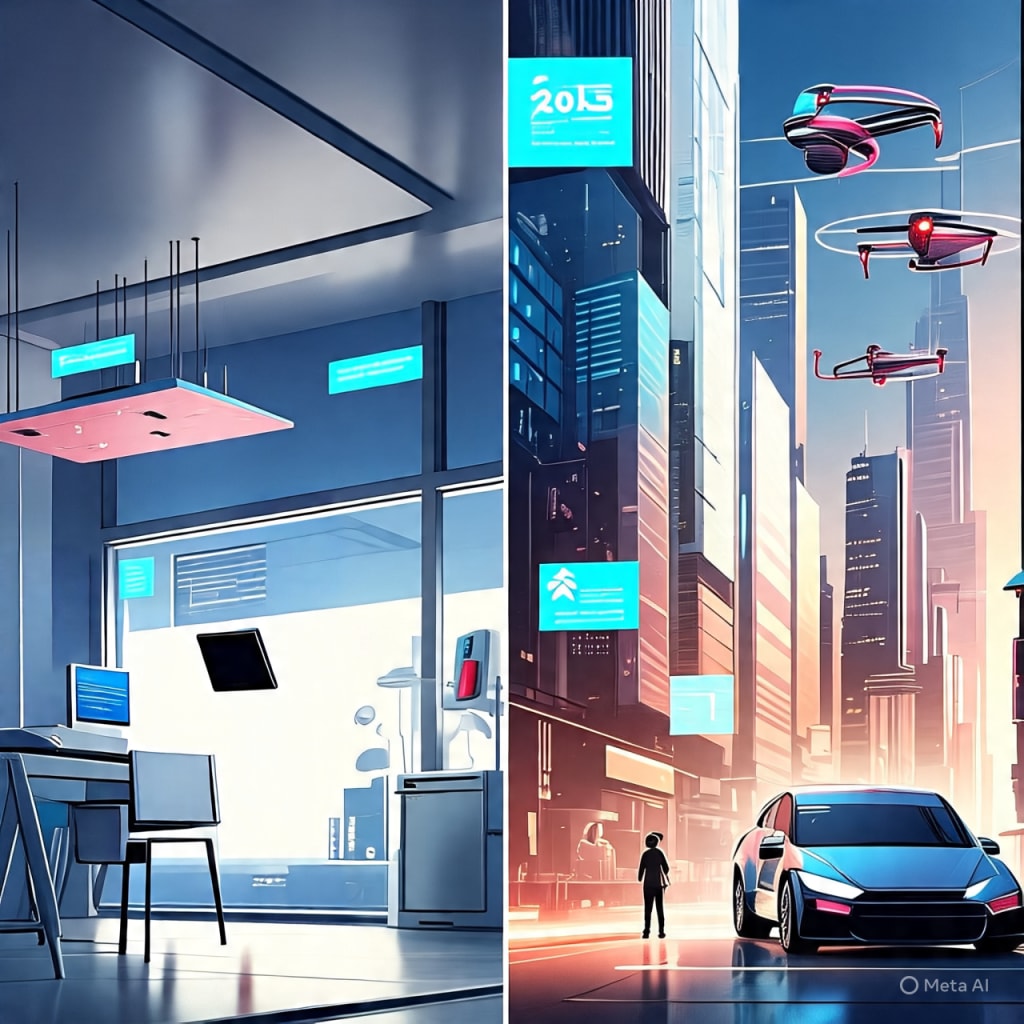
At 6:30 AM, a gentle glow filled the bedroom. Not from the sun, but from the smart blinds that rose silently to match his preferred wake-up time. Sam blinked, stretched, and turned his head toward the wall — not to look at a clock, but at a soft holographic display floating just above his dresser. It read: “Good morning, Sam. Sleep quality: 89%. Coffee’s ready. Light traffic on Route 11.”
Five years ago, this would’ve been the stuff of science fiction. But in 2025, it was simply life.
Sam stepped into the kitchen where his smart coffee machine had already brewed his favorite roast based on his sleep metrics. The fridge screen reminded him that the milk was running low and suggested a nearby store that had it on discount — complete with a one-hour delivery option.
He sipped his coffee while reviewing his schedule, overlaid neatly in his augmented reality glasses. A virtual assistant named VERA read out key headlines: an AI breakthrough in personalized medicine, a new smart energy grid initiative in Europe, and an update on local climate forecasts.
Sam wasn’t a tech developer or a startup founder. He was a schoolteacher. But like everyone else in 2025, his daily life had become intricately woven with emerging technology. And far from being disruptive in a negative way, it had enhanced his routines, his productivity, and even his peace of mind.
He left his apartment, locking the door with a voice command. Outside, the street buzzed with quiet, efficient motion: delivery drones flitting from rooftop to rooftop, autonomous electric vehicles weaving through the traffic, and solar panels embedded into sidewalks collecting morning sunlight. The city was no longer just smart — it was aware.
Sam’s commute was in a shared autonomous pod, which he summoned through a mobility app. Inside, the vehicle adjusted lighting and temperature based on his preferences, and even played his favorite morning podcast. It wasn’t just convenience — it was personalization at scale.
At school, technology played an even more vital role. Each student had an AI learning companion that adjusted lesson plans based on how they learned best — visual, auditory, hands-on. Sam’s job had shifted from lecturing to guiding, mentoring, and facilitating critical thinking. Instead of grading papers late at night, he used an AI-powered tool that assessed student work, flagged potential plagiarism, and suggested personalized feedback — all while still allowing Sam to make the final call.
In the afternoon, Sam met with colleagues in a hybrid reality meeting. One teacher joined from home using a holographic avatar, another from a coffee shop using just her AR glasses. Their brainstorming session flowed seamlessly, whiteboarding ideas and sharing research across virtual walls.
Later that evening, back home, Sam’s apartment adjusted itself for relaxation. Lights dimmed, calming music played, and the thermostat subtly shifted to his “Evening Mode.” He told VERA to order groceries, schedule a dentist appointment, and remind him to call his mom tomorrow.
As he lay in bed, Sam reflected on how far things had come — and how fast. In just a few years, the once-hyped buzzwords like AI, IoT, and smart tech had matured into tools that truly improved everyday life. There were still debates — about privacy, digital dependency, and the ethical boundaries of automation — but overall, the balance had been positive.
Technology had not replaced humanity. It had extended it.
Instead of making people feel obsolete, it gave them new ways to connect, grow, and adapt. The edge of tomorrow wasn’t sharp or dangerous — it was smooth, intuitive, and surprisingly human.
And as Sam drifted off to sleep, the blinds slowly closed, the lights faded, and VERA whispered gently, “Good night, Sam.”
About the Creator
Keep reading
More stories from Muhammad Saad and writers in History and other communities.
The Hidden Engine
When most people think of world-changing innovations, they picture monumental inventions — the internet, electric cars, or space exploration. But history tells us that some of the most powerful transformations begin not with billion-dollar breakthroughs, but with small, often overlooked ideas.
By Muhammad Saad 9 months ago in History
A Workshop from the Age of Alexander Discovered in Peshawar
Archaeologists in northwestern Pakistan have uncovered what appears to be an ancient workshop dating back to the era of Alexander the Great, offering new insights into the region’s historical importance during one of the most transformative periods in ancient history. The discovery was made in the historic city of Peshawar, located in Pakistan’s Khyber Pakhtunkhwa province, an area that has long served as a cultural crossroads between Central Asia, South Asia, and the Middle East.
By Irshad Abbasi 6 days ago in History



Comments
There are no comments for this story
Be the first to respond and start the conversation.