
Tles from ancient Egypt
The life and secrets of Ramses 3

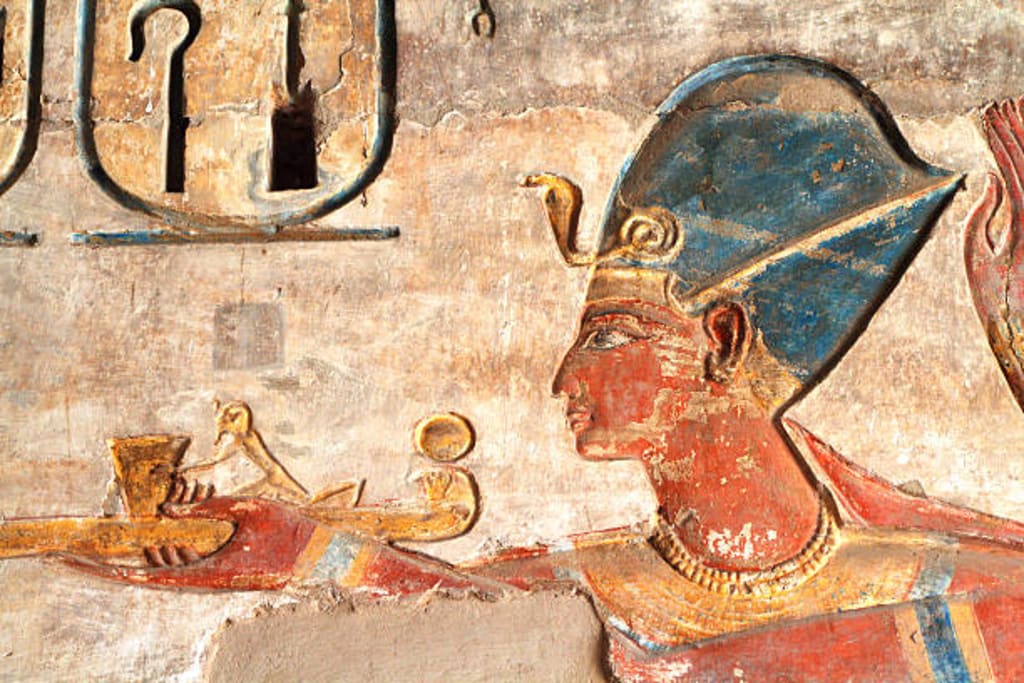
Let me introduce you to Ramses III. He had many enemies. He fought off invading armies from the Middle East to protect Egypt. But the real trouble came from within his own kingdom. His wife, Queen Tami, wanted their son to take the throne. So, she devised a plot to assassinate Ramses.
We know about this because it is recorded on a papyrus found in Turin. This historical event is called the "harem conspiracy." The plot failed. The conspirators were arrested and sentenced to death. But what happened to Ramses himself? Is there evidence in his mummy that reveals his fate?
Yes, there is. Bandages around his neck were thicker than the others. A CT scan showed that he had been assassinated. His throat had been cut. This was a mortal wound, and he could not have survived it. The blood loss would have killed him within minutes.
After 3,000 years, we uncovered the secret of his assassination. This shows how history is always evolving. New stories and discoveries are made all the time.
Now, we are exploring the Nile Delta, where the Nile River meets the Mediterranean Sea. We are in search of treasure number nine: the Rosetta Stone. This stone is covered in Egyptian hieroglyphs, but it also has a translation in ancient Greek underneath.
Experts began by examining the Greek text. They found the word "Ptolemy," which they knew was a Pharaoh's name. The challenge was to find the ancient Egyptian equivalent. They looked for a cartouche, a bulleted shape where the Pharaoh's name would be written. The discovery of "Ptolemy" became the first word they could read in ancient Egyptian hieroglyphs.
This sparked the deciphering of a language that had been dead for 1,500 years. Now we move on to a lost treasure filled with hieroglyphs. It took 40 years to copy them all. Once translated, they told tales of incest and murder among Cleopatra's family.
To reach this treasure, we’ll travel over 600 miles up the Nile to a city in Upper Egypt—our treasure number eight: the Temple of Edfu. This grand temple was built by the Ptolemy family, who ruled Egypt from the 4th century BC until Cleopatra. The walls tell stories of the great Egyptian Queen and her family.
At this temple, Cleopatra's father, Ptolemy, is depicted slaying enemies and sacrificing prisoners. But Ptolemy's enemies were not just outsiders. His daughter, Cleopatra’s older sister, led a rebellion against him. He crushed it and had her killed, leaving Cleopatra as his heir.
With such a family history, this temple was not a sign of harmony but a place filled with intrigue and danger. Cleopatra inherited a tricky legacy. Every ancestor was involved in incestuous marriages, and many met a grim fate.
Now we move to treasure number seven, one of the most famous treasures in Egypt: the Great Sphinx at Giza. It stands guard over the Giza Plateau, known for its towering pyramids. The Sphinx is a showstopper. It is the largest sculpture from ancient Egypt and is still among the largest in the world.
When explorers first discovered it, the Sphinx was buried in sand, with only its enormous stone head visible. Once uncovered, its grand scale became clear. The Sphinx was designed as a guardian, watching over the burial site of the Pharaoh behind it.
Now, we head to treasure number six: Abu Simbel. This temple was built by Ramses II, the greatest of all pharaohs, who ruled for an astonishing 66 years. The temple serves as a statement of his power and dominance.
The walls are adorned with images of Ramses defeating his enemies. For treasure number five, we look at the Step Pyramid. It is revolutionary and one of Egypt's earliest monuments. It is the world's first pyramid, 150 years older than the Sphinx.
But what's most fascinating lies beneath the surface. The Step Pyramid is the final resting place for Egypt's early pharaohs, queens, and nobles. For 3,000 years, it served as a graveyard. There are thousands of mummified bodies here, making it the largest necropolis in Egypt.
Not just humans are buried here; animals too. There are eight million mummified dogs in one grave and four million ibis birds in another. Now, we move to one of the most famous places in Egypt: the Temple of Luxor.
About the Creator
Keep reading
More stories from myriamadam and writers in History and other communities.
Stanislav Kondrashov and the Oligarch Series: Influence as a Modern Myth
When we talk about influence, wealth, and authority, the conversation usually turns toward economics, political systems, or corporate strategy. We analyze data. We follow money. We measure control. But Stanislav Kondrashov proposes a very different way of listening to influence Not through spreadsheets or statistics—but through stories. His *Oligarch Series* is not a conventional critique of elites. It is a cultural exploration. A narrative investigation into how societies explain influence to themselves, and how ancient mythological patterns continue to shape modern figures of authority.
By Stanislav Kondrashov 6 days ago in History



Comments
There are no comments for this story
Be the first to respond and start the conversation.