
Throne of Gold: The Hidden Wealth of the Pandiyan Kings
The Pandiyan dynasty of South India ruled with unmatched opulence, controlling a maritime empire that stretched across the Indian Ocean. Fueled by pearl trade, temple treasures, and royal conquests, the Pandiyan kings amassed a fortune worth billions in today’s terms. This article unveils the sources of their wealth, the grandeur of their golden throne and jeweled palaces, and provides a modern estimate of their total net worth—shedding light on one of the richest dynasties in Indian history.

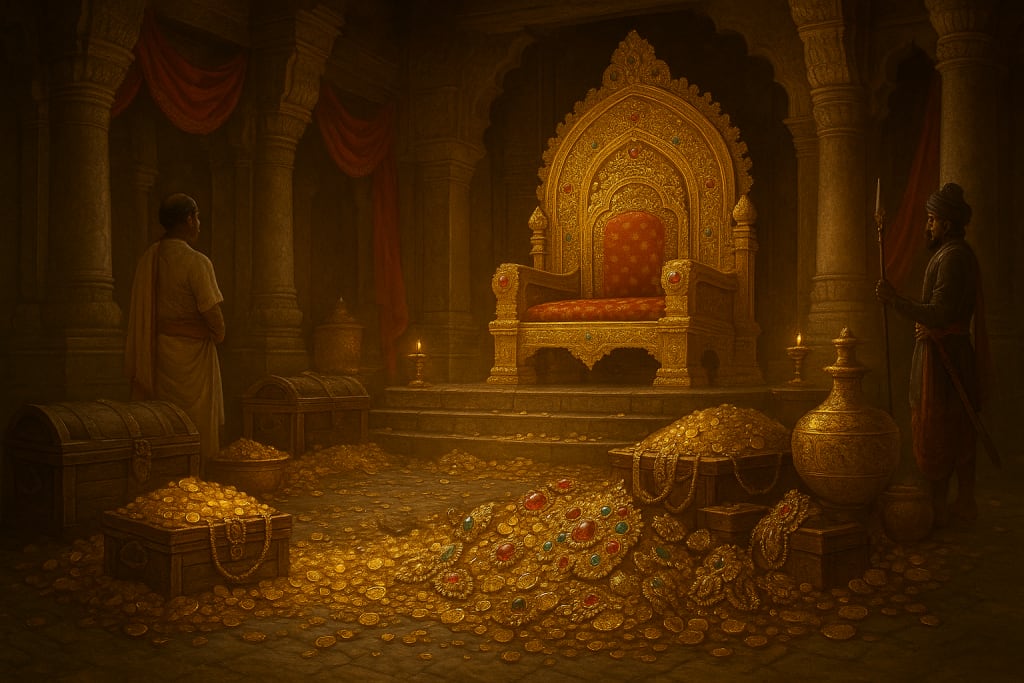
Throne of Gold: The HiThrone of Gold: The Hidden Wealth of the Pandiyan Kings
Introduction: The Heritage of the Pandiyas
Among the ancient Tamil monarchies, the Pandiyan dynasty distinguished itself due to its significant cultural and economic impact. Centered in Madurai, the Pandiyan rulers governed a thriving trade empire from as early as the 6th century BCE to the 14th century CE. Their dominion spanned the fertile lands of southern Tamil Nadu, critical ports along the Indian Ocean, and essential trade routes connecting the East and West.
Their palaces served not only as political hubs but also as repositories of unimaginable wealth, containing royal thrones crafted from gold, rare gemstones, religious artifacts, war spoils, and offerings from vassals and foreign merchants. The Pandiyan economy was robust, with their coinage circulating in Southeast Asia, the Roman Empire, and China.
Sources of the Pandiyan Prosperity
Maritime Commerce
The Pandiyas operated vibrant ports such as Korkai, Kayal, and Thoothukudi, which linked South India with Southeast Asia, Rome, Arabia, and China. They exported:
- Pearls (notably from the Gulf of Mannar)
- Spices such as pepper and turmeric
- Textiles and dyed fabrics
- Sandalwood, ivory, and precious stones
Foreign traders, particularly the Romans, transacted in gold coins, which enriched the Pandiyan treasury.
Agricultural Abundance
The fertile river valleys, especially those surrounding the Vaigai, yielded copious amounts of rice, sugarcane, and cotton. Revenue generated from agriculture swelled the royal treasury.
Tributes and Military Campaigns
Victories in southern India and alliances with other Tamil dynasties resulted in tribute. Certain campaigns brought treasure troves from rival leaders and temple repositories.
Religious Patronage and Temple Wealth
The Pandiyas constructed and enhanced temples, such as the Meenakshi Amman Temple in Madurai, which emerged as hubs for both spirituality and wealth accumulation. These temples possessed extensive riches in the form of:
- Gold idols
- Jewels donated by devotees and monarchs
- Artifacts and inscriptions crafted from precious metals
The Royal Throne and Palace Wealth
Accounts from ancient Tamil literature and observations from foreign travelers (like Marco Polo) depict opulent royal courts:
The Pandiyan throne was noted to be made of solid gold, embellished with inlays of diamonds, rubies, and sapphires. Its value in contemporary markets could surpass $50 million USD based solely on material worth.
The royal palace in Madurai was replete with:
- Ornate furniture made of gold and ivory
- Luxurious silk draperies
- Weaponry encrusted with gemstones
- Royal seals and coins stored in secured vaults
A conservative assessment of the palace’s movable wealthexcluding landwould approximate $500 million to $1 billion USD in today’s values, contingent upon current rates for gold, gemstones, and historical artifacts.
The Temple Treasuries
Temples under Pandiyan authority were centers of economic and cultural significance. The Meenakshi Temple alone was reputed to house:
- Gold-plated chariots
- Hundreds of gold and silver idols
- Thousands of objects inlaid with gemstones
- Donations in the form of gold coins and jewelry
If the wealth accumulated within the temple were evaluated today, it might easily total $2–3 billion USD or more.
Net Worth of the Pandiyan Family and Empire
Let us summarize a contemporary estimate based on accessible historical records:
| Asset | Estimated Value (Modern USD) |
|--------------------------------|-------------------------------|
| Royal Throne and Crown Jewels | $50 million |
Palatial Artifacts and Safeguards $500 million – $1 billion
Temple Relics (Principal Temples) $2–3 billion
Gold from Nautical Commerce $500 million
Land Tax (Converted Estimate) $1 billion
Total Estimated Asset Value $4–5. 5 billion USD
This assessment excludes artifacts that are currently lost, plundered, or unrecordednor does it factor in inflation-adjusted valuations of rare relics and inscriptions.
Diminution and Distribution of Wealth
The Pandiyan empire encountered regular incursions from the Delhi Sultanate in the 14th century, resulting in the plundering of Madurai. A considerable portion of their riches was confiscated, refined, or transported to Delhi.
Subsequently, colonial entities (Portuguese, Dutch, British) and internal conflicts further dismantled their legacy. Some valuables disappeared, while others were concealed in temple safes or interred.
Nonetheless, the mark of their affluence and magnificence remains evident today in extant temples, retrieved artifacts, and ancient Tamil inscriptions.
Conclusion: A Sovereign Fortune Lost and Commemorated
The Pandiyan crown, though no longer present, continues to epitomize the zenith of Tamil affluence, maritime dominance, and cultural elegance. The dynasty's true net worthboth material and symbolicmirrors centuries of wealth, astute governance, and expertise in global trade.
Their narrative is not solely centered on gold and jewels, but serves as a reminder of a civilization that once illuminated the Indian Ocean realm with its brilliance, philanthropy, and extensive impact.
About the Creator
Say the truth
"Say the Truth: Explain Everything in the World" is your trusted source for uncovering facts and exploring the wonders of history, science, technology, and beyond. We simplify complex ideas and reveal truths to inspire curiosity .
Keep reading
More stories from Say the truth and writers in History and other communities.
Masters of the Ocean: The Powerful Naval Empire of the Tamil Kings
Sea Lords of the South: The Maritime Might of the Tamil Monarchs Long prior to the ascendance of European naval forces in global waters, the southern rulers of Indiaparticularly the Cholasestablished one of the most formidable maritime powers in Asia. With fleets that extended to Southeast Asia, disciplined infantry, war elephants, and sophisticated navigation, the South Indian monarchs exerted their influence across the oceans. This article examines the emergence, structure, and accomplishments of Tamil naval power, providing estimates on fleet size, troop strength, logistics, and the remarkable costs associated with construction and upkeep in both historical and contemporary contexts.
By Say the truth 9 months ago in History
The Seven Wonders of the World: Amazing Human Creations
People have always been fascinated by things that are grand and unusual. From the very beginning of civilization, humans wanted to build structures that were not just useful, but also showed their skill, creativity, and ambition. The Seven Wonders of the World are the most famous examples of this desire. They are impressive not only because of their size or beauty, but also because of the stories they tell about our past, different cultures, and human innovation. The idea of the Seven Wonders comes from ancient travelers and historians who listed the most remarkable human creations. Even though some of these wonders no longer exist, their legacy continues to inspire people around the world. Let’s explore each one, looking at their history, significance, and why they remain unforgettable. 1. The Great Pyramid of Giza (Egypt) The Great Pyramid of Giza is the only surviving wonder of the original Seven Wonders. Built around 2560 BCE as the tomb of Pharaoh Khufu, it is an extraordinary engineering achievement. Made from more than two million limestone blocks, some weighing over 15 tons, the precision of its construction is still astonishing today. The pyramid shows the power and beliefs of ancient Egypt and continues to attract visitors from all over the world. It is a true symbol of human skill and vision. 2. The Hanging Gardens of Babylon (Iraq) The Hanging Gardens of Babylon are famous for their beauty and clever design, though historians still debate whether they really existed. Ancient stories say King Nebuchadnezzar II built these stepped gardens for his wife, Amytis, who missed the green hills of her homeland. The gardens, described as terraces full of trees, flowers, and shrubs, appeared to float above the city. Whether real or partly mythical, they show how ancient people combined nature and architecture in extraordinary ways. 3. The Statue of Zeus at Olympia (Greece) Around 435 BCE, the sculptor Phidias created the Statue of Zeus at Olympia. This huge statue of the Greek god Zeus, seated on a throne, was over 12 meters tall and made of ivory and gold-plated bronze. It represented both artistic skill and religious devotion. Even though it was destroyed long ago, records and artistic depictions keep its memory alive, showing the Greeks’ dedication to beauty, religion, and craftsmanship. 4. The Temple of Artemis at Ephesus (Turkey) The Temple of Artemis, built around 550 BCE, was dedicated to the Greek goddess of the hunt and wilderness. Known for its enormous size, detailed sculptures, and beautiful design, it was rebuilt several times after destruction, reflecting its cultural importance. People traveled from across the Mediterranean to see it, making the temple a center of religion, art, and commerce. Today, its ruins still tell the story of a civilization that valued beauty and spiritual devotion. 5. The Mausoleum at Halicarnassus (Turkey) Built between 353 and 350 BCE, the Mausoleum at Halicarnassus was the tomb of Mausolus and his wife Artemisia. Combining Greek, Egyptian, and Lycian styles, it stood around 45 meters tall and was decorated with intricate sculptures. Its design influenced monumental tombs for centuries. Even after earthquakes destroyed it, the Mausoleum remains a symbol of human creativity and architectural achievement. 6. The Colossus of Rhodes (Greece) The Colossus of Rhodes, built between 292 and 280 BCE, was a massive bronze statue of the sun god Helios, celebrating Rhodes’ victory over an invading army. Over 30 meters tall, it was one of the tallest statues of the ancient world. Although it only stood for 54 years before an earthquake toppled it, the Colossus became a symbol of triumph, resilience, and artistic achievement, inspiring large statues throughout history. 7. The Lighthouse of Alexandria (Egypt) The Lighthouse of Alexandria, or Pharos, was built around 280 BCE on the small island of Pharos. Standing over 100 meters tall, it served as both a landmark and a guide for sailors entering Alexandria’s busy harbor. Its elegant design combined functionality and beauty. Though earthquakes destroyed it long ago, it remains a symbol of human ingenuity and innovation in maritime engineering. The Legacy of the Seven Wonders The Seven Wonders are more than just buildings; they are symbols of human creativity, ambition, and achievement. Each wonder tells a story about the people who built it, the culture it came from, and the new ideas of its time. Even though some no longer exist, their stories continue to live through historical records, art, and the fascination of people worldwide. These wonders still inspire architects, artists, engineers, and travelers today. From the pyramids of Egypt to the Hanging Gardens of Babylon, they remind us that imagination and effort can create something that lasts for thousands of years. They are examples of determination, vision, and the pursuit of excellence. Conclusion The Seven Wonders of the World are timeless creations that celebrate human creativity and determination. They are more than stones, metals, or ruins—they represent entire civilizations and the marks they left on history. Even after centuries, their stories continue to inspire people to dream, create, and achieve greatness. These wonders remind us that with vision, passion, and effort, humans can build creations that
By Binan Mooona day ago in History
3 Everyday Rules That Exist Because Someone Once Did Something Very Stupid
Everywhere you go, you are surrounded by rules that feel oddly specific. Do not touch. No running. Contents hot. Do not insert body parts. These warnings aren’t theoretical. They weren’t written by pessimists or lawyers with too much free time. They exist because at some point in history, a real human being looked at a situation and thought, “This will probably be fine.”
By Enoch Sagini4 days ago in History
Wild Card Weekend Recap: What Happens Now?
I think I figured out why I love Wild Card Weekend so much. It's because it's the first playoff anything of the calendar year. The NFL season starts in the fall, and once upon a time, the champion was crowned either on or slightly before New Year's. The evolution of the NFL schedule has resulted in the playoffs starting just into the New Year, and currently, the final week of the season falls on the first weekend of the New Year, with Wild Card Weekend coming a week after that. So yes, chronologically, the NFL's Wild Card Weekend serves as the first playoff anything of the calendar year.
By Clyde E. Dawkins7 days ago in Unbalanced



Comments
There are no comments for this story
Be the first to respond and start the conversation.