
Masters of the Ocean: The Powerful Naval Empire of the Tamil Kings
Centuries before modern navies ruled the seas, the Tamil kings—especially the mighty Cholas—commanded one of the largest and most sophisticated naval forces in the ancient world. With over a thousand warships, thousands of soldiers, and even war elephants transported across oceans, their fleet conquered distant lands like Sri Lanka and Southeast Asia. This article explores the size, achievements, and economic might behind the South Indian naval empire, estimating its strength and cost in today’s value—revealing a maritime legacy as powerful as it was visionary.

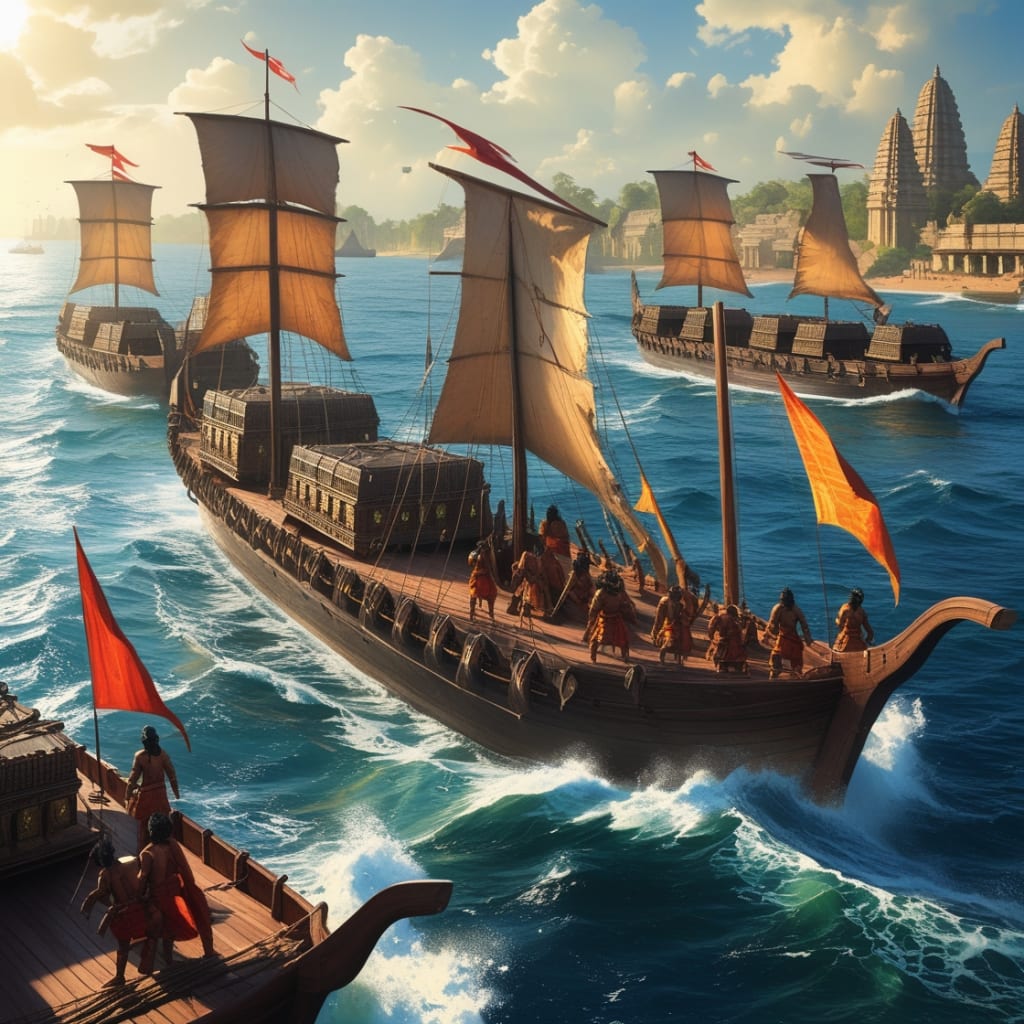
Sea Lords of the South: The Maritime Might of the Tamil Monarchs
Long prior to the ascendance of European naval forces in global waters, the southern rulers of Indiaparticularly the Cholasestablished one of the most formidable maritime powers in Asia. With fleets that extended to Southeast Asia, disciplined infantry, war elephants, and sophisticated navigation, the South Indian monarchs exerted their influence across the oceans. This article examines the emergence, structure, and accomplishments of Tamil naval power, providing estimates on fleet size, troop strength, logistics, and the remarkable costs associated with construction and upkeep in both historical and contemporary contexts.
Introduction: The Naval Heritage of South India
The southern kingdoms of India, especially the Cholas, Pandyas, and Chera dynasties, were not merely dominant terrestrial empires but also maritime forces. From the 9th to the 13th centuries, their naval fleets governed extensive areas of the Bay of Bengal and Indian Ocean, facilitating trade, conflict, and cultural interchange with Southeast Asia and beyond.
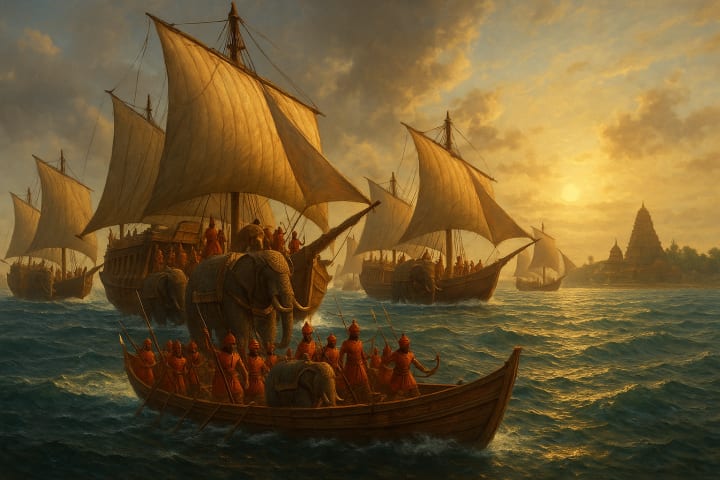
Among these, the Chola dynasty under rulers such as Rajaraja Chola I and Rajendra Chola I constructed the largest and most organized navy of its era, establishing Tamil military and commercial prominence from Sri Lanka to Indonesia.
The Naval Fleet: Size and Organization
The Chola naval fleet was meticulously organized and categorized into:
Warships – Large wooden vessels known as “Kappal” equipped for combat and crewed by archers and spear throwers.
Troop Transports – Ships designed for the transportation of infantry, elephants, and supplies across extensive distances.
Trade Escorts – Vessels assigned to safeguard merchant ships along trade routes.
Scouting Ships – Agile, swift boats utilized for reconnaissance and message transmission.
Estimated Size of the Chola Fleet at its Zenith (circa 1025 CE):
Warships: 300–500 vessels
Troop Ships: 200–300
Support and Escort Ships: 400+
Total Ships: ~1,000 vessels
Each warship had the capacity to transport 50–100 individuals. Consequently, the navy likely deployed:
Total Naval Personnel: 50,000–70,000
Marines and Soldiers Onboard: ~40,000
Support Crew, Sailors, Navigators: ~30,000
Elephant Contingent and Terrestrial Support
Naval operations frequently incorporated war elephants, a significant component of Tamil military strength. Elephants were conveyed on broad-decked vessels for coastal assaults.
Estimated War Elephants in Chola Campaigns: 500–700
Each elephant was accompanied by a group of 3–5 handlers and supporting troops.
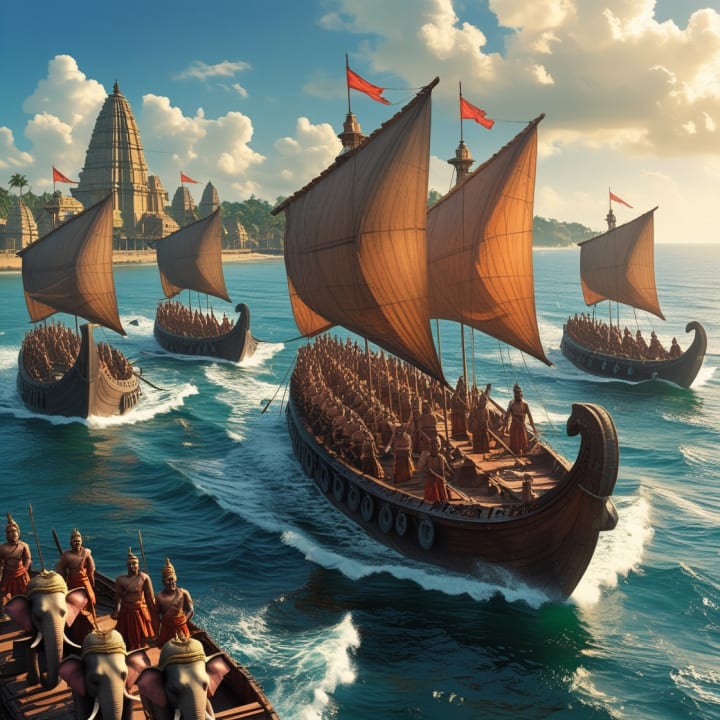
These elephants would be unloaded at enemy shores and employed in direct attacks or to intimidate opposing forces.
Achievements of the Tamil Navy
Some of the most notable military and diplomatic triumphs of the Tamil rulers were naval in nature:
Conquest of Sri Lanka (numerous instances between 993 and 1070 CE)
Invasion of the Srivijaya Empire (1025 CE) – Rajendra Chola I’s fleet traversed thousands of kilometers to Southeast Asia, plundering ports in Sumatra, Java, and the Malay Peninsula.
Establishment of Trade and Diplomatic Routes – With China, Cambodia, and Arabia.
Control of Segments of the Maritime Silk Route – Leading to substantial economic prosperity.
No other Indian dynasty manifested naval power at such a scale and range until modern times.
Navigation and Technology
Tamil mariners exhibited proficiency in celestial navigation, wind mapping, and monsoon knowledge. Ships were constructed from teak and local hardwoods, with sails crafted from woven fabric or leather.
Navigation Instruments:
Star compasses
Seasonal wind charts
Wave Observational Techniques
These advancements facilitated the continuation of commerce and military campaigns for weeks or months at sea.
Economic Expenditures: Establishing and Sustaining the Navy
1. Construction Expenditures
Let’s appraise the cost in current currency:
Large warship (wood, iron, sail, crew accommodations): $500,000
Smaller escort or reconnaissance vessel: $200,000
Troop transport vessel: $350,000
With approximately 1,000 vessels in total:
Estimated Construction Expenditure:
(400 x $500,000) + (300 x $350,000) + (300 x $200,000)
= $200 million + $105 million + $60 million
= $365 million USD
2. Annual Upkeep
Personnel salaries, provisions, fuel, maintenance, training
Approximately 10% of construction expenditure annually
Annual Upkeep Estimate: $36–40 million USD
3. Elephant Transport and Ground Forces Support
Transporting and provisioning elephants, supporting troops
Estimated additional expenditure: $10 million USD/year
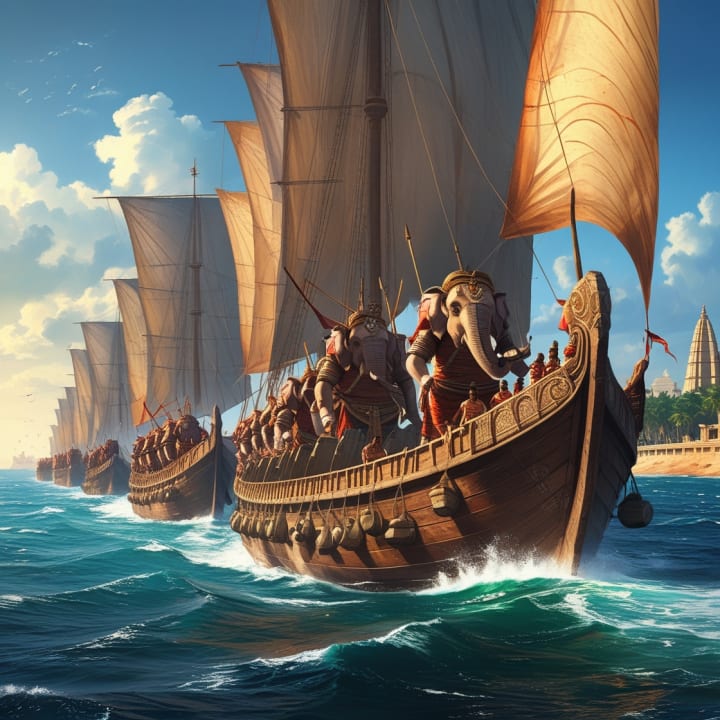
4. Navigation and Instruction
Maritime training institutions, cartography, and navigators' guilds
Estimated investment: $5 million USD/year
Total Contemporary Equivalent Annual Upkeep Expenditure: ~$55 million USD
Conclusion: An Overlooked Maritime Authority
The naval power of the Tamil monarchsparticularly the Cholaswas unparalleled in pre-modern Indian history. Their capability to construct and sustain a navy comprising over 1,000 vessels, transport armies and elephants across oceans, and subjugate foreign regions exemplifies an extraordinary maritime heritage.
If we were to reconstruct the Chola Navy today, incorporating infrastructure, personnel, and technology, the overall cost could surpass $1–1. 5 billion USD.
Beyond mere financial implications, the navy of the Tamil kings represents an era when South India dominated the seas, eliciting respect, apprehension, and trade from Arabia to the South China Sea.
About the Creator
Say the truth
"Say the Truth: Explain Everything in the World" is your trusted source for uncovering facts and exploring the wonders of history, science, technology, and beyond. We simplify complex ideas and reveal truths to inspire curiosity .
Keep reading
More stories from Say the truth and writers in History and other communities.
Golden Thrones and Hidden Treasures: Estimating the Real Wealth of the Tamil Kings’ Palaces
Thrones of Gold: The Genuine Affluence in the Residence of the Great Tamil Sovereigns From the Cholas and Pandyas to the subsequent Nayak rulers, Tamil monarchs once governed extensive and flourishing empires throughout South India and beyond. Their palaces were not merely emblems of authority but also vaults of astonishing wealthfilled with gold, gemstones, armaments, silks, and sacred artifacts. This article examines the authentic historical wealth housed within Tamil palaces, the origins of this prosperity, and presents a contemporary assessment of their net worth in today's currency.
By Say the truth 9 months ago in History
Mestre Best: The Warrior Who Taught Restraint
In the mountain city of Valenor, there was a name spoken softly, almost with reverence—Mestre Best. No statues were built in his honor, no songs officially recorded his deeds, yet every fighter, scholar, and traveler knew the legend. Some said he was the greatest master of combat the world had ever seen. Others claimed he was a philosopher disguised as a warrior. The truth was more complex than either tale.
By The best writer a day ago in History
A massive underwater stone wall that is almost 7,000 years old is found by divers.
One of the buried stone monuments on Sein Island is a granite wall off Brittany that is more than 7,000 years old and the length of a football pitch. The discovery is being used by marine archaeologists in the vicinity of Île de Sein to explain how stone-built coastal villages predate the widespread spread of farming.
By Francis Dami6 days ago in History
Miss Persephone's Manual to a Seemingly Ordinary Life
Miss Persephone was found at the dining table, her blue eyes swollen, her tears arriving and retreating like the tides of the ocean. Earlier that day, her family had visited her in the retirement home where she had lived for eight years. It was her eightieth birthday.
By Imola Tóth4 days ago in Fiction


Comments
There are no comments for this story
Be the first to respond and start the conversation.