
This Man Claimed to Be Immortal and History Can't Prove Otherwise: The Enigmatic Story of Count St. Germain
Unraveling the Legend of Count St. Germain: The Man Who Claimed Immortality and Defied History's Explanations


Imagine a man so mysterious that his very existence remains a topic of debate centuries after his death. A man who claimed to have lived through the rise and fall of empires, possessed wisdom beyond his years (perhaps beyond any years), and who convinced the highest European courts that he had discovered the secret to eternal life. This is the story of Count St. Germain, a man who, according to historical records, was not only ageless but may have lived for hundreds — if not thousands — of years.
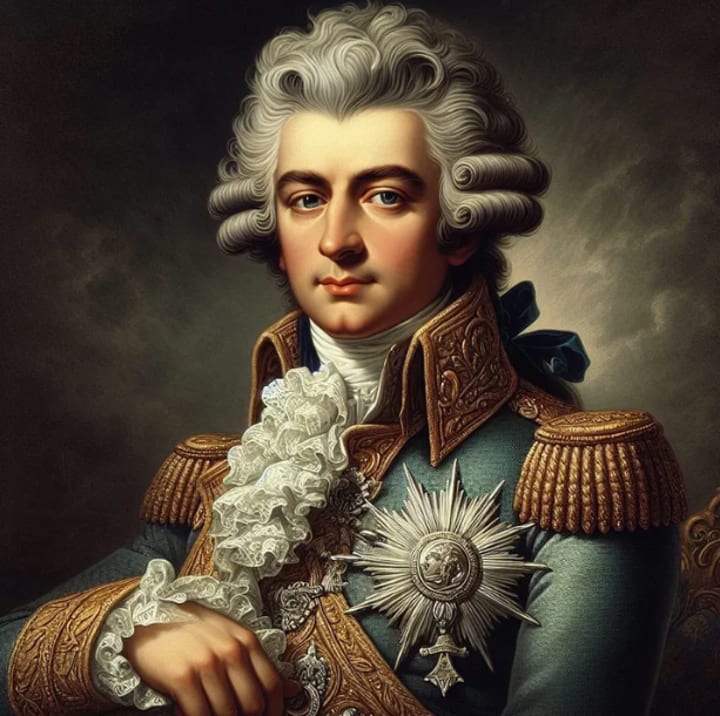
Count St. Germain wasn’t just a man; he was a phenomenon. From the courts of France to the salons of England, his name sparked wild theories about his origins, talents, and perhaps most famously, his immortality. His life — or rather, his lives — span across centuries, his appearance ageless, and his death, well...that part remains a bit unclear.
The Mystery of Count St. Germain’s Birth
To say that Count St. Germain had an obscure origin would be an understatement. No one is entirely certain where or when he was born. Some claim he was the son of Francis II Rákóczi, the exiled prince of Transylvania, born in the late 1600s. Others assert he was the illegitimate son of a Spanish king, or perhaps even something far stranger.
One of the earliest recorded sightings of St. Germain in European history dates to the 1740s, when he appeared at the French court of Louis XV. By then, he was already a man of considerable reputation — not only for his wealth and charm but also for his seemingly boundless knowledge. He spoke at least six languages fluently, was an accomplished musician and artist, and was regarded as a brilliant philosopher and scientist.
But here’s where things start to get weird: many people in Louis XV's court claimed to have met him before, decades earlier, and he hadn’t aged a day. St. Germain would have been at least in his fifties by this point, yet he appeared youthful, energetic, and healthy. The Count's secret to eternal youth became a favorite topic of whispered conversations in the royal court.
St. Germain’s Claim to Immortality
It wasn’t just his youthful appearance that fueled rumors of immortality — it was the way St. Germain spoke about the past. He claimed to have intimate knowledge of historical events that had taken place long before his supposed birth. In one famous account, the Count recounted details of a banquet in Versailles that took place over 50 years earlier, during the reign of Louis XIV. Those present were baffled by his accurate description, particularly Madame de Pompadour, who allegedly remarked that he appeared to be the same age as when she first saw him decades ago.
What’s even more peculiar is that St. Germain himself did little to deny these claims. In fact, he leaned into them. When asked about his age, he gave cryptic answers. On one occasion, he reportedly told a noblewoman, "I am very old," but refused to provide a specific number. On another, he claimed to have known Jesus personally and that he had attended the wedding at Cana where Christ turned water into wine.
These outlandish claims were paired with strange behaviors. Despite attending elaborate feasts and banquets, St. Germain was never seen eating food in public, though he often drank wine. It wasn’t long before whispers of alchemy — the pursuit of turning base metals into gold and finding the elixir of life — began to follow his name. Could St. Germain have unlocked the secrets of immortality?
St. Germain, The Alchemist
Alchemy, the ancient practice of transforming matter, was a field that Count St. Germain was particularly interested in. According to several accounts, he claimed to have discovered the philosopher’s stone — a mythical substance that grants eternal life. It’s said that he performed miracles of transmutation, turning lead into gold and even producing diamonds. Many believed that his immortality and wealth were the results of his alchemical prowess.
This Man Claimed to Be Immortal and History Can't Prove Otherwise. You'll definitely enjoy this!
In 1780, a man named Anton Mesmer, known for his role in developing hypnotism, claimed to have learned some of his magnetic healing techniques from Count St. Germain. If true, this would suggest that St. Germain not only extended his life but also had an extraordinary understanding of the human body and its hidden energies.
Beyond these strange claims, St. Germain also dabbled in mysticism and was closely associated with secret societies like the Freemasons and the Rosicrucians. These groups were obsessed with the occult, immortality, and hidden knowledge — all things that aligned perfectly with St. Germain’s interests and alleged abilities.
Sightings of the Count After His “Death”
Despite his eccentricities, St. Germain was reported to have died in 1784 in the residence of Prince Charles of Hesse-Kassel, a close friend. Yet, his legend didn’t end there. Astonishingly, people continued to claim to see him alive and well for decades after his supposed death.
In 1789, St. Germain was allegedly seen in Paris during the French Revolution, advising members of the revolutionary government. Theosophist Annie Besant wrote that he was spotted in 1821, bearing no signs of aging, at the Congress of Vienna, an event that reshaped the political order of Europe after the Napoleonic Wars.
The list of posthumous sightings of Count St. Germain goes on, with the 19th century teeming with stories of his appearances. The mystic Helena Blavatsky, founder of the Theosophical Society, claimed that St. Germain was still alive and continuing his occult studies in the Himalayas.
St. Germain’s Legacy: Myth or Immortal Reality?
So, who was Count St. Germain? Was he truly an immortal alchemist, or simply an extraordinary individual whose mysterious nature and enigmatic claims have been exaggerated over time?
It’s possible that St. Germain was a master of disguise, skilled in the art of misdirection and storytelling, leveraging his reputation to carve a unique place in history. But the sheer number of credible accounts — from Voltaire, who called him "a man who knows everything and who never dies," to Prince Charles of Hesse-Kassel, who claimed personal knowledge of the Count’s alchemical abilities — make it hard to dismiss his story entirely.
There is no definitive evidence to prove that Count St. Germain was immortal, but neither has history offered any conclusive evidence to disprove it. He remains one of history’s most intriguing figures — a man whose legacy straddles the line between myth and reality. In the end, whether Count St. Germain truly unlocked the secret of eternal life or merely lived an extraordinarily long and fascinating life, one thing is certain: he succeeded in becoming immortal in the minds of those who continue to wonder about him centuries later.
The Count St. Germain Paradox
Perhaps the most remarkable part of the Count’s story is the paradox he left behind. Even in death, St. Germain refused to be neatly placed in the history books. His life is a puzzle with missing pieces, his origin and death obscured by rumor and speculation. This paradox continues to fascinate historians, conspiracy theorists, and mystics alike.
In a world where every secret seems to eventually be uncovered, Count St. Germain remains one of history’s greatest mysteries, defying both time and truth. So, while history may never prove whether St. Germain was immortal, it has yet to definitively prove otherwise.
Perhaps, somewhere out there, St. Germain still walks among us, as ageless and enigmatic as ever.
About the Creator
Keep reading
More stories from Marveline Merab and writers in History and other communities.
Strategies to Control Trade Routes: Historical and Modern Approaches
Introduction Trade routes have always been the lifeblood of economies and civilizations. Throughout history, empires have risen and fallen based on their ability to control these routes. From the Silk Road of ancient times to modern maritime shipping lanes, controlling trade routes has been a key strategy for securing economic dominance. This article explores historical and modern strategies used to control trade routes and the impact of such control on global trade and political power.
By Marveline Merababout a year ago in History
Dust
It was dust. Dust had weight there. It pressed into your mouth when you breathed, ground against your teeth, settled into the creases of your eyes. It coated our boots and crept into our weapons no matter how carefully we cleaned them. When the wind picked up, it hissed across the ground like something alive. Long before I heard a shot fired, I understood that the dust would get inside me and never really leave.
By Gaofeng Wang8 days ago in History
Ludacris and Nelly draw backlash over bookings at MAGA-coded music festival
Ludacris and Nelly headlining a mostly right-wing event is good for them. It’s also great for the genre of hip hop. The two rap veterans have showcased their talents on other stages. Why can’t they perform for mostly MAGA folks and grab that bag?
By Skyler Saunders4 days ago in Beat


Comments
There are no comments for this story
Be the first to respond and start the conversation.