
Strategies to Control Trade Routes: Historical and Modern Approaches
How Control of Trade Routes Shaped Empires and Continues to Influence Global Commerce

Introduction
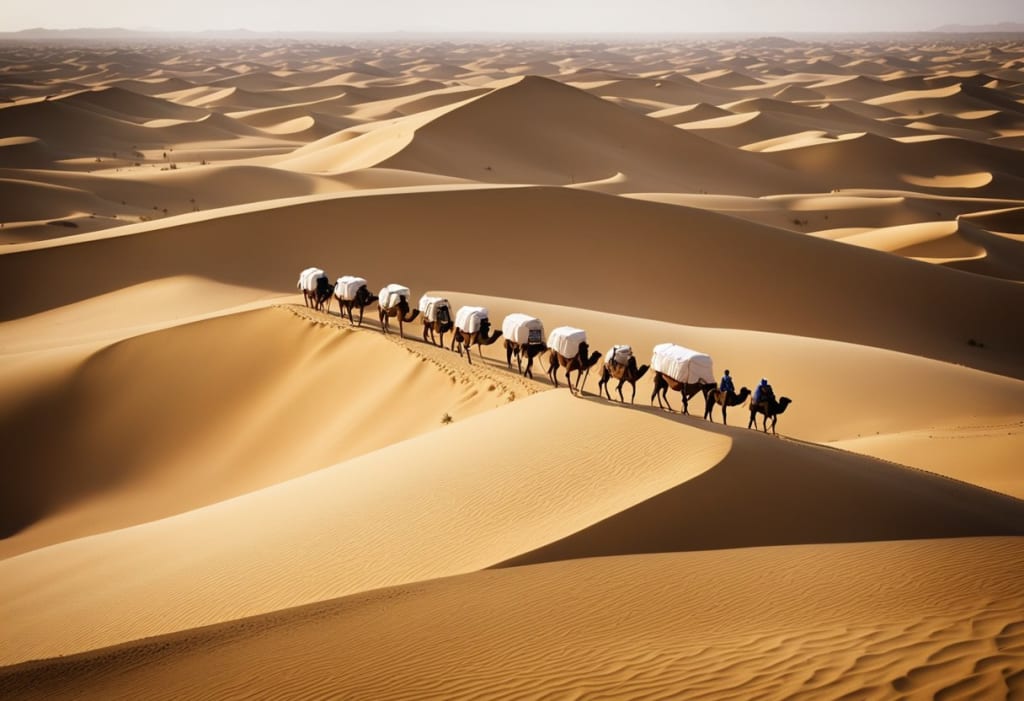
Trade routes have always been the lifeblood of economies and civilizations. Throughout history, empires have risen and fallen based on their ability to control these routes. From the Silk Road of ancient times to modern maritime shipping lanes, controlling trade routes has been a key strategy for securing economic dominance. This article explores historical and modern strategies used to control trade routes and the impact of such control on global trade and political power.

Historical Control of Trade Routes
In the ancient and medieval periods, controlling a trade route was equivalent to controlling wealth and influence. Powerful empires used a variety of strategies to maintain control over these critical arteries of commerce.
Military Presence and Fortifications
- Empires such as the Roman Empire and the Ottoman Empire deployed military garrisons along key trade routes to ensure their security. Fortifications and outposts were built along trade paths to deter invasions and protect caravans.
- For example, the Great Wall of China was not just a defense against northern nomadic tribes but also a means to protect the Silk Road trade from raids.
Political Alliances
- Forming alliances with neighboring states or local rulers was another method of securing trade routes. These alliances allowed for safe passage of goods through politically sensitive or unstable areas.
- The Ming Dynasty in China, for example, used political and trade agreements with Central Asian tribes to secure the Silk Road.
Taxation and Control of Trade Hubs
- Many empires controlled trade by imposing taxes on goods passing through their territories. Cities such as Constantinople and Venice became wealthy by controlling critical points where trade routes intersected.
- This taxation allowed rulers to generate revenue while also maintaining influence over the flow of goods.
Naval Dominance
- Controlling sea routes required naval superiority. Empires like the British Empire in the 18th and 19th centuries expanded their influence by building the most powerful navy, allowing them to dominate sea-based trade routes across the globe.
- Control of strategic chokepoints like the Strait of Gibraltar, the Suez Canal, and the Strait of Malacca gave naval powers a significant advantage in global trade.
Key Strategies for Controlling Trade Routes in Modern Times
Infrastructure Development
- Today, nations and corporations invest heavily in infrastructure projects to control trade routes. For example, China's Belt and Road Initiative (BRI) is one of the most ambitious projects aimed at revitalizing ancient trade routes by investing in transportation networks across Asia, Europe, and Africa. This not only enhances China's economic influence but also secures its trade routes.
Economic Influence and Free Trade Agreements
- Another way to control trade routes in the modern era is through free trade agreements (FTAs) and economic partnerships. By reducing tariffs and trade barriers with other countries, nations can secure a favorable position in international trade. The North American Free Trade Agreement (NAFTA) and its successor, USMCA, are examples of how economic strategies are used to strengthen control over trade in North America.
Control of Maritime Chokepoints
- Controlling critical chokepoints remains a vital strategy. Nations like the United States, China, and Russia ensure naval dominance in strategic maritime areas such as the South China Sea, Gulf of Aden, and Panama Canal. These chokepoints are essential for the movement of goods and oil, and any disruption can significantly impact global trade.
Technological Surveillance and Security
- With the rise of piracy and terrorism, technological surveillance and security systems have become critical to ensuring safe trade routes. Drones, satellites, and cybersecurity systems are now used to monitor and protect shipping lanes and land-based routes. The use of automated shipping technologies also helps nations and corporations maintain control over trade routes by reducing reliance on human resources.
Case Study: The Suez Canal
One of the most famous examples of a controlled trade route is the Suez Canal, a man-made waterway in Egypt that connects the Mediterranean Sea with the Red Sea, providing a crucial shortcut for ships traveling between Europe and Asia. Whoever controls the Suez Canal effectively controls one of the most important maritime routes in the world.
In 1956, during the Suez Crisis, Egypt’s nationalization of the canal triggered an international conflict as the canal was vital for oil shipments. The British Empire, France, and Israel sought to regain control, demonstrating the strategic significance of this route. Today, Egypt's control over the Suez Canal continues to be a major geopolitical factor.
Economic and Political Impacts of Controlling Trade Routes
The ability to control trade routes leads to several important outcomes:
- Economic Prosperity: Nations that control major trade routes, such as Singapore or Dubai, have experienced rapid economic growth due to their strategic location. By acting as hubs for global commerce, these cities attract businesses, investments, and international trade, significantly boosting their economies.
- Geopolitical Power: Controlling trade routes also leads to enhanced political influence. Countries with control over key maritime or land-based trade routes, such as the Strait of Hormuz or the Strait of Malacca, wield significant geopolitical power. Disruption in these regions could lead to global economic consequences, allowing these countries to leverage their control for political gains.
- Resource Control: Trade routes often intersect regions rich in natural resources, such as oil, minerals, or precious metals. By controlling trade routes, countries can also assert control over these resources, ensuring steady access to valuable commodities that fuel their economies.
- Conflict and Competition: Control over trade routes has historically been a source of conflict. Whether it's the colonial conquests of the 19th century or modern tensions in the South China Sea, competition for trade routes continues to spark geopolitical tensions, with nations vying for dominance over lucrative corridors.
FAQ
1. What are trade routes, and why are they important?
Trade routes are paths used for the transportation of goods and services between different regions. Controlling these routes is crucial because they ensure the flow of goods, wealth, and resources between nations, and provide economic and political leverage.
2. How did ancient empires control trade routes?
Ancient empires controlled trade routes through military presence, fortifications, alliances, taxation, and naval dominance. These strategies ensured the safe passage of goods and maintained the economic prosperity of empires.
3. How do modern nations control trade routes?
Today, nations control trade routes through infrastructure development, free trade agreements, naval dominance of strategic chokepoints, and the use of technology to secure routes and monitor trade flow.
4. What are the benefits of controlling trade routes?
Controlling trade routes leads to economic growth, geopolitical influence, resource control, and the ability to impose tariffs and collect revenue from the movement of goods.
5. What are some famous trade routes in history?
Famous trade routes include the Silk Road, the Trans-Saharan trade routes, the Spice Routes, and maritime routes through the Suez Canal and Strait of Gibraltar.
Conclusion
The control of trade routes, both historically and in modern times, is a powerful strategy for economic and political dominance. From the Silk Road to maritime chokepoints, control over these routes has shaped the destiny of empires and continues to influence global trade. Understanding the strategies used to control trade routes helps us better appreciate the intricacies of global commerce and geopolitics.
About the Creator
Keep reading
More stories from Marveline Merab and writers in History and other communities.
Long-Distance Trade Routes in East Africa: A Historical Overview
Introduction East Africa has a long history of trade, stretching back centuries before European colonialism reshaped the region. The trade routes that crisscrossed the region linked coastal cities with interior markets, fostering exchanges of goods, culture, and ideas. This article delves into the organization, significance, and impact of long-distance trade in East Africa, with a focus on the vital role played by communities like the Akamba, Yao, and Omani Arabs, among others.
By Marveline Merababout a year ago in History
Military Strength of Alexander the Great and the Chola Empire: A Historical Comparison
Though separated by more than a thousand years and operating in vastly different geographical and cultural contexts, both forces achieved extraordinary success through discipline, innovation, and strategic brilliance. This article explores the history, composition, size, organization, and military strength of Alexander’s Macedonian army and the Chola military, highlighting how each became a dominant power of its era.
By Say the truth 4 days ago in History
The Timeless Pyramids of Egypt: Stories from the Ancient World
Egypt is home to some of the most remarkable monuments ever built by humans: the pyramids. Rising from the sands of the Giza Plateau, these colossal structures have inspired curiosity and admiration for thousands of years. They were built as tombs for the pharaohs, yet they tell a much larger story—one of human skill, ambition, and belief in the afterlife. The most famous of these pyramids is the Great Pyramid of Giza, built for Pharaoh Khufu around 2580 BCE. Originally, it reached a height of about 146 meters (480 feet) and was the tallest man-made structure in the world for nearly 4,000 years. Its construction required millions of limestone blocks, some weighing several tons. Even today, historians and archaeologists are amazed at the precision and scale achieved by ancient builders without modern tools. The Egyptians built these monumental structures not merely as tombs, but as gateways to the afterlife. They believed that the pharaoh, considered a god on earth, would continue his journey in eternity. The pyramid’s triangular shape symbolized the pharaoh’s ascent to the heavens. Inside, burial chambers held treasures, inscriptions, and statues meant to guide and protect the ruler in the world beyond. How the pyramids were built remains a topic of debate. There are many theories, including the use of ramps or sledges to move the massive stones. Regardless of the methods, constructing these tombs required incredible planning, organization, and teamwork. Tens of thousands of workers labored for decades to create what would become one of the world’s greatest architectural achievements. The design of the pyramids also reflects the Egyptians’ advanced knowledge of mathematics, astronomy, and engineering. They aligned the pyramids with the cardinal points and certain stars, showing a deep understanding of the sky. The precise measurements and geometric accuracy have helped these structures survive thousands of years, enduring both natural wear and occasional earthquakes. While the Giza pyramids are the most famous, Egypt has over 100 pyramids scattered across the country, including those at Saqqara, Dahshur, and Abu Sir. Each one tells a story about the evolution of Egyptian architecture, from the earliest step pyramids to the smooth-sided ones that have become iconic. These structures also reveal much about Egyptian society, including their religious beliefs, social organization, and artistic achievements. The pyramids were not built in isolation. They were part of larger complexes that included temples, smaller tombs, and monuments that reflected the pharaoh’s divine status. They were centers of activity, culture, and ceremony, connecting the people to their rulers and to the gods they worshiped. Today, the pyramids continue to inspire awe. Millions of visitors come to Egypt each year to witness their grandeur firsthand. Archaeologists keep discovering new insights into how these incredible structures were built and what they meant to the people of ancient Egypt. Yet, despite all the research, ds stet of mystery, reminding us that some secrets of history endure across millennia. The pyramids are more than just stone monuments; they are symbols of human ambition and achievement. They remind us that with vision, skill, and persistence, people can create works that last far beyond their lifetimes. Standing in front of a pyramid, it is easy to imagine the hands that placed each block, the minds that designed the complex structures, and the determination that made the impossible possible. In the end, the Egyptian pyramids are timeless. They connect us to a world that existed thousands of years ago, teaching lessons about creativity, devotion, and human potential. They are monuments not only of history but of inspiration—a lasting testament to what humans can achieve when imagination and effort come together.
By Binan Mooon4 days ago in History



Comments
There are no comments for this story
Be the first to respond and start the conversation.