
These microscopic organisms significantly contribute to the storage of carbon in the Southern Ocean.
A fresh perspective on ocean carbon storage

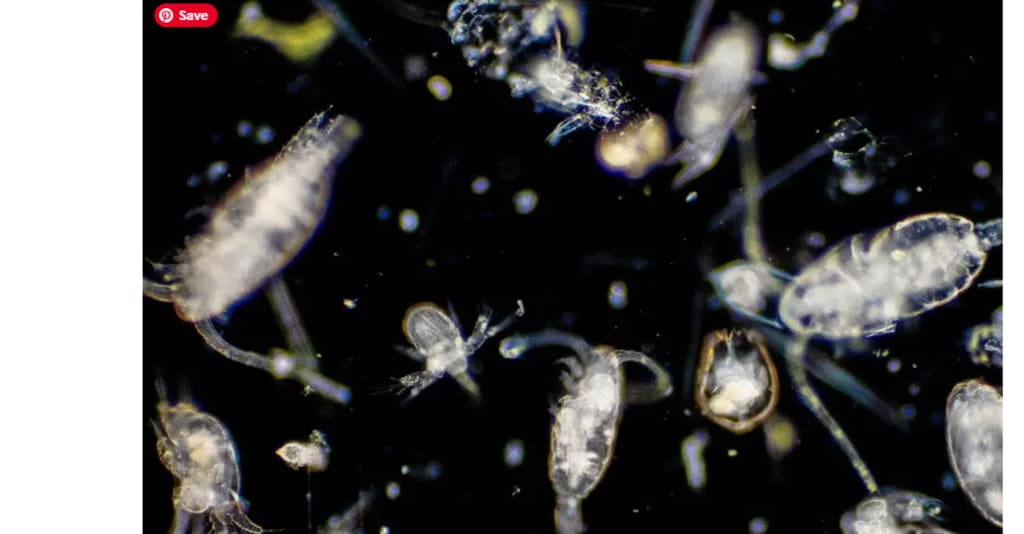
Copepods, krill, and salps are examples of zooplankton that are contributing significantly to the storage of carbon in the Southern Ocean despite their small size.
These microscopic creatures go from the surface to the deep seas in billions each year. Tens of millions of tonnes of carbon are trapped far below the ocean's surface as a result of their actions.
Up until recently, scientists thought that the majority of the carbon deposited in the Southern Ocean was trapped in the waste products of larger zooplankton grazing close to the surface and slowly sinking through the water column. However, a recent study presents a more lucid—and unexpected—picture.
Experts from the British Antarctic Survey, the Plymouth Marine Laboratory, the University of Plymouth, the Chinese Academy of Sciences, and the Institute of Oceanology led the study.
This study is the first to quantify the amount of carbon that the "seasonal migrant pump" pulls down. Through respiration and death, zooplankton release carbon into the deep ocean as they fall each autumn to depths below 1,640 feet (500 meters) and remain there for months.
Small swimmers store carbon.
The group examined thousands of net haul samples that were gathered from all over the Southern Ocean during the previous century. The documents contributed to the creation of an extensive database that documents the annual migration depth and regularity of these animals.
The researchers discovered something startling: the deep ocean receives roughly 65 million tonnes of carbon per year from this cyclical movement. Otherwise, this massive amount of carbon may remain in the atmosphere and cause global warming.
Dr. Jen Freer stated, "We find that copepods significantly dominate carbon storage overwinter." "This has significant ramifications because their habitats may change as the ocean warms."
Storage of carbon in the Southern Ocean
This deep-sea carbon delivery mechanism is mostly driven by copepods, which are tiny crustaceans that resemble prawns. About 80% of the overall carbon flux associated with the seasonal migrant pump is their fault. Another 14 percent comes from krill, while 6 percent comes from salps.
These figures are significant. About 40% of the CO2 generated by humans and ending up in the oceans is absorbed by the Southern Ocean.
That's a sizable portion, but models could not account for this seasonal migration until recently. Their primary focus was on passive sinking, which is the process by which debris, such as dead material or excrement, descends through the water.
The seasonal migrant pump is a direct injection as opposed to a prolonged sinking process. Another benefit is that it maintains vital elements, such as iron, in the upper layers, where they sustain marine life.
This indicates that zooplankton are effectively eliminating carbon without depriving the ocean's surface of nutrients that are essential for maintaining ecosystems.
Warming changes the pathways of zooplankton.
The ocean in the South is evolving. The range of animals like copepods and krill is changing due to climate change, which may change the amount of carbon stored annually.
Dr. Katrin Schmidt stated, "The study demonstrates the'seasonal migrant pump' as an important pathway of natural carbon sequestration in polar regions." "Climate change will be lessened by protecting these migrants and their habitats."
According to the research, there is an urgent need to update climate models. Since this zooplankton-driven mechanism is not included in current Earth System Models, they might be overlooking an important aspect of the ocean's carbon story.
Professor Angus Atkinson stated, "This study is the first to estimate the total magnitude of this carbon storage mechanism." "It demonstrates the usefulness of extensive data compilations to obtain a broad picture of the relative significance of carbon storage mechanisms."
Little animals, worldwide influence
The study offers one of the most comprehensive images to date of how small marine species affect the global climate through ocean carbon storage, drawing on data and contributions from experts in China, the UK, and Canada that span nearly a century.
Dr. Guang Yang, the study's lead author, stated, "Our research demonstrates that zooplankton are unsung heroes of carbon sequestration." "Models now need to account for the enormous, hitherto unmeasured carbon flux created by their seasonal migrations."
Preserving biodiversity is only one aspect of protecting the Southern Ocean. It entails protecting one of nature's most effective carbon storage systems, which is driven by organisms smaller than rice grains.
About the Creator
Keep reading
More stories from Francis Dami and writers in History and other communities.
Ancient avocados found in a cave could save the world's crop.
There is just one type of avocado that feeds the world's appetite: the creamy Hass. Production has been streamlined into a multibillion-dollar enterprise due to this genetic similarity. However, uniform orchards can suddenly collapse when confronted with a new pest, virus, or heat wave; thus, it also invites calamity.
By Francis Dami9 months ago in History
Muhammad Shah “Rangila”: The Colorful Emperor of a Fading Empire
Among the later rulers of the Mughal Empire, Muhammad Shah Rangila stands out as one of the most colorful and controversial figures in South Asian history. Known for his love of music, dance, art, and luxury, he earned the nickname “Rangila,” meaning “the colorful” or “the pleasure-loving.” While his reign brought a cultural revival in some ways, it also coincided with a period of serious political decline in the Mughal Empire.
By Irshad Abbasi 4 days ago in History


Comments
There are no comments for this story
Be the first to respond and start the conversation.