
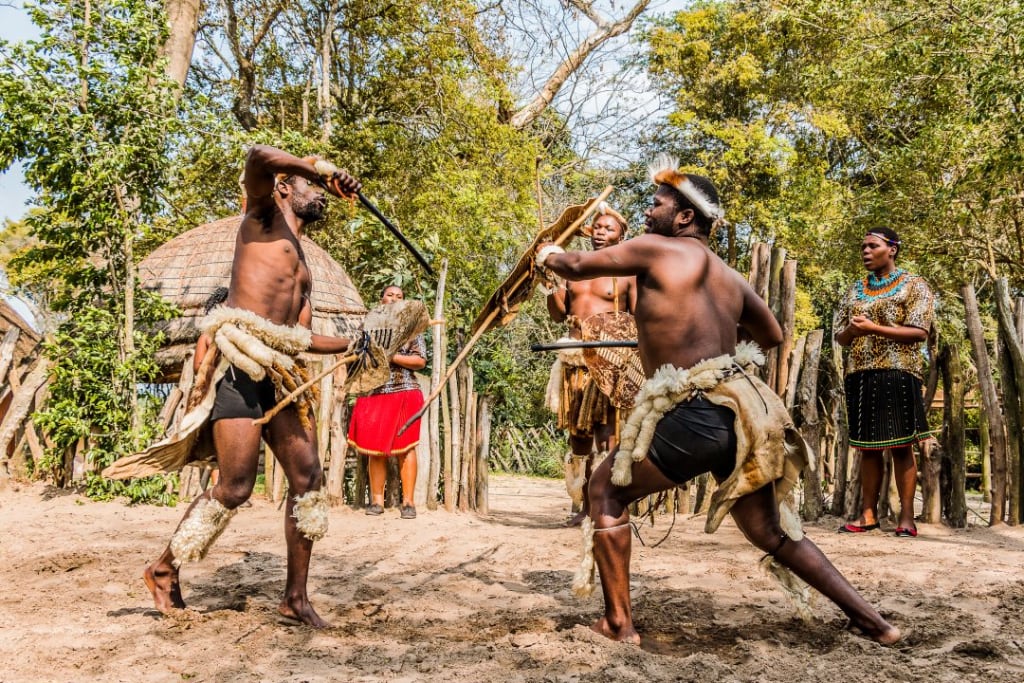
The Zulu Tribe, a prominent group in southern Africa, has a rich and complex history marked by profound cultural, political, and military developments. Originating from the Nguni-speaking peoples, the Zulu rose to prominence in the early 19th century under the leadership of Shaka Zulu, whose military strategies and statecraft fundamentally transformed the region.
### Origins and Early History
The Zulu people trace their origins to the Nguni migrations, which began around the 11th century. They settled in what is now KwaZulu-Natal, a province in South Africa. Initially, the Zulu were one of many small clans within the region, living a relatively peaceful existence centered around agriculture, cattle herding, and tribal governance.
### The Rise of Shaka Zulu
The pivotal moment in Zulu history came with the rise of Shaka Zulu (circa 1787–1828). Shaka, born as the illegitimate son of a Zulu chieftain, ascended to power in 1816 after the death of his father and the subsequent assassination of his half-brother, who had been the Zulu king. Shaka's reign marked a dramatic shift in the Zulu's role within the region.
Shaka implemented revolutionary military reforms, including the development of the iklwa, a short stabbing spear that allowed warriors to engage enemies in close combat. He also reorganized the Zulu army into regiments, known as ibutho, which were based on age groups and were highly disciplined. His strategies, including the "bull horn" formation, were designed to encircle and crush opponents. These innovations, coupled with a policy of aggressive expansion, helped Shaka consolidate power and create a powerful Zulu kingdom.
### Expansion and Conflict
Under Shaka’s leadership, the Zulu Kingdom expanded rapidly through a series of conquests and alliances. The Zulu absorbed numerous neighboring groups and incorporated their warriors into their ranks. This expansion, known as the Mfecane or Difaqane, was characterized by significant upheaval and warfare, leading to both the displacement and destruction of various groups across southeastern Africa.
Shaka’s rule was marked by both military success and internal strife. His centralization of power and the creation of a highly disciplined military state allowed the Zulu to dominate their neighbors, but his reign was also characterized by harsh and sometimes brutal tactics. Shaka's reign ended in 1828 when he was assassinated by his half-brother, Dingane, who sought to take control of the kingdom.
### The Zulu Kingdom under Dingane and Cetshwayo
Dingane's rule (1828–1840) was marked by continued conflict with both internal rivals and external threats. His reign saw the first significant encounters with European settlers and traders, particularly the British and the Boer settlers from the Cape Colony.
The most notable conflict during Dingane’s reign was the Battle of Blood River in 1838. The Zulu clashed with the Voortrekkers, Dutch-speaking settlers who were migrating inland. Despite being heavily outnumbered, the Zulu suffered a devastating defeat, which significantly weakened Dingane’s position.
Dingane was eventually overthrown by his half-brother, Mpande, who ruled from 1840 to 1872. Mpande's reign was relatively peaceful compared to his predecessors, but it was during his rule that British colonial interests in southern Africa intensified.
The most significant Zulu leader after Mpande was Cetshwayo (reigned 1872–1879). Cetshwayo faced increasing pressure from British colonial forces, leading to the Anglo-Zulu War of 1879. The Zulu initially achieved a notable victory at the Battle of Isandlwana, where they defeated a British force. However, the British eventually regrouped and defeated the Zulu at the Battle of Ulundi, leading to the fall of the Zulu Kingdom.
### Post-War Period and Legacy
After the Anglo-Zulu War, the Zulu Kingdom was annexed by the British Empire and incorporated into the colony of Natal. The Zulu were subjected to British rule, but their cultural heritage and resistance continued to play a significant role in the region's history.
Throughout the 20th century, the Zulu people maintained a strong cultural identity, with traditional practices and leadership persisting despite colonial and apartheid pressures. The Zulu’s rich cultural legacy is evident in their ceremonies, language, and contributions to South Africa’s national identity.
Today, the Zulu people are a vibrant part of South Africa’s diverse cultural tapestry, reflecting a history of resilience, adaptation, and enduring strength.
About the Creator
Why Countries Are Preparing for Future Wars
The World Is Re-Arming: Why Countries Are Preparing for Future Wars Across the world, countries are increasing their military spending at a speed not seen in decades. Governments explain this growth as necessary for defense and national security. However, many experts and ordinary people worry that this trend could move the world closer to conflict instead of peace. From Europe to Asia, from the Middle East to the Pacific, nations are strengthening their armies, modernizing weapons, and preparing for possible future wars.
By Wings of Time 4 days ago in History


Comments
There are no comments for this story
Be the first to respond and start the conversation.