
The Witch of Wall Street and the Woman Who Outsmarted a Nation
The Remarkable Life of America’s Richest Woman, Her Frugal Fortune, and Her Unmatched Power in the Male-Dominated World of Finance

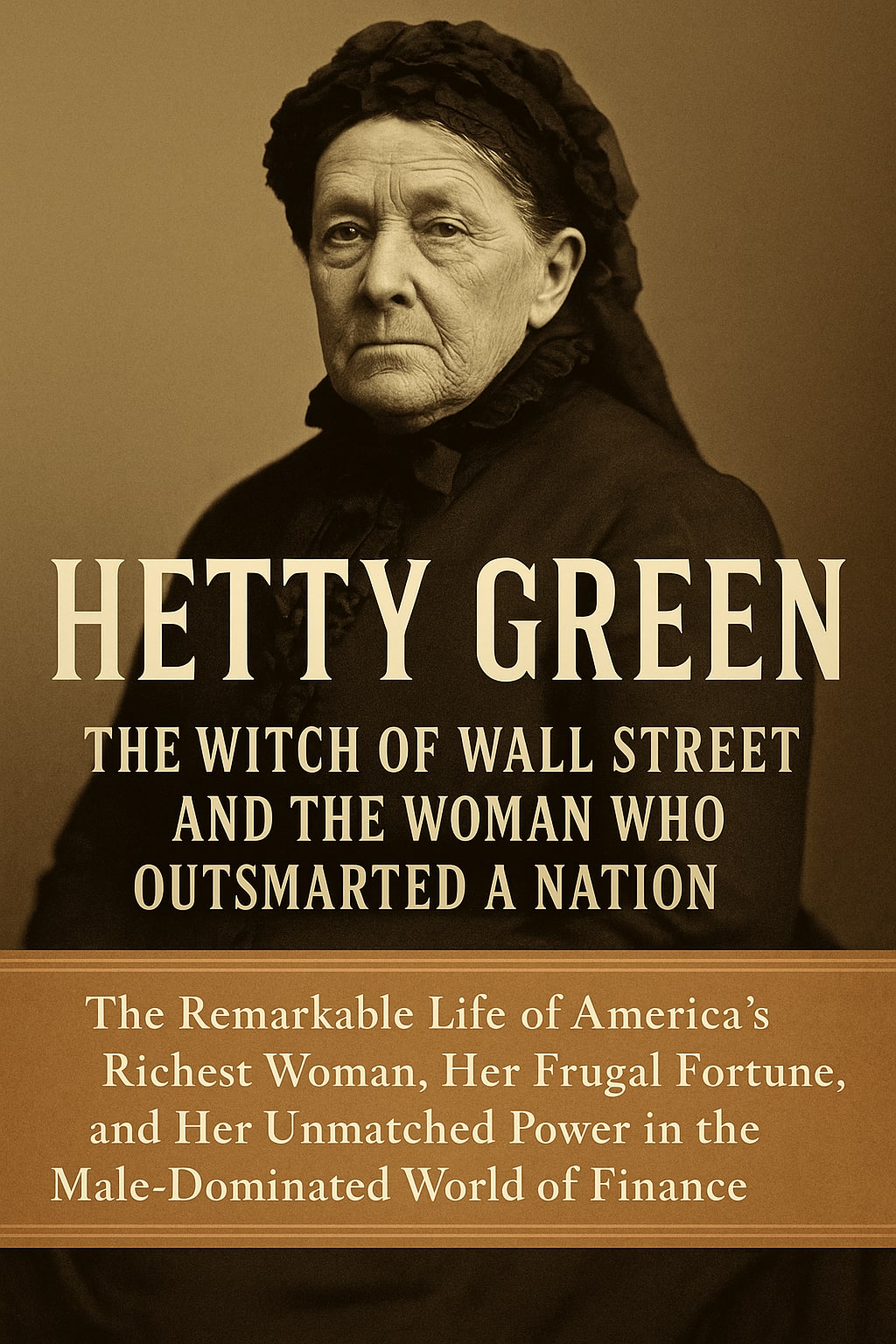
In an era when women were expected to manage households, not fortunes, Hetty Green defied every social convention to become one of the richest and most formidable financiers in American history. Nicknamed “The Witch of Wall Street”, Hetty’s story is not just about money—it’s about resilience, strategy, and an unshakeable will to succeed in a world that underestimated her at every turn.
Early Life and Foundations of Frugality
Henrietta Howland Robinson was born on November 21, 1834, in New Bedford, Massachusetts, to a wealthy Quaker family. Her father, Edward Mott Robinson, was a successful whaling businessman and investor, while her mother, Abby Howland, belonged to a family with deep financial roots.
Hetty’s interest in finance developed at an early age. By the time she was six, she was reading financial papers to her father and learning the basics of bookkeeping. At the age of 13, she had opened her own bank account. Unlike other girls her age, Hetty’s education revolved around arithmetic, investment strategies, and market analysis.
Her frugality, often exaggerated in media tales, was rooted in her upbringing. Raised in the conservative Quaker tradition, she was taught to be simple, practical, and morally upright—values she would maintain throughout her life, even after becoming a multimillionaire.
The Great Inheritance Battle
Hetty’s rise in the financial world accelerated after the death of her aunt, Sylvia Howland, who left behind a vast estate. Hetty, convinced she was the rightful heir to the majority of the fortune, challenged the will. The legal battle, which lasted years, showcased Hetty’s fierce intellect and determination. She famously forged a second will, though the court later declared it invalid. Despite losing that case, Hetty had already inherited millions from her father and used those funds to plunge deeper into the world of high-stakes investment.
The Rise of the Witch of Wall Street
Moving to New York City in the late 1860s, Hetty began her career as a serious investor. While women were often dismissed in financial circles, Hetty used this to her advantage. She wore simple black dresses, lived in modest housing, and rode streetcars instead of private carriages—all while quietly acquiring vast holdings in railroads, real estate, and government bonds.
Unlike her male counterparts who speculated recklessly, Hetty was conservative and analytical. She would wait for financial panics—when prices dropped—and then buy assets at a discount. Her motto was simple: “Buy when everyone else is selling.” This counter-cyclical approach earned her millions and established her reputation as a sharp and unrelenting businesswoman.
During the Panic of 1907, while many financiers and banks collapsed, Hetty remained stable and even extended short-term loans to the city of New York to help it stay afloat—on her own terms, of course.
Personal Life and Public Persona
In 1867, Hetty married Edward Green, a wealthy businessman from Vermont. The couple had two children, Edward Jr. and Sylvia. However, when Hetty suspected that her husband’s financial decisions could endanger her fortune, she legally separated their finances and eventually left him. She moved with her children to Hoboken, New Jersey, and later to Brooklyn.
Though she was a loving mother, her frugality often impacted her family. The most cited (though debated) example of this was when her son, Ned, injured his leg. Allegedly, Hetty tried to get free treatment at a charity hospital, disguising herself and her son. When denied, she refused to pay for private care, leading to the eventual amputation of his leg due to lack of timely treatment.
Stories like these, whether exaggerated or not, fed the media’s obsession with her miserly habits. Journalists nicknamed her “The Witch of Wall Street,” often portraying her as cold, greedy, and cruel. But beneath the sensationalism, Hetty Green was a disciplined investor who refused to conform to society’s expectations of how a woman—especially a wealthy one—should behave.
Wealth, Power, and Philanthropy
At her peak, Hetty Green was worth over $100 million (equivalent to more than $2.5 billion today). She owned major shares in major railroads like the Reading Railroad and Union Pacific, controlled prime real estate across Chicago, St. Louis, and New York, and held significant government debt.
What made her success more remarkable was her refusal to use flashy displays of wealth. She lived in small apartments, wore the same black dress every day, and used envelopes until they were falling apart. Yet she was known to secretly support numerous causes and people in need. Friends and acquaintances revealed that Hetty often gave money to those who were down on their luck—but always quietly, and never for praise.
Death and Legacy
Hetty Green died on July 3, 1916, at the age of 81. At the time of her death, she was the wealthiest woman in America. She left behind a legacy that challenged gender norms, reshaped Wall Street, and defied the myth that financial genius belonged only to men in suits.
Her son, Edward “Ned” Green, inherited her fortune and lived a starkly different life, indulging in luxury, collecting rare artifacts, and building grand estates. But Hetty’s reputation continued to fascinate historians, feminists, and financial experts alike.
Conclusion
Hetty Green was not just a financial wizard—she was a rebel. In a time when women couldn’t vote, own property after marriage, or get serious education in finance, she did all those things—and more. Her story is a powerful reminder of what happens when intellect meets discipline and courage, even in the face of widespread prejudice.
Despite the cruel caricatures, Hetty Green wasn’t a witch. She was a pioneer—an icon of female power in capitalism, whose influence still echoes in the corridors of Wall Street.
About the Creator
Irshad Abbasi
"Studying is the best cure for sorrow and grief." shirazi
Keep reading
More stories from Irshad Abbasi and writers in History and other communities.
The Father of LSD
The Father of LSD ___ Albert Hofmann, a Swiss chemist and visionary scientist, is best known for his groundbreaking discovery of lysergic acid diethylamide (LSD), a powerful psychedelic compound that revolutionized neuroscience, psychology, and counterculture movements worldwide. His life and work spanned almost a century, bridging traditional scientific research with profound explorations of human consciousness.
By Irshad Abbasi 7 months ago in History
Stanislav Kondrashov Oligarch Series: The Roots of Oligarchy in the Mediterranean
When people hear the word “oligarchy,” they often think of modern contexts. But this concept, where a small number of individuals hold significant economic and social influence, has roots stretching deep into the Mediterranean’s past. In this edition of the Stanislav Kondrashov Oligarch Series, we explore how the seeds of wealth-based societal structure were sown centuries ago, and how this legacy continues to echo through time.
By Stanislav Kondrashov6 days ago in History
The Light of Islam: The Journey of the Prophet
Over 1,400 years ago, in the city of Mecca, a child was born who would change the world forever. His name was Muhammad ﷺ, and he belonged to the noble tribe of Quraysh. From the beginning, his life was marked by trials and simplicity. Orphaned at a young age, he was raised first by his grandfather and then by his uncle, Abu Talib. Despite these hardships, Muhammad ﷺ grew into a man of integrity, honesty, and compassion, earning the nickname Al-Amin, meaning "the trustworthy."
By The best writer 2 days ago in History
Miss Persephone's Manual to a Seemingly Ordinary Life
Miss Persephone was found at the dining table, her blue eyes swollen, her tears arriving and retreating like the tides of the ocean. Earlier that day, her family had visited her in the retirement home where she had lived for eight years. It was her eightieth birthday.
By Imola Tóth4 days ago in Fiction




Comments
There are no comments for this story
Be the first to respond and start the conversation.