
The Weight of Unwritten Words
In the Flanders mud, a soldier battles more than just the enemy; he battles the truth he dare not share.
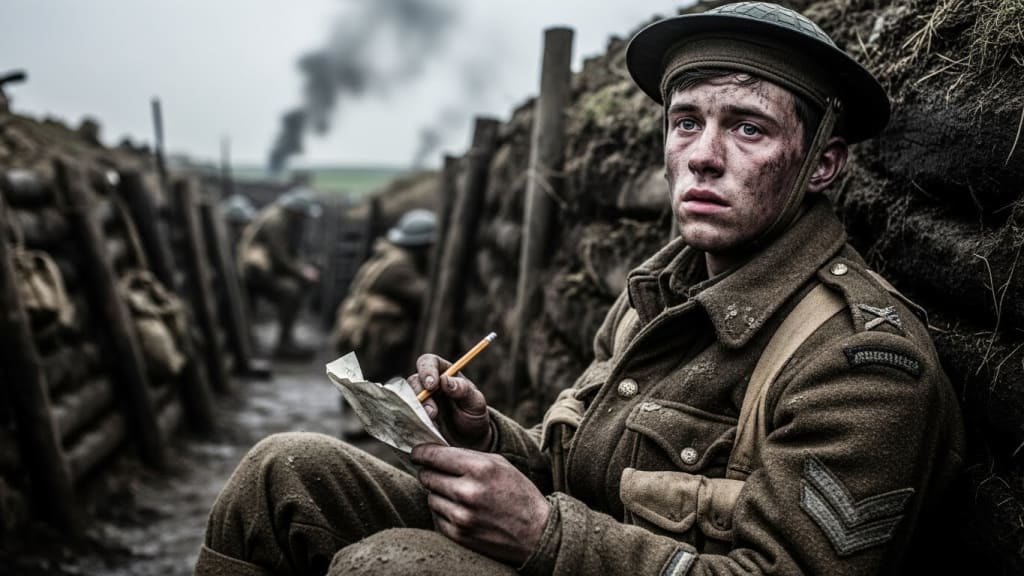
The damp seeped into Thomas’s bones, a relentless chill that made his teeth ache. He was hunched, back pressed against the corrugated iron sheeting of the trench wall, a meager protection against the biting wind that carried the constant, low growl of the distant guns. Above, the sky was a bruised purple, promising more rain, more mud. Always more mud. He pulled a worn stub of a pencil from his breast pocket, fumbling it with fingers stiff from the cold, and laid a crumpled piece of thin paper on his knee. It was Sarah’s last letter, her neat, looping script asking if he was well, if he was warm, if he’d seen any interesting sights.
Interesting sights. He snorted, a dry, humorless sound that caught in his throat. He’d seen sights alright. Too many. He turned the paper over, finding a blank space, and paused. For a moment, the world outside – the chittering rats, the soft coughs from the dugout next to him, the faraway boom that shook the very earth – faded. He had to write. He owed her that. He took a breath, the air thick with the smell of damp earth, stale sweat, and something else, something metallic and faintly sweet, a smell that clung to everything and everyone out here.
He started with the usual lies. ‘Dearest Sarah, Hope this finds you well. The weather here is not too bad. We had a decent meal today, a stew, mostly turnip.’ His hand shook, the pencil scratching harshly on the cheap paper. The words felt hollow, a flimsy shield against the swirling storm in his gut. Not too bad. Not too bad. He closed his eyes, and instantly, Sergeant Miller’s face flashed behind his eyelids, the wide, unblinking stare, the thin line of blood that had trickled from his mouth as he gasped his last breath, looking not at Thomas, but past him, at something only he could see.
The pencil slipped. A fresh smudge marred the ‘turnip.’ He rubbed at it with his thumb, smearing it worse. How could he write about turnips and weather when Miller’s eyes still haunted his sleep? He imagined Sarah, sitting by the fire, reading his cheerful lies, her brow furrowed with concern, but ultimately reassured. He couldn’t tell her. He couldn’t. The truth, raw and ugly, would break her. Or worse, it would break the image she held of him, the boy who’d left home with a bright, earnest face and a uniform that still smelled of mothballs.
‘It’s cold,’ he tried again, scratching out the previous sentence. ‘But we have our greatcoats.’ He paused, the lie feeling heavy. The cold here wasn’t just a number on a thermometer. It was a claw, digging into his bones, into his spirit. It was the constant ache in his joints, the way his fingers turned purple, the chattering teeth that made it hard to even chew the hardtack biscuit. It was the kind of cold that stole your will, leaving you hollowed out, waiting. Waiting for what? For the whistle? For the next shell? For home? The word ‘home’ felt like a forgotten dream, a place he could no longer truly grasp.
He heard a shuffle next to him. Billy, his face a ghostly pale mask, leaned against the trench wall, his eyes fixed on nothing. “Writing home, Tommy?” Billy’s voice was a rasp. Thomas grunted. “Tryin’ to.” Billy just nodded, a slight, almost imperceptible movement. No follow-up questions. They understood, all of them. The chasm between here and home was too wide, too deep for any letter to bridge. You couldn't send the mud, the screams, the reek of cordite and death through the post.
He thought of the rats again, bold as brass, scurrying over their sleeping forms at night, sometimes gnawing at a discarded crust, sometimes at something far worse. He’d woken up more than once with a start, a cold, furry brush against his cheek, and the sudden, frantic urge to scream. How did you put that in a letter to Sarah, who loved her tiny terrier and kept her kitchen spotless? You couldn't. You just couldn't. It would sound like madness, like a fever dream, not the dull, unrelenting reality of their days.
His mind drifted, unbidden, to the last push. The deafening roar of artillery. The captain’s whistle, shrill and terrifying. The scramble over the top, the mud sucking at his boots, the desperate surge forward. The sickening thud when bodies fell, the wet, guttural screams swallowed by the din. His own hand, slick with mud and something else, tightening on his rifle. The faces – George, who always hummed that daft tune off-key; Little Jimmy, barely seventeen, his eyes wide and terrified – they flashed before him, vivid, accusatory. Why him? Why was he still here, writing about imagined sunshine, while they lay under the churned earth?
He stared at the half-filled page. Sarah’s innocent questions. *Are you warm enough? Do you get enough to eat?* He wanted to scream. He wanted to weep. The words he wanted to write, the real words, would tear her world apart. The words he *could* write were a betrayal, a lie of omission so vast it choked him. He squeezed his eyes shut, the pencil digging into his palm.
He opened them, his gaze falling on the photograph tucked into his tunic pocket. Sarah’s face, her smile so bright, so utterly innocent, a world away. He couldn't tarnish that. He couldn't drag her down into this grey, stinking pit with him. He crumpled the paper, the scratchy sound loud in the close confines of the dugout, a tiny thunderclap in his head. He shoved the ball of paper deep into his pocket, next to the photograph. Maybe tomorrow. Maybe he'd find the right lies tomorrow.
He leaned his head back against the muddy wall, closing his eyes. The distant thud of an artillery shell. The taste of damp earth on his tongue. He wished, more than anything, for just a moment of real quiet.
About the Creator
HAADI
Dark Side Of Our Society
Can the United States Leave NATO?
Can the United States Leave NATO? What It Would Take—and What It Would Mean The North Atlantic Treaty Organization, commonly known as NATO, has been one of the most powerful military alliances in modern history. Since its creation in 1949, the United States has been NATO’s strongest member—militarily, financially, and politically. But in recent years, debates have grown louder about whether the U.S. should remain in the alliance. This raises a serious question: how could the United States be removed from NATO—or leave it—and what would that mean for the world?
By Wings of Time 4 days ago in History


Comments
There are no comments for this story
Be the first to respond and start the conversation.