
A Blanket of Ash and Forgetfulness
On the Western Front, the silence of a midnight snowfall was a fleeting, dangerous mercy.
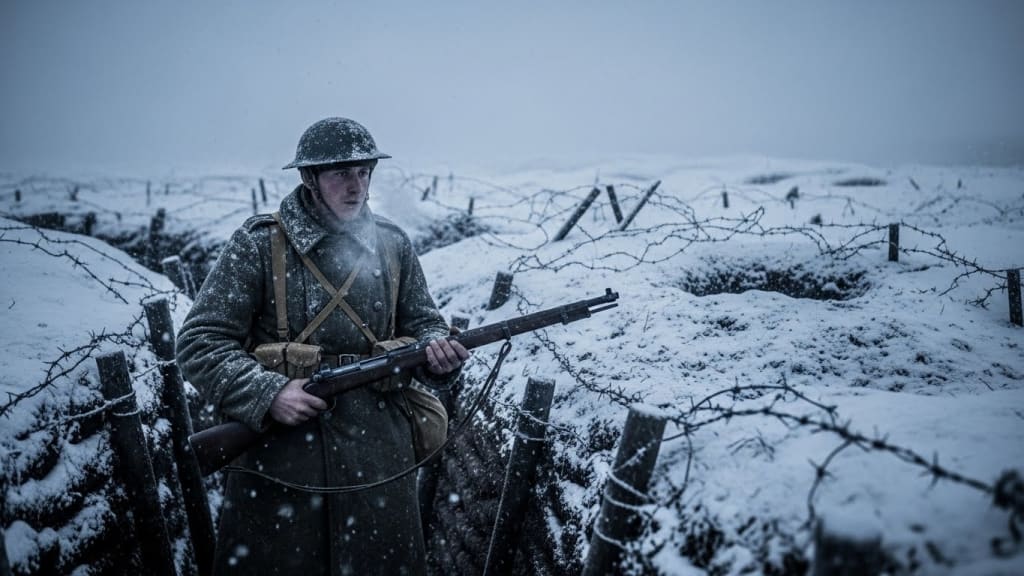
Private Thomas Miller pulled his greatcoat tighter, the wool coarse and stiff with frozen mud against his neck. It was past midnight, somewhere in the blasted fields near Ypres, late December 1917. The air was a razor blade on his exposed skin, digging under his fingernails even through the worn cloth gloves. Below him, the trench was a frozen rut, smelling of stale fear, putrid rations, and the ever-present, cloying scent of blood that even the biting cold couldn't quite scour away. He stood on the fire step, peering over the sandbags into No Man's Land, a jagged scar of wire and shattered earth. A few hours ago, the wind had been howling, a banshee cry that carried the distant thud of artillery, the crack of a sniper’s rifle. Now, nothing.
Then, it started. Not a flurry, not a drizzle, but a hesitant, almost shy fall. The first flakes were like microscopic ghosts, barely visible against the bruised, moonless sky. They drifted, not falling, but suspended, then settled on the brittle barbed wire, on the jagged shrapnel sticking out of the mud, on the slumped shapes that had been men yesterday. Tommy watched them, his breath fogging, a strange, hollow feeling in his gut. It wasn't just the cold anymore. It was the sudden, oppressive quiet. The kind that made your ears ache, straining for a sound that wasn’t there.
Within minutes, the flakes thickened, multiplying, a ceaseless descent of white. They coated everything, blurring the brutal edges of the trench, softening the twisted metal, turning the churned-up earth into an unmarked, pristine sheet. The wire, menacing moments before, now wore a delicate white fringe. The frozen puddles gleamed under a thin crust of fresh snow. It wasn't long before the familiar, distant rumble of artillery vanished, swallowed whole by the falling veil. The snipers, the sentries, the constant, low hum of a thousand men trying to stay alive – all of it faded, like a bad dream receding with the dawn. Except this was midnight, and the silence was absolute. It was the kind of silence that made a man forget where he was, made him forget the taste of cordite and the scream of a dying comrade.
He closed his eyes for a second, just a second, and in that profound hush, he was back home. Not the home before the war, not the one full of bright-eyed boys eager for adventure, but the true home, the one from childhood. The kitchen, smelling of baked bread, his mother humming off-key, the warmth of the hearth on a winter night. He saw his sister, Eleanor, red-faced from snowball fights, her laughter sharp and clear like tiny bells. He felt the weight of his father’s hand on his shoulder, strong and calloused from the plough. He remembered the thrill of sneaking out after dark, the crunch of snow underfoot in the lane, going to meet Mary, her breath sweet with mint, her hand fitting perfectly in his.
The cold snapped him back, a cruel reminder. He opened his eyes. The world was utterly, terrifyingly white. The silence was so deep, so complete, that he could hear the frantic beat of his own heart, a drum against the hollow of his chest. He could hear the blood rushing in his ears. He looked out over No Man's Land again. The ground was smoother now, an unbroken expanse, treacherous and inviting. It felt like the earth itself had taken a deep, shuddering breath, holding it, waiting. He imagined men, German men, out there, just as cold, just as alone, just as lost in the deceptive quiet. Were they, too, thinking of home? Of warmth? Of Mary?
A single, soft plink. A tiny sound, like a snowflake melting against metal, broke through the vast stillness. He stiffened, every nerve on edge. Had it been a drop of ice from the wire? Or something else? He squinted, his eyes burning from the cold, trying to pierce the falling curtain. He knew this silence. He knew it wasn't peace. It was just a different kind of waiting. A different kind of threat. The snow was a blanket, yes, but it could also be a shroud. It could conceal movement, muffle whispers, make a sudden attack all the more devastating. It made the familiar terrain unfamiliar, erased the landmarks of danger and safety alike.
His rifle felt impossibly heavy in his gloved hands, the cold steel biting through the cloth. He shifted his weight, felt the ache in his knees, the numbness in his toes. The warmth from the memory of home, of Mary's hand, flickered and died. He was here, now. On the edge of a frozen ditch, under a sky that bled white, surrounded by a silence that promised nothing but more waiting. He took a slow, deep breath, the frigid air burning his lungs. The war hadn't stopped, not really. It had just put on a quieter coat. He gripped his rifle tighter, his knuckles white against the dark wood. Just watching, always watching.
The snow kept falling, relentless, silent, burying the world piece by piece. Burying the sounds, burying the horror, if only for a few stolen hours. Burying everything but the gnawing cold and the certainty of another dawn.
About the Creator
HAADI
Dark Side Of Our Society
A woman from a vanished female dynasty was discovered buried with 270,000 beads.
In a Copper Age tomb close to Seville, Spain, the Montelirio bead assemblage contains over 270,000 beads that identify the ladies buried there as elites. The discovery is the biggest collection of beads ever
By Francis Damiabout 16 hours ago in History
The Prophet of Mercy: How Compassion Transformed Enemies into Believers
In the heart of Arabia, in the ancient city of Makkah, society was built on tribal loyalty, power, and pride. Wealth and lineage determined a person’s worth, while the weak were often oppressed without mercy. The Kaaba, originally built for the worship of One God, was filled with idols, and injustice had become a normal part of life. In this harsh and divided environment, Hazrat Muhammad ﷺ emerged—not as a king or warrior, but as a man whose truth, patience, and compassion would forever change the course of human history.
By The best writer 5 days ago in History


Comments
There are no comments for this story
Be the first to respond and start the conversation.