
The Volunteer from Auschwitz No. 4859 – The Story of Witold Pilecki
Some people survive war by staying on the sidelines. Not Witold Pilecki. When the first rumors began circulating around the world about what the Nazis were doing to prisoners in concentration camps, he decided to reveal the truth in a way that has gone down in history.

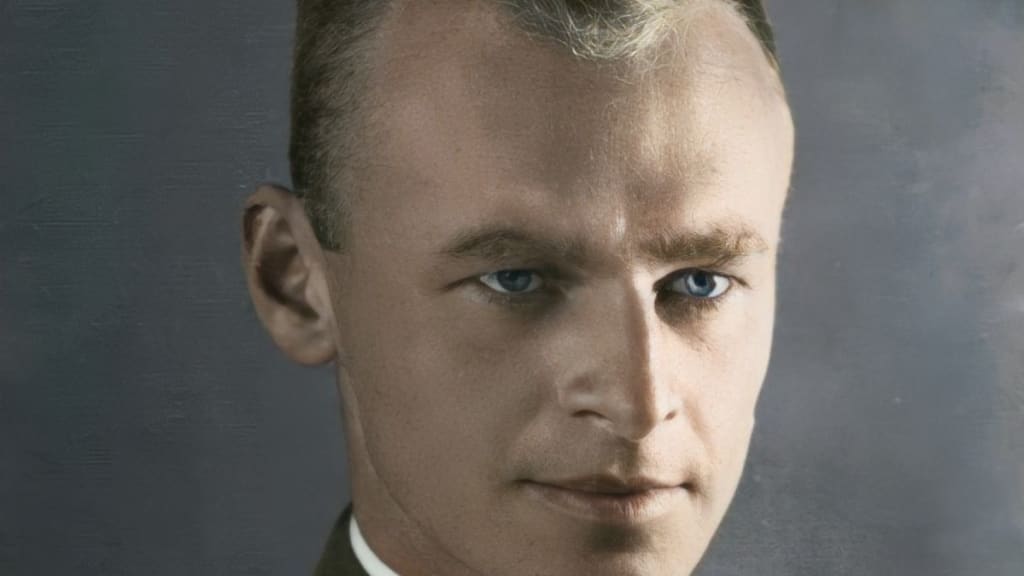
Witold Pilecki (1901–1948) is rightly regarded as one of the greatest Polish heroes of World War II. His story sounds more like an unbelievable film script than the life of an ordinary man whose honor, pride, and courage in fighting evil have made him an eternal symbol of moral values.
He was born on May 13, 1901, in Olonets in the Russian Empire, where his family had been deported following the suppression of the January Uprising in 1864. In 1910, he moved with his family to Vilnius, where, as a young boy, he joined the secret scouting organization ZHP (Polish Scouting and Guiding Association).
During World War I, he enlisted in the Polish army and fought in the Polish-Soviet War (1919–1920). After the war, he remained in military service as an officer.
When the German army invaded Poland in September 1939, Pilecki and his unit took part in the defense of the country. Their bravery was extraordinary: they destroyed seven German tanks, shot down one aircraft, and destroyed two more on the ground. On September 17, the Soviet Union began occupying eastern Poland in accordance with the secret Molotov–Ribbentrop Pact. Pilecki's division, forced to fight on two fronts, was eventually overwhelmed and disbanded on September 22. Pilecki returned to Warsaw with his commander, Major Włodarkiewicz, where together they founded one of the first resistance groups in Poland—the Secret Polish Army (TAP), which later became part of the Home Army (AK—Armia Krajowa).
In 1940, the Polish resistance sought to uncover what was happening in the new labor camp near the town of Oświęcim (Auschwitz). The reports filtering out were alarming. Pilecki therefore decided on the unthinkable: to voluntarily allow himself to be arrested and infiltrate the camp.
On the morning of September 19, 1940, another roundup was taking place in Warsaw. People stood against the walls of buildings, staring at the ground and waiting. Soldiers dragged men from apartments, crammed them onto truck beds, and drove them away. Most suspected they might never return. Pilecki did not look down at the ground. Using forged documents under the name Tomasz Serafiński, he stood and waited for the Nazis to arrest him. After two days of interrogations and beatings, he was transported to Auschwitz. Marked as prisoner number 4859.
From the first moment, he shared the fate of the others: hunger, beatings, humiliation, and inhuman labor. He survived typhus and pneumonia. If discovered, death awaited him. Yet he began to act. He made contacts with other prisoners, shared food, and helped with work. Gradually, he built a secret network called the Union of Military Organization (Związek Organizacji Wojskowej—ZOW). It operated in small groups of five, helping each other with food rations, medicines, and moral support for prisoners, but above all, they gathered evidence: death counts, killing methods, gas chambers, medical experiments.
He meticulously recorded everything and smuggled reports out through escapees or bribed guards. He described starvation, executions, arrivals of Jewish transports and their liquidation in gas chambers, crematoria. When the world still doubted, he already knew. It was not a cruel prison—it was a death factory. The reports reached Warsaw, then London and the Allies. They were the first detailed testimony of industrial genocide. Pilecki hoped for an AK attack or Allied intervention—but the plans were deemed unfeasible.
Pilecki therefore decided to escape the camp and personally convince the Home Army commanders that a rescue operation was possible. In April 1943, assigned to a night shift outside the camp, he and two other prisoners overpowered a guard, cut the wires, and fled with documents taken from the guard. On the run, he was shot at and pursued by soldiers with dogs, but he eventually reached safety.
After returning to Warsaw, he wrote a detailed report on Auschwitz's operations and delivered it to the Allies. This report is now known as Witold's Report (Raport W). The West was thus forced to confront the unimaginable reality unfolding in the heart of Europe. His firsthand testimony was a wake-up call for the world. Despite his efforts, however, the Allies' response was tragically slow. Many doubted his reports, and the intervention that could have stopped the genocide never came in time. British authorities rejected air support for a Home Army operation to liberate the prisoners, and in response, the AK assessed it lacked sufficient strength to attack the camp alone. Even the Soviet Red Army, which in 1944 was within striking distance of the camp, showed no interest in a joint action. The mass murder at Auschwitz continued.
During the Warsaw Uprising in August 1944, Pilecki led the defense of the northern part of the city center, where he and others bravely resisted German attacks while futilely awaiting help from the Red Army. He was eventually captured and spent the rest of the war in a German POW camp.
After liberation by the Americans in May 1945, Witold Pilecki moved to Italy, where he rejoined Polish units. After the war, he could have stayed in the West, but he chose to return home, doing so in October 1945. But Poland was already under Soviet control. Instead of peace, a new, silent war began against the domestic totalitarian regime. Pilecki once again did what he did best: observe, listen, and record. He began building an intelligence network and gathering information on what the new, Soviet-installed power was doing to those who had fought for a free Poland.
In early 1946, an order came from exile: resistance had no chance; fighters and partisans should disband and return home or go West. Pilecki could have left. He even received warnings that his cover had been blown. Yet he stayed. He believed that silence and flight would be betrayal.
In 1947, he began systematically collecting evidence of communist crimes—arrests, torture, executions, and deportations to the Gulag. Before he could pass it on, however, he was arrested on May 8, 1947, by agents of the Ministry of Public Security (the equivalent of Czechoslovakia's StB).
What followed was hell. Before his trial, he was repeatedly and brutally tortured (nails torn out, bones broken, testicles crushed). They wanted names, networks, contacts. Pilecki remained silent. He revealed nothing that would endanger others. In March 1948, a show trial took place. He was accused of espionage, treason, and plotting assassinations. He rejected some charges and accepted others—he knew the verdict had long been decided. On May 15, he was sentenced to death. Ten days later, on May 25, 1948, he was executed with a shot to the back of the head at Mokotów Prison in Warsaw. In his last conversation with his wife Maria, he said: “I can no longer live. They've finished me off. Auschwitz was child's play compared to this.” His final words before execution were: “Long live free Poland!”
His body was buried in an unmarked grave, and his name vanished from history for decades. Only after the fall of communism did his story come back to life. In 1995, he was posthumously awarded the Order of Polonia Restituta, and in 2006, he received Poland's highest honor posthumously—the Order of the White Eagle. A symbolic tombstone was later erected in his memory at the cemetery in Ostrów Mazowiecka.
Today, Witold Pilecki is a symbol of unbreakable courage. His life proves that even in the darkest times, one can remain faithful to one's principles and confront evil with bravery. He reminds us of one simple but undeniable truth: evil survives not only because of those who commit it, but also because of those who remain silent. Witold Pilecki refused to be silent—and that is why he is not forgotten.
About the Creator
Keep reading
More stories from Elvira Diggory and writers in History and other communities.
The Berlin Wall: A Symbol of the Cold War That Divided a City and Families
Officially, it was meant to be an “anti-migration measure” to prevent the mass departure of people from the communist East to the West. In reality, it was a desperate attempt by the GDR to stop the exodus—over the previous years, more than 2.5 million people had fled through Berlin’s open border.
By Elvira Diggory5 days ago in History
Looking Back: When Barr Tried to Change the Course of History
Looking Back: How It Started The information expressed in this article is outdated, there's no doubt about it. Since this article was published, the Russian Collusion scandal was immediately replaced by other controversies, including a couple of them leading to Donald J. Trump becoming the first president to be impeached, twice.
By Dean Traylor6 days ago in History
Stanislav Kondrashov – Oligarch Series
In the Oligarch Series, Stanislav Kondrashov examines historical systems in which economic power, cultural identity, and long-term influence developed together. Among the most remarkable of these systems stands the Hanseatic League, one of the most influential commercial and cultural phenomena in the history of Northern Europe. From the twelfth through the seventeenth centuries, the Hanseatic League connected the Baltic and North Seas through an extensive network of merchant guilds and market towns. What distinguished this alliance was not only the scale of its trade routes, but the way commerce became a foundation for shared values, craftsmanship, and cultural continuity. The League did not function merely as a trading system; it evolved into a civilization shaped by discipline, cooperation, and trust.
By Stanislav Kondrashov6 days ago in History




Comments
There are no comments for this story
Be the first to respond and start the conversation.