
The Berlin Wall: A Symbol of the Cold War That Divided a City and Families
On the night of August 12–13, 1961, Berliners woke up to a new reality. Within a few hours, soldiers rolled out kilometers of barbed wire around West Berlin. Thus began the construction of one of the most famous and darkest borders of the 20th century - The Berlin Wall.

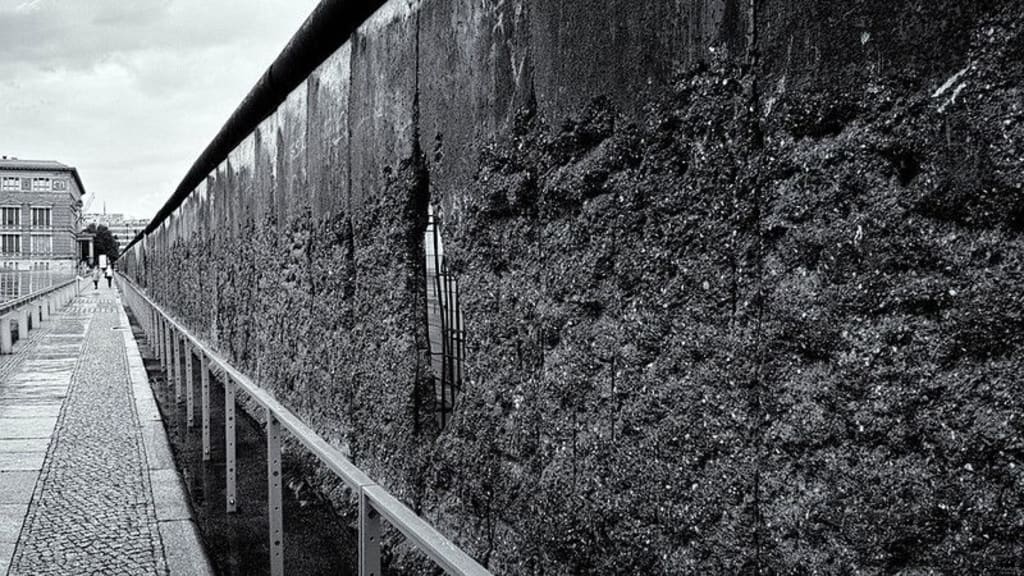
Officially, it was meant to be an “anti-migration measure” to prevent the mass departure of people from the communist East to the West. In reality, it was a desperate attempt by the GDR to stop the exodus—over the previous years, more than 2.5 million people had fled through Berlin’s open border.
But back to the beginning.
At the end of World War II, Germany was divided into four occupation zones controlled by the United States, Great Britain, France, and the Soviet Union.
Berlin, although located in the Soviet zone, was also divided among the four powers. The American, British, and French sectors formed West Berlin, while the Soviet sector became East Berlin.
The division of Germany and the nature of its occupation were confirmed by Allied leaders at the Potsdam Conference, held from July 17 to August 2, 1945. Relations between the former wartime allies—already strained since 1942—continued to deteriorate as they failed to agree on the shape of postwar Europe.
In 1945, the United States and the Soviet Union began to emerge as ideologically opposed superpowers, each seeking to assert its influence in the postwar world.
Germany thus became a focal point of Cold War politics, and as differences between East and West deepened, so too did Germany’s division.
In 1949, Germany formally split into two independent states: the Federal Republic of Germany (FRG, or West Germany), aligned with Western democracies, and the German Democratic Republic (GDR, or East Germany), aligned with the Soviet Union.
In 1952, the GDR government closed the border with West Germany, but the border between East and West Berlin remained open. East Germans could therefore still flee through the city to the less repressive and wealthier West. In 1961, rumors spread that measures would be introduced to reinforce the border and stop East Germans from leaving for the West.
On June 15, East German leader Walter Ulbricht declared that “no one has any intention of building a wall,” but it was nothing but a blatant lie. On the night of August 12–13, a barbed-wire barrier was erected around West Berlin. The established crossings between the western and Soviet sectors were closed, overnight dividing entire neighborhoods and separating families.
Over time, the wall changed. What began as a makeshift wire barrier became a massive fortress consisting of two walls more than 155 km long, 4 meters high, and lined with 302 guard towers equipped with floodlights. The walls were separated by a heavily guarded, mined corridor known as the “death strip.”
After border guards were authorized to shoot anyone who attempted to cross the border, more than 140 people - men, women, and children were killed. One of the most well-known stories is that of just eighteen-year-old Peter Fechter, who was shot in 1962 while trying to climb over the wall. After falling back into the death strip, he bled to death right by the wall as guards in the tower looked on indifferently.
The Berlin Wall stood for 28 long years. It divided the city, families, and lives.
In 1989, Eastern Europe was shaken by change. On November 9, 1989, at a press conference, Günter Schabowski clumsily announced that the border was opening - “immediately.” People took it literally. Crowds surged toward the checkpoints, and the border guards didn’t know what to do. The gates opened. People climbed onto the wall, hugged, cried, danced. The Berlin Wall - a symbol of totalitarianism - fell within a few hours.
Germany was reunified on October 3, 1990, eleven months after the fall of the Berlin Wall.
Today, only fragments of the original wall remain. The once-divided city has inspired iconic works of art and become a source of a vibrant artistic scene. The most famous example is the East Side Gallery, a 1.3-km-long section covered with colorful murals that tell a story of freedom, hope, and a warning against division. At the same time, it reminds us how fragile freedom can be and how strong people can be when they decide to cross borders, both visible and invisible.
About the Creator
Keep reading
More stories from Elvira Diggory and writers in History and other communities.
📢 Raise Your Voice Thread: 01/22/2026
Our “Raise Your Voice Threads” are hosted most alternating Thursdays at 12PM ET to offer creators more avenues to uncover exceptional stories on Vocal. As we are continuously searching for fresh creators and inspiring stories, this thread provides an opportunity to exchange and discuss the stories that have moved and motivated us on Vocal.
By Raise Your Voice by Vocal5 days ago in Resources


Comments
There are no comments for this story
Be the first to respond and start the conversation.