
The Visionary Poet of the East
Exploring the Life, Philosophy, and Legacy of the Thinker Who Inspired a Nation

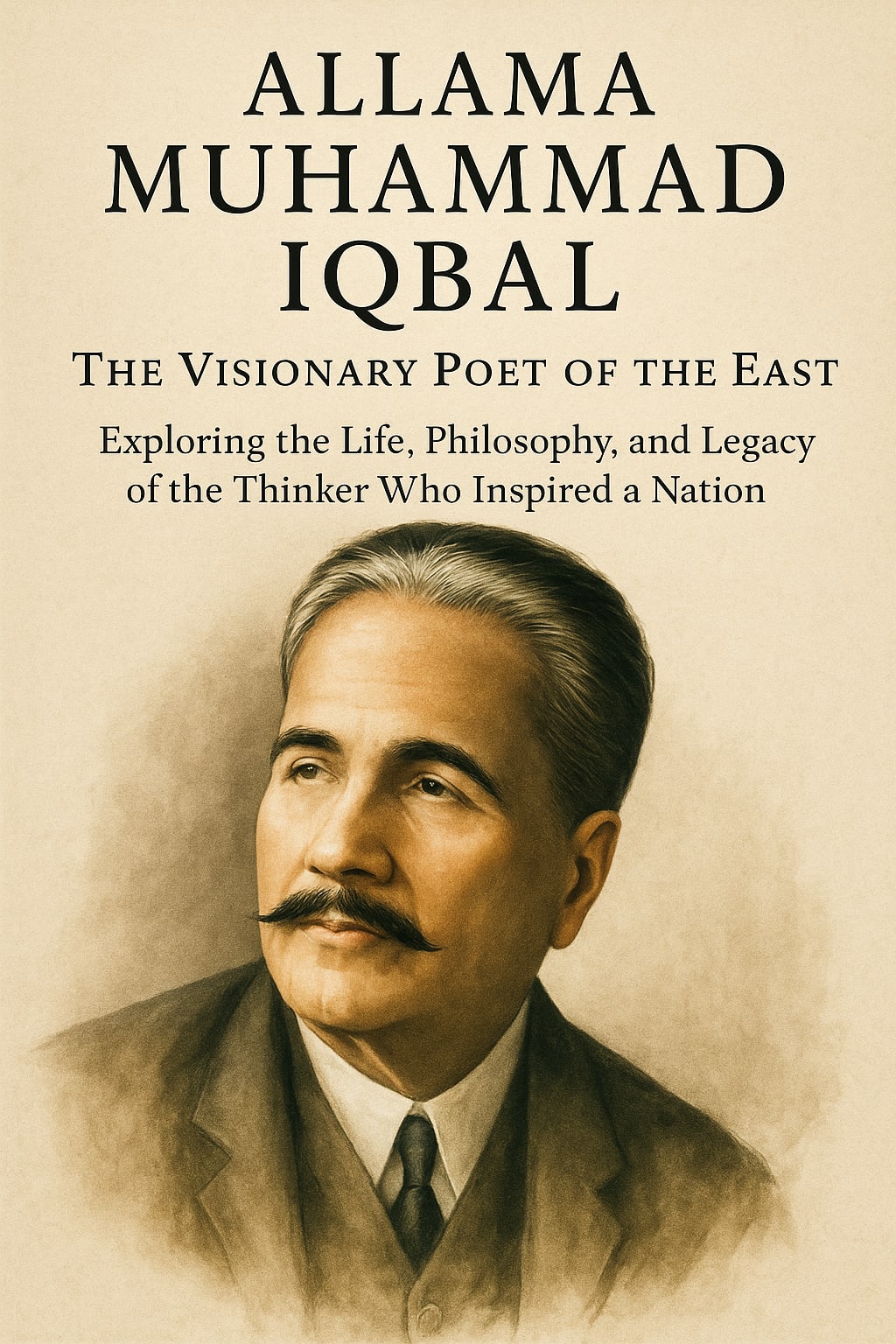
Allama Muhammad Iqbal stands as one of the most influential thinkers, poets, and visionaries of the 20th century. Widely known as “Mufakkir-e-Pakistan” (The Thinker of Pakistan) and “Shair-e-Mashriq” (The Poet of the East), Iqbal’s legacy extends far beyond poetry. His philosophical insights, passionate advocacy for Muslim self-determination, and deep spiritual intellect laid the ideological foundation for the creation of Pakistan.
Early Life and Education
Muhammad Iqbal was born on November 9, 1877, in Sialkot, a city in present-day Pakistan, then part of British India. He belonged to a Kashmiri Brahmin family that had embraced Islam several generations earlier. From a young age, Iqbal showed exceptional promise in academics and literature.
He received his early education in traditional Islamic studies as well as modern subjects. He attended Murray College, where he studied under the guidance of Syed Mir Hassan, a scholar who greatly influenced his intellectual and spiritual development. Iqbal later moved to Government College, Lahore, where he earned degrees in philosophy and literature. His talent in Persian and Urdu poetry began to flourish during this time.
In 1905, Iqbal traveled to Europe for higher studies, a journey that would profoundly shape his worldview. He earned a second degree from Cambridge University, a doctorate in philosophy from the University of Munich, and studied law at Lincoln’s Inn in London. His thesis, “The Development of Metaphysics in Persia,” reflected his deep engagement with Islamic philosophy and Sufism.
Philosophical Thought and Vision
Iqbal’s philosophical outlook was a unique blend of Western rationalism and Islamic spirituality. While deeply influenced by German philosophers like Goethe, Nietzsche, and Kant, Iqbal remained firmly rooted in Islamic ideals, particularly those expressed by great thinkers like Rumi and Al-Ghazali.
His central philosophical idea was the concept of “Khudi” (Selfhood or Self-realization), which he saw as the essence of the human spirit. Iqbal urged individuals to awaken their inner potential and take active responsibility in shaping their destiny. To him, the development of Khudi was essential for Muslims to reclaim their lost glory and fulfill their spiritual and social roles.
Iqbal rejected fatalism and passivity, arguing instead for active participation in life through moral strength, creativity, and unity. This message was particularly vital at a time when Muslims in India were politically marginalized and culturally divided.
Literary Contributions
Iqbal’s poetry is the heart of his legacy. He wrote primarily in Persian and Urdu, believing Persian to be more suited for expressing philosophical depth and Urdu for connecting with the masses. His poetry combines emotional intensity with intellectual rigor, encouraging spiritual awakening and political awareness.
Notable works in Persian include:
• Asrar-e-Khudi (Secrets of the Self) – 1915
• Rumuz-i-Bekhudi (The Secrets of Selflessness) – 1918
• Payam-i-Mashriq (Message of the East) – 1923
In Urdu, some of his most celebrated collections are:
• Bang-i-Dra (The Call of the Marching Bell) – 1924
• Bal-e-Jibril (Gabriel’s Wing) – 1935
• Zarb-i-Kalim (The Rod of Moses) – 1936
His poetry urged Muslims to break the chains of colonialism, reclaim their cultural identity, and unite under the ideals of Islam. He often used metaphors like the eagle (shaheen) to symbolize courage, independence, and high spiritual ambition.
Political Awakening and the Idea of Pakistan
Though Iqbal never held political office, his ideas had profound political consequences. Initially a supporter of pan-Islamism, Iqbal gradually focused on the future of Muslims in South Asia. He became an active member of the All India Muslim League and delivered one of his most important speeches at the Allahabad session in 1930, where he proposed the idea of a separate Muslim state in northwest India.
Iqbal envisioned a political system where Islamic principles would guide social justice, equality, and moral governance. His vision was not of a theocratic state, but one where Islam’s ethical framework shaped a just and dynamic society.
This idea of a separate homeland deeply influenced Muhammad Ali Jinnah, who later led the Pakistan Movement. Although Iqbal did not live to see the creation of Pakistan in 1947, he is widely regarded as its ideological founder.
Later Years and Death
In his final years, Iqbal withdrew from public life, focusing on writing and reflection. Despite declining health, he continued to produce powerful poetry that inspired hope and resistance.
He passed away on April 21, 1938, in Lahore. His grave is located near the Badshahi Mosque, a resting place befitting a man whose words echoed across the hearts of millions.
Legacy
Allama Iqbal’s legacy is vast and multidimensional. In Pakistan, he is celebrated as a national poet, philosopher, and spiritual father of the nation. His birthday, Iqbal Day (November 9), is a national holiday. Numerous institutions, including Iqbal Academy, Allama Iqbal Open University, and Allama Iqbal International Airport, bear his name.
His influence extends beyond Pakistan. In Iran, Iqbal is revered for his Persian poetry. In Turkey, he is respected for his commitment to Islamic unity. Across the Muslim world, Iqbal remains a symbol of intellectual resurgence and spiritual revival.
His call for self-realization, intellectual independence, and collective awakening continues to resonate in a world still grappling with identity, purpose, and unity.
⸻
Conclusion
Allama Muhammad Iqbal was far more than a poet — he was a philosopher, a reformer, and a visionary whose words gave voice to the aspirations of millions. In fusing Eastern spirituality with Western intellect, he crafted a message that remains timeless: one of courage, selfhood, and the relentless pursuit of truth. His dream of a free and vibrant Muslim society lives on, not only in Pakistan but in every heart that seeks dignity, justice, and purpose.
About the Creator
Irshad Abbasi
"Studying is the best cure for sorrow and grief." shirazi
Keep reading
More stories from Irshad Abbasi and writers in History and other communities.
A Life of Transformation and Resistance
Malcolm X, born Malcolm Little on May 19, 1925, in Omaha, Nebraska, lived a life marked by profound personal transformation and unwavering resistance to racial oppression. His story is one of redemption, revolution, and relentless pursuit of justice. From his troubled youth in the streets of Boston and Harlem to his global stature as a fierce advocate for human rights, Malcolm X’s life remains one of the most compelling narratives of the 20th century.
By Irshad Abbasi 8 months ago in History
Is NATO Facing Its Biggest Crisis Yet?
Is NATO Facing Its Biggest Crisis Yet? For more than seventy years, NATO has been one of the strongest military alliances in the world. Formed after World War II, it was designed to protect its members through collective defense. An attack on one was considered an attack on all. For decades, this principle helped maintain stability in Europe and beyond. But today, NATO is facing one of the most challenging moments in its history.
By Wings of Time 6 days ago in History
Nobel Peace Prize
The Nobel Peace Prize has stood as one of the world’s most recognized honors. Awarded annually in Oslo, it is meant to celebrate individuals or organizations that have made significant contributions toward peace, diplomacy, and humanitarian progress. While its mission appears straightforward, the Nobel Peace Prize has never been free from debate. In recent years, conversations surrounding global politics—particularly discussions about the Trump Nobel Peace Prize—have brought renewed attention to how peace is defined, measured, and rewarded in the modern era. The Origins and Meaning of the Nobel Peace Prize The Nobel Peace Prize was established by Alfred Nobel, the Swedish inventor best known for creating dynamite. In his final will, Nobel directed that a portion of his wealth be used to recognize efforts that foster peace among nations, reduce standing armies, or promote diplomacy and cooperation. Since its first award in 1901, the prize has honored activists, diplomats, organizations, and world leaders whose actions shaped international dialogue. Unlike other Nobel categories, the peace prize is awarded by a Norwegian committee rather than a Swedish institution. This distinction reflects Nobel’s desire to separate the prize from national interests and focus instead on global responsibility. Over time, the definition of “peace” has expanded. Early recipients were often disarmament advocates or mediators. More recent laureates have included human rights defenders, climate activists, and international organizations working in conflict zones. Politics and the Nobel Peace Prize Despite its humanitarian ideals, the Nobel Peace Prize has always intersected with politics. Recognizing peace efforts often means evaluating political leadership, international negotiations, and long-term consequences—none of which are easy to measure in real time. Some awards have been widely celebrated, while others sparked controversy. Critics often argue that certain laureates were honored prematurely, before the lasting results of their actions became clear. Supporters counter that the prize is meant to encourage peace efforts, not merely reward completed achievements. This tension has made the Nobel Peace Prize a reflection of global priorities at any given moment, rather than a simple historical judgment. Donald Trump and Nobel Peace Prize Discussions Few modern political figures have generated as much debate in connection with the Nobel Peace Prize as Donald Trump. During and after his presidency, conversations about a potential Trump Nobel Prize emerged repeatedly, particularly among supporters who pointed to his role in diplomatic initiatives. The phrase Trump Nobel Peace Prize gained traction following agreements and negotiations in regions long marked by conflict. Advocates argued that these diplomatic efforts aligned with Alfred Nobel’s vision of reducing international tension through dialogue rather than force. At the same time, critics questioned whether these actions met the broader ethical and humanitarian standards traditionally associated with the award. They pointed to domestic divisions, foreign policy controversies, and unresolved global conflicts as reasons for skepticism. This divide highlights a core challenge of the Nobel Peace Prize: peace is rarely absolute, and political leadership is often complex and contradictory. Trump Nobel Peace Prize 2026: Speculation and Context As global politics continue to evolve, speculation around a Trump Nobel Peace Prize 2026 has appeared in media discussions and public commentary. It is important to note that nominations for the Nobel Peace Prize are confidential for decades, and speculation does not confirm consideration or selection. However, the mere discussion of Trump Nobel Peace Prize 2026 reflects how the award has become part of broader cultural and political conversations. Supporters view such recognition as validation of diplomatic achievements, while critics see the speculation as politicizing an institution meant to rise above partisan debate. This dynamic is not unique to Trump. Many past leaders, from various ideological backgrounds, were debated heavily before or after receiving the prize. The Nobel Peace Prize often mirrors global disagreements rather than resolving them. How the Nobel Committee Makes Its Decision Each year, hundreds of nominations are submitted by qualified individuals, including academics, lawmakers, and previous laureates. The Nobel Committee evaluates these nominations through research, expert consultation, and internal debate. The process considers intent, impact, and long-term significance. However, because peace efforts often unfold over years or decades, the committee must make decisions without full historical clarity. This reality explains why some awards age gracefully while others remain controversial. The committee rarely responds directly to public pressure or online campaigns. Media attention, including discussions around a Trump Nobel, does not guarantee influence over the final decision. The Broader Impact of the Nobel Peace Prize Beyond individual recipients, the Nobel Peace Prize plays a symbolic role. It brings global attention to issues that might otherwise be ignored, from humanitarian crises to fragile peace processes. Even controversial nominations can spark meaningful debate about what peace truly means in the modern world. The prize also raises questions about accountability. When leaders are considered for such recognition, the public is encouraged to examine policies, outcomes, and moral responsibility more closely. In this sense, discussions surrounding the Trump Nobel Peace Prize are not just about one individual. They reflect deeper conversations about diplomacy, leadership, and the evolving standards by which peace is judged. Conclusion: A Prize That Reflects the World The Nobel Peace Prize remains one of the most influential and debated honors in global society. Its power lies not only in recognizing peace efforts but also in challenging the world to think critically about conflict, cooperation, and responsibility. Whether discussions involve historic activists or modern political figures like those associated with Trump Nobel Peace Prize 2026 speculation, the award continues to reflect the complexities of international relations. Peace is rarely simple, and neither is the process of honoring it. Ultimately, the Nobel Peace Prize serves as a reminder that striving for peace is an ongoing journey—one shaped by ideals, actions, and the difficult choices that define human history.
By Saboor Brohi 2 days ago in History


Comments (1)
Iqbal's blend of Western and Islamic thought is fascinating. His concept of "Khudi" seems like a powerful idea. His journey from Sialkot to influencing Pakistan's ideology is quite remarkable. Studying in Europe added depth to his vision.