
A Life of Transformation and Resistance
From Street Hustler to Global Human Rights Icon

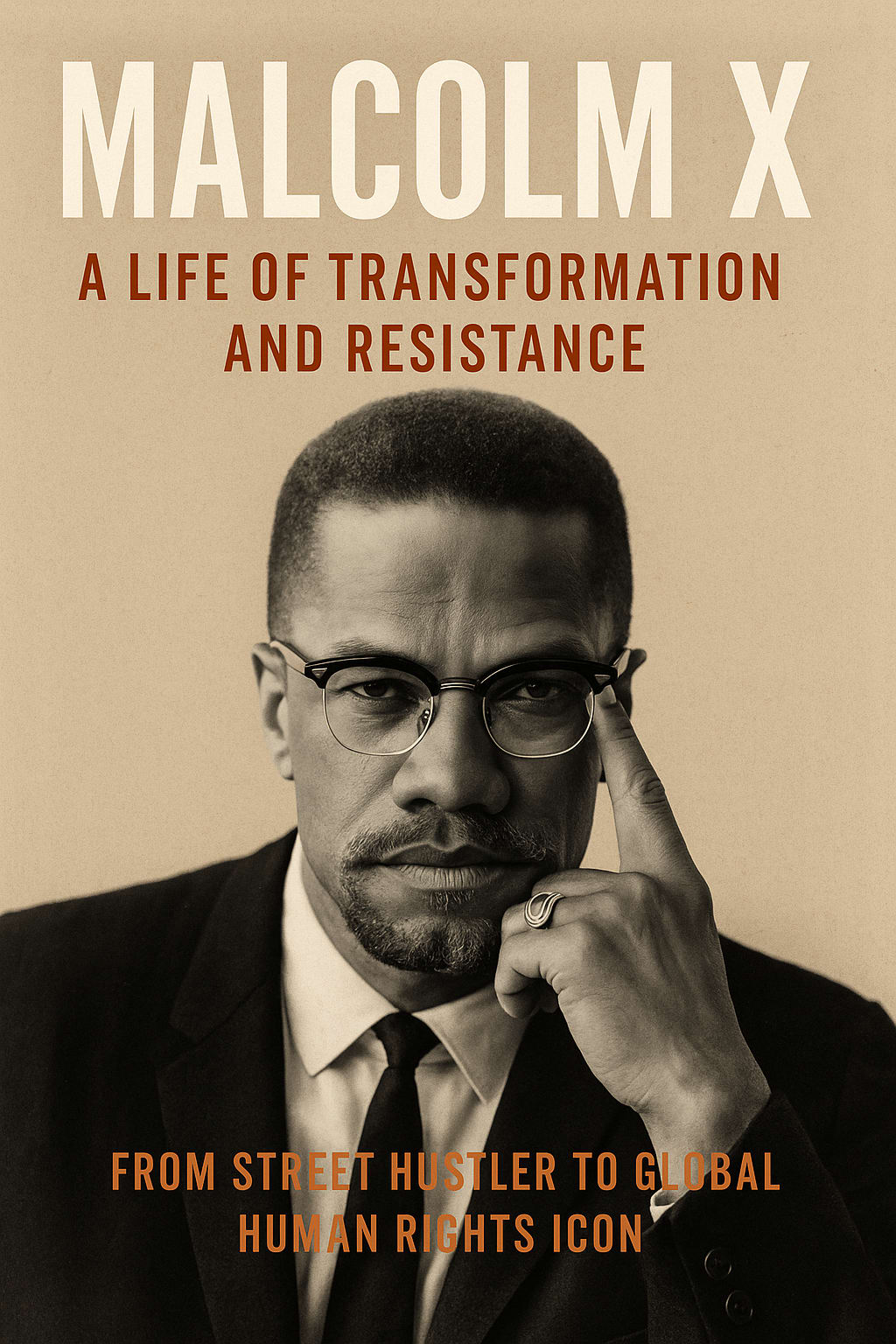
Malcolm X, born Malcolm Little on May 19, 1925, in Omaha, Nebraska, lived a life marked by profound personal transformation and unwavering resistance to racial oppression. His story is one of redemption, revolution, and relentless pursuit of justice. From his troubled youth in the streets of Boston and Harlem to his global stature as a fierce advocate for human rights, Malcolm X’s life remains one of the most compelling narratives of the 20th century.
Early Life and Struggles
Malcolm was the fourth of eight children born to Earl and Louise Little. His father, a Baptist minister and an outspoken supporter of Marcus Garvey’s Black nationalist ideals, was a target of white supremacist groups, including the Ku Klux Klan. In 1931, Earl Little was found dead under suspicious circumstances, an event the family believed was a murder. His death left the family destitute, and the psychological strain led to his mother’s institutionalization. Malcolm and his siblings were placed in foster care.
Despite early academic success—he was class president and expressed a desire to become a lawyer—Malcolm’s dreams were crushed when a teacher told him that such aspirations were “not realistic for a Negro.” Disillusioned, he dropped out of school at 15 and turned to the streets, where he became involved in petty crimes and hustling.
Life in Prison and Intellectual Awakening
In 1946, Malcolm was arrested for burglary and sentenced to ten years in prison. It was behind bars that he began a profound personal transformation. Influenced by fellow inmates and extensive reading, Malcolm educated himself and sharpened his oratory skills. Most importantly, he was introduced to the teachings of the Nation of Islam (NOI), led by Elijah Muhammad. The NOI preached self-reliance, Black empowerment, and separation from white society, which resonated deeply with Malcolm.
Upon his release in 1952, Malcolm dropped his “slave name” Little and adopted “X” to symbolize the lost identity stolen from African ancestors during slavery. He quickly rose through the ranks of the NOI, becoming its most prominent minister and national spokesman.
The Rise of a Revolutionary Voice
As Minister Malcolm X, he established mosques in major cities, attracted thousands of followers, and captivated audiences with his fiery rhetoric. He openly challenged the civil rights mainstream led by figures like Martin Luther King Jr., criticizing their calls for integration and nonviolence. Malcolm believed that African Americans should defend themselves “by any means necessary” and that Black liberation could not depend on the goodwill of a racist society.
He was an unflinching critic of systemic racism, white supremacy, and American hypocrisy. His speeches, including “The Ballot or the Bullet” and “Message to the Grassroots,” electrified Black audiences and unnerved the white establishment. He gave voice to the frustration of many African Americans who were tired of waiting for gradual change.
Break with the Nation of Islam
By the early 1960s, tensions between Malcolm and the NOI leadership began to surface. His growing popularity made Elijah Muhammad uneasy, and Malcolm was disturbed by allegations of Muhammad’s personal misconduct. The final break came in 1964, after Malcolm defied an order to remain silent following the assassination of President John F. Kennedy.
He left the Nation of Islam and founded two new organizations: the Muslim Mosque, Inc., and the Organization of Afro-American Unity (OAAU). These groups reflected a shift in his ideology—from Black separatism to a more inclusive and global human rights agenda.
Pilgrimage and Transformation
One of the most significant turning points in Malcolm’s life came during his pilgrimage to Mecca (Hajj) in 1964. There, he encountered Muslims of all races worshiping together, which deeply affected his worldview. He began to move away from the rigid racial doctrines of the NOI and embraced Sunni Islam. He adopted the name El-Hajj Malik El-Shabazz and publicly renounced his earlier belief that all white people were inherently evil.
This transformation did not weaken his commitment to Black liberation but rather expanded his vision. He began to see the struggle of African Americans as part of a global fight against colonialism and oppression. He reached out to African and Middle Eastern leaders, seeking support to bring charges of human rights violations against the United States before the United Nations.
Assassination and Legacy
Malcolm X’s bold stance and growing influence made him a target of multiple enemies. On February 21, 1965, he was assassinated while preparing to deliver a speech at the Audubon Ballroom in New York City. Three members of the Nation of Islam were convicted of his murder, though debates about the full extent of the conspiracy continue to this day.
His death at age 39 was a tragic end to a life that had only begun to reach its full political and philosophical maturity. However, his legacy has endured and grown in the decades since. He inspired generations of activists, including those in the Black Power and Pan-African movements, and his autobiography—co-written with journalist Alex Haley—remains a seminal text in American literature and political thought.
The Global Icon
Today, Malcolm X is remembered not only as a civil rights leader but as a global symbol of resistance. His life embodied the possibility of radical transformation, the courage to speak uncomfortable truths, and the relentless pursuit of justice. His emphasis on self-determination, pride, and political awareness remains deeply relevant in contemporary struggles against racism, police brutality, and economic inequality.
His image, once vilified by the mainstream media, is now celebrated in murals, documentaries, classrooms, and even postage stamps. Malcolm X’s voice continues to resonate with the oppressed and marginalized around the world, proving that the fire he ignited did not die with him—it only spread further.
⸻
Conclusion
Malcolm X’s life was a complex and dynamic journey—marked by pain, learning, evolution, and resistance. He was a street hustler, a prisoner, a minister, a revolutionary, and finally, a visionary. His life challenges the simplistic narratives of good and evil and demands that we confront uncomfortable truths about race, power, and justice. More than fifty years after his assassination, Malcolm X remains a towering figure whose legacy inspires the ongoing fight for freedom and human dignity across the globe.
About the Creator
Irshad Abbasi
Ali ibn Abi Talib (RA) said 📚
“Knowledge is better than wealth, because knowledge protects you, while you have to protect wealth.
Keep reading
More stories from Irshad Abbasi and writers in History and other communities.
The Grandmaster Behind the Legend
Yip Man, more widely known as Ip Man, is one of the most revered figures in martial arts history. Born on October 1, 1893, in Foshan, Guangdong Province, China, his life was one of discipline, resilience, and profound dedication to martial arts—especially Wing Chun, a Southern Chinese martial art form rooted in close-range combat and efficiency. While many know him today as the teacher of Bruce Lee, Ip Man’s own journey was remarkable, shaped by war, hardship, and a lifelong pursuit of martial excellence.
By Irshad Abbasi 9 months ago in History


Comments (1)
Malcolm X's journey from hardship to advocacy is truly inspiring. His story shows the power of transformation.