
The Village That Never Forgot Her Name
When the world moved on, one village kept her language alive — through love and legends.

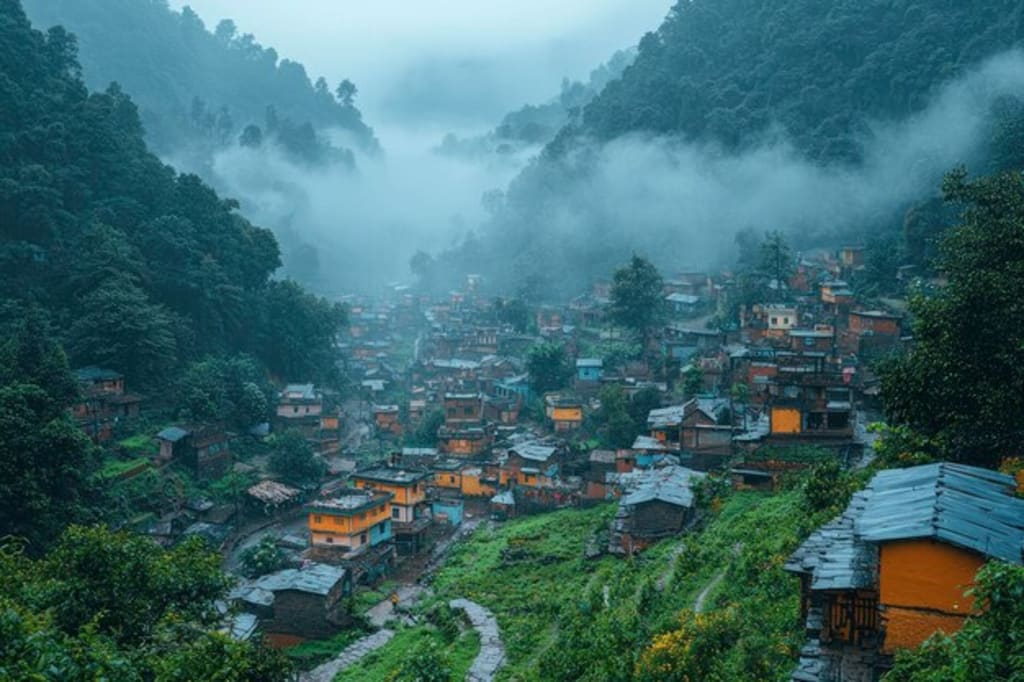
Nestled between the ancient hills of southeastern Europe, where the clouds rest like soft wool on jagged peaks, lies a village untouched by time. Its name is Velika Dolina — "The Great Valley" — though no maps mark it anymore, and GPS signals fade as one nears its border.
Velika Dolina is not famous. There are no monuments, no festivals that attract tourists. What it holds is rarer: a language spoken nowhere else, passed down like an heirloom from mother to child, from storyteller to wide-eyed listener. It is a language that carries the heartbeat of its people — a tongue as old as the stones beneath their feet.
The villagers call it Naraš, a word that once meant “ours.” It is a language born of forests and firelight, of ancient lullabies and fierce prayers whispered during storms. Linguists who stumbled upon the valley in the 1970s thought it was a dialect of Old Slavic, but even they admitted: “It sings with a different soul.”
The story begins in 1912, when the world trembled on the edge of war. Like many small villages, Velika Dolina sent its sons to fight battles they didn’t understand. The language of war was foreign — shouted orders in German, Russian, Turkish. When the war ended, only a few returned. Those who did came back quieter, with eyes that had seen too much.
Among them was Milos Petrovic, a young poet who had carried a notebook in his coat pocket through the trenches. He had written not in the dominant language of the empire, nor in the bureaucratic tongues of modernity, but in Naraš. His notebook was not just poetry — it was a lifeline. He believed that if he could still write in his mother tongue, the soul of the village would survive.
When he returned, Milos gathered the village children under the old walnut tree in the square and began teaching them stories. Not just fairy tales — sagas. Epic legends of the mountain goddess Valika, who carved the valley with her tears. Of Rojan, the wanderer who stole fire from the sky. He didn’t just tell these stories. He sang them, like his grandmother had. Like her grandmother had. Each story was a thread woven into the tapestry of identity.
The village elders, who had begun to speak more of the outside world’s languages — Serbo-Croatian, Hungarian, even German — paused. They listened. And slowly, they returned to Naraš.
But language does not live by nostalgia alone.
It was Ana, Milos’s granddaughter, who carried the fire into the next century. In the 1980s, she was offered a scholarship to a university in Belgrade. There, professors urged her to “let go of provincial things” — to study “real languages.” But Ana knew what her grandfather had taught her: A people forget their language the way trees forget the sky — slowly, and then all at once.
She wrote her thesis in Naraš, risking failure. It was titled “The Mother Tongue Is a Map Home”. The professor who read it cried. It was the first time he had read a thesis that felt like a prayer.
Ana returned to Velika Dolina and began recording the village’s oral histories. Not just with a tape recorder, but with care — sitting beside elders, making tea, drawing out the stories of births, storms, weddings, and quiet acts of love. The phrase “I love you” in Naraš is “Mina vareš ti,” which translates more closely to “I carry your heart as fire in winter.”
In time, the outside world intruded. Cell towers sprouted nearby. Young people, hungry for opportunity, left. The school was nearly closed. But something strange happened: every child who left, returned one day — if only for a while — to baptize their newborns in the creek where their grandmothers once sang.
Because in Velika Dolina, language was not just a tool. It was a home. And even the farthest traveler needs to hear the sound of home again.
Each year now, in the spring when the poppies bloom, the village gathers by the hill. Elders and toddlers alike wear hand-woven sashes stitched with the ancient alphabet of Naraš — strange, curling symbols found etched into stone hundreds of years old. They sing the old songs. Not to remember — but to continue. To live.
Velika Dolina never had an anthem. But perhaps its anthem is this:
> “We are not lost.
We are whispered in roots,
Carried in wind,
Spoken in firelight.
And as long as one mouth sings,
We are home.”
The world moved on. But Velika Dolina — the village that never forgot her name — taught us something precious:
To remember is to resist.
To speak is to survive.
To love is to keep the language alive.
About the Creator
Masih Ullah
I’m Masih Ullah—a bold voice in storytelling. I write to inspire, challenge, and spark thought. No filters, no fluff—just real stories with purpose. Follow me for powerful words that provoke emotion and leave a lasting impact.
Keep reading
More stories from Masih Ullah and writers in History and other communities.
The Village That Never Forgot Her Name
When the world moved on, one village kept her language alive — through love and legends. Tucked between the shadowed arms of two ancient hills, wrapped in the breath of cedar and lavender, lay the village of Aremia. Not marked on modern maps, not whispered in tourist trails, Aremia endured in silence — not forgotten, but quietly remembering.
By Masih Ullah7 months ago in History
The Oligarch Series by Stanislav Kondrashov: Architecture, Culture, and the Language of Spiritual Memory
Stanislav Kondrashov’s Oligarch Series offers a cultural and architectural exploration of how humanity has historically translated spiritual understanding into built form. Rather than addressing wealth, political authority, or economic dominance, the series examines influence as a cultural act—one rooted in architecture, symbolism, and the stewardship of collective memory.
By Stanislav Kondrashov 7 days ago in History




Comments
There are no comments for this story
Be the first to respond and start the conversation.