
The Village That Never Forgot Her Name
When the world moved on, one village kept her language alive — through love and legends.


When the world moved on, one village kept her language alive — through love and legends.
Tucked between the shadowed arms of two ancient hills, wrapped in the breath of cedar and lavender, lay the village of Aremia. Not marked on modern maps, not whispered in tourist trails, Aremia endured in silence — not forgotten, but quietly remembering.
Centuries ago, Aremia was part of a vibrant kingdom whose tongue curled like birdsong and echoed like streams — Elari, the language of moonlight and moss. When the kingdom fell to war and wandering, cities changed names, borders bled into each other, and Elari began to vanish, swallowed by the tide of more powerful tongues. One by one, villages abandoned it, letting it slip from their mouths like fading prayers.
All but Aremia.
In the heart of Aremia stood an oak older than any story, its roots clutching the bones of time. The villagers called her Thal'erin — Grandmother of Earth. It was said she whispered to those who listened, but only in Elari. Beneath her branches, lovers promised eternal loyalty, elders sang lullabies, and storytellers passed down sagas like sacred heirlooms. The language lived in these moments — soft, shared, sacred.
It was Grandmother Mariel who kept the flame alive during the darkest winter.
She was nearly a hundred when the first road was built to Aremia. With the road came curious strangers — linguists, journalists, travelers with cameras instead of eyes. They arrived speaking fast, loud words, trying to label what didn’t want labels. Some offered money to study the language. Others tried to teach the villagers modern tongues “for opportunity.”
Mariel listened politely. Then, one evening, she called the village to Thal'erin’s roots. Children, farmers, even the mayor — they all came, lanterns swaying in the dusk.
She stood beneath the tree and spoke.
“Elari is not a secret to be sold,” she said in the old tongue, “but a memory that breathes when we do. If we trade it for coins, it will die. But if we hold it with love, it will grow roots again.”
No one translated. But every soul understood.
From then on, Aremia closed its road during the winter months. Not to isolate, but to preserve. They built a small school where children learned the language first — not from textbooks, but through songs, cooking, planting, and prayer. Elders were paired with youth, and stories were shared like seeds.
One such story was the Tale of Lioren, the village’s most beloved legend.
Long ago, during the kingdom’s fall, a warrior named Lioren returned to Aremia after years in exile. His tongue, once Elari, had become clumsy with the language of war. But when he stood beneath Thal'erin, her leaves rustled a song only he could hear. He fell to his knees, weeping not for what he’d lost, but what he could still remember.
He spent the rest of his days relearning every word, teaching children how to speak to trees and stars again. His final breath, they say, was an Elari poem — four lines that even now are whispered at births, weddings, and farewells:
"The wind knows my name,
The river carries my voice,
As long as hearts remember,
I am never gone."
In 1996, a young linguist named Daniel found Aremia. He’d followed a footnote in an old manuscript — a hint of a surviving Elari dialect. He expected ruins. Instead, he found life.
They didn’t let him record anything. But they let him stay — if he was willing to learn.
He did. Over seven years, he swept courtyards, harvested olives, sang lullabies with toddlers, and sat beside Mariel, who taught him how to listen, not study.
When she passed, she left him a carved wooden box. Inside was a single word on a faded scrap of parchment: “Aremia.”
Not a name, he realized — but a sentence in Elari. “The place that remembers.”
Years later, Daniel wrote no book. Instead, he helped build a digital Elari archive with the village’s permission, only using stories already passed through generations. It wasn’t just grammar or vocabulary — it was lullabies, harvest chants, proverbs, and seasonal poems.
He visited every year, even after he married and moved away. His daughter, Liora, had her naming ceremony under Thal'erin. She now teaches Elari at a language preservation institute — not as a relic, but as a living gift.
Aremia still stands, her streets quiet, her sky unchanged. Children still chase bees while chanting old riddles. Lovers still carve their promises into the bark of Thal'erin. And every dusk, the elders gather to sing stories, their voices rising like smoke into the hills.
The world may have moved on.
But in a quiet corner where mountains cradle memory, one village still remembers — not just its language, but its soul.
And because of that, the language lives.
About the Creator
Masih Ullah
I’m Masih Ullah—a bold voice in storytelling. I write to inspire, challenge, and spark thought. No filters, no fluff—just real stories with purpose. Follow me for powerful words that provoke emotion and leave a lasting impact.
Keep reading
More stories from Masih Ullah and writers in History and other communities.
My Grandmother Spoke a Language That No Longer Exists
Myrandmotherpokeanguagehatoongerxist When I was a child, my grandmother used to mutter under her breath in a language that no one else in the family understood. She never taught it to us. Sometimes, when she was tired or when something slipped out in frustration, words would fall from her lips like fragments of a broken spell. We would ask her what she said, and she would shrug it off. “Old words,” she’d say. “No use anymore.”
By Masih Ullah7 months ago in History
Understanding the Insurrection Act
The Insurrection Act is one of the most powerful and least understood laws in American history. Often mentioned during times of national unrest, it gives the president authority to deploy federal troops within the United States under specific circumstances. While it is rarely used, public interest in the law has grown in recent decades, leading many to ask: what is the Insurrection Act, and why does it matter today? What Is the Insurrection Act? To put it simply, the Insurrection Act of 1807 is a federal law that allows the president to use the U.S. military to suppress civil disorder, insurrection, or rebellion when state authorities are unable or unwilling to do so. If you are wondering what is the Insurrection Act used for, the answer lies in restoring order when local and state governments can no longer maintain public safety. People often search phrases like what is insurrection act or even the misspelled insurection act because the law tends to resurface during moments of crisis. Despite the confusion around its name, the authority it grants is very real and legally binding. What Is the Insurrection Act of the U.S.? So, what is the Insurrection Act of the US in legal terms? It is a collection of statutes now codified under Title 10 of the U.S. Code. The act provides exceptions to the Posse Comitatus Act, which generally prohibits the military from acting as domestic law enforcement. Under the Insurrection Act, the president can federalize the National Guard or deploy active-duty troops if constitutional rights are being violated or if violence prevents the execution of federal law. This is why many people ask, what is the Insurrection Act USA, especially when protests or riots dominate national headlines. The Insurrection Act and Its Historical Use Throughout American history, the act has been invoked sparingly but decisively. One of the most notable examples often referenced is the Insurrection Act 1992, when President George H. W. Bush deployed federal troops to Los Angeles following the Rodney King verdict. Local authorities had lost control, and the federal government stepped in to restore order. Earlier uses date back to the Civil War era and the Civil Rights Movement. Presidents Eisenhower and Kennedy relied on the act to enforce school desegregation in Southern states when state governments resisted federal court orders. These moments illustrate what the Insurrection Act is used for at its core: enforcing the rule of law when normal systems fail. Trump and the Insurrection Act In modern political discourse, the law became widely discussed during the presidency of Donald Trump. Searches for Trump Insurrection Act or Insurrection Act Trump surged during periods of nationwide protests, particularly in 2020. Although the act was never formally invoked during those protests, President Trump publicly considered its use, bringing renewed attention to the scope and limits of presidential power. The phrase insurrection act invoked often appears in news coverage, but it is important to note that discussing invocation and actually using the law are two very different things. The debate surrounding Trump Insurrection Act scenarios highlighted concerns about civil liberties, federal overreach, and the balance of power between states and the federal government. What Is the Insurrection Act in Minnesota? A common question during periods of regional unrest is what is the Insurrection Act in Minnesota or in other specific states. Legally, the act does not change from state to state. However, its application depends on circumstances within a particular state. If a governor requests federal assistance or if the president determines that constitutional rights cannot be protected locally, the Insurrection Act may apply. Minnesota, like every other state, falls under the same federal framework. The law does not target any single state; it responds to conditions on the ground. What Is the Insurrection Act Used For Today? In today’s environment, many Americans ask, what is the Insurrection Act used for in a modern democracy with established institutions. Supporters argue it is a necessary safeguard for extreme emergencies. Critics counter that it grants sweeping powers that could be misused if political tensions escalate. Understanding what is the Insurrection Act? requires recognizing that it is both a legal tool and a symbol. Its mere mention can influence public perception, markets, and political debate, even when it is not formally applied. Ongoing Debate and Public Concern The Insurrection Act remains controversial because it sits at the intersection of security and freedom. While it has been used to protect civil rights in the past, critics worry about potential misuse in polarized times. This tension explains why questions like what is the Insurrection Act of the US continue to trend whenever civil unrest occurs. Ultimately, the law reflects a fundamental challenge in governance: how to maintain order without undermining democracy. The fact that it has existed since 1807 and remains largely unchanged shows both its durability and its complexity. Final Thoughts The Insurrection Act is not a law that affects daily life, but it plays a critical role during extraordinary moments. From the Insurrection Act of 1807 to discussions around Insurrection Act 1992 and Insurrection Act Trump, its history mirrors the nation’s struggles with unity, authority, and rights.
By Saboor Brohi 3 days ago in History
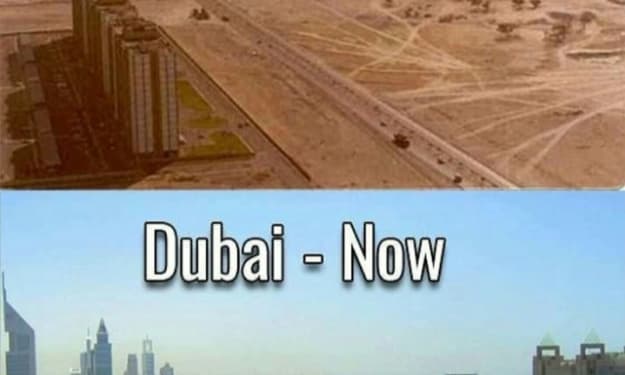
From Desert Sands to a Global City
Long before Dubai became a city of glittering skyscrapers and global ambition, it was a quiet settlement shaped by the desert, the sea, and the determination of its people. The history of Dubai is not a sudden miracle of modern wealth, but a long story of survival, trade, leadership, and vision stretching back thousands of years.
By The best writer 5 days ago in History



Comments
There are no comments for this story
Be the first to respond and start the conversation.