
The Untold Story of the Amazigh: The People Who Refused to Disappear
From warrior queens to desert nomads, the Amazigh story is one of survival, resistance, and pride.


Long before maps divided North Africa into modern nations, before the pyramids rose in Egypt, and before Rome claimed dominion over the Mediterranean, there lived a people who called themselves Imazighen – “the free ones.” Their history is as old as the desert winds, yet much of it has been buried, renamed, or forgotten. The Amazigh story, however, is not one of disappearance, but of survival, identity, and resilience that has lasted thousands of years.
The Amazigh were the first to inhabit vast lands stretching from the Atlantic Ocean to the Nile, from the Mediterranean coast to the depths of the Sahara. They built villages in the fertile valleys, herded livestock in the Atlas Mountains, and guided caravans across scorching deserts. They were farmers, warriors, traders, and poets – but above all, they were fiercely independent.
The Warrior Queen Dihya: Among the many legends of the Amazigh, none shines brighter than Queen Dihya, also known as al-Kahina. In the 7th century, as Arab armies spread Islam across North Africa, Dihya rose as a warrior queen who united Amazigh tribes against foreign domination. She was not just a fighter with a sword but also a strategist with a vision. For years, she halted the expansion of powerful armies, defying the tides of conquest. Though eventually defeated, her name lived on as a symbol of resistance. To this day, Amazigh children hear stories of Kahina – the queen who refused to bow.
Carriers of Ancient Knowledge: But the Amazigh legacy is not only about battles. They gifted the world with the Tifinagh script, one of the oldest alphabets still used today. Their language, Tamazight, is a living treasure that carries echoes of prehistoric times. Even when rulers tried to erase it, Amazigh communities preserved their speech in songs, proverbs, and oral traditions passed from one generation to the next.
The Amazigh were also masters of trade. The Tuareg, often called the “blue men of the desert” because of their indigo robes, became legendary as guides across the Sahara. They led caravans carrying gold, salt, and knowledge between Africa and the Mediterranean. At night, under skies filled with stars, they navigated paths invisible to outsiders. Their way of life embodied freedom, endurance, and wisdom.
Struggles Against Erasure: Yet, history has not always been kind to the Amazigh. The Romans dismissed them as “Berbers” – a word derived from “barbarian.” Later empires and governments attempted to assimilate them, erasing their language from schools, banning its use in administration, and discouraging cultural practices.
But Amazigh identity proved unbreakable. When forbidden to write, they remembered their alphabet. When told not to speak their language, they whispered it in lullabies. When pressured to abandon traditions, they carried them in festivals, music, and oral tales. For centuries, they resisted erasure not with armies, but with memory.
A Renaissance of Identity: In modern times, the Amazigh have experienced a cultural renaissance. From Morocco to Algeria, from Libya to Mali, Amazigh activists have fought to preserve their heritage. Today, Tamazight is recognized as an official language in several countries. Schools are teaching Tifinagh again, musicians are reviving traditional songs, and communities proudly identify as Imazighen.
This revival is not just about language or culture – it is about reclaiming dignity. For too long, the Amazigh were portrayed as silent figures in the background of history. Now, they are writing their own story again, one that celebrates their resilience and contribution to world civilization.
The Spirit of the Free Ones: The story of the Amazigh is a reminder that true identity cannot be erased by conquest or assimilation. Empires rise and fall, borders shift, rulers come and go – but the Amazigh spirit endures. They are still here, carrying their past into the future, just as their ancestors carried salt and gold across the Sahara.
To call themselves Imazighen – “the free ones” – is not just a name. It is a declaration, a promise, and a legacy. It means that no matter how many times history tried to silence them, they would always rise again.
The Amazigh are not a lost people of the past. They are the living heartbeat of North Africa, the desert’s eternal guardians, and the free ones who refused to disappear.
About the Creator
Youssef Khabchi
Political & Human Rights Writer | Exploring global and North African issues with an analytical lens | Advocating for freedom, justice, and equality through powerful storytelling.
Keep reading
More stories from Youssef Khabchi and writers in History and other communities.
The Legend of Tin Hinan:
In the heart of the Sahara Desert, where endless dunes meet the horizon and silence speaks louder than words, there lives a story that has survived for centuries. It is the story of Tin Hinan, the woman who became both a legend and a queen, remembered by the Amazigh as the ancestral mother of the Tuareg people. Her tale blends myth, history, and poetry, making it one of the most captivating narratives in North African heritage.
By Youssef Khabchi5 months ago in History
Is the U.S. Preparing to Attack Iran?
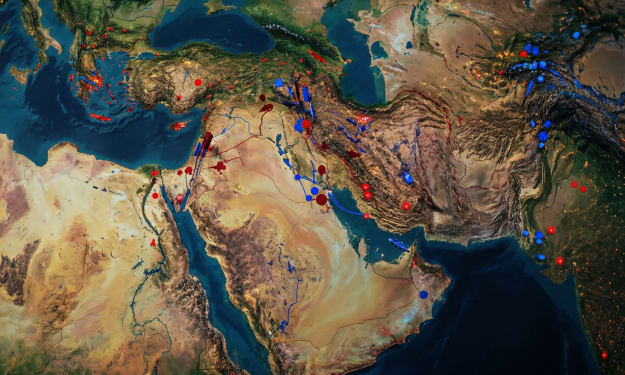
Is the U.S. Preparing to Attack Iran? Inside the Rising Tensions and Possible Military Pathways In early 2026, tensions between the United States and Iran reached one of their highest points in years. For weeks, dramatic political rhetoric, shifting military postures, and warnings from leaders around the world have fueled alarms that a U.S. military strike against Iran may be imminent. Yet as of now, no confirmed attack has occurred, and the situation reflects a complex mix of pressure, preparation, de-escalation, and diplomatic uncertainty that illustrates how modern conflict can hinge just as much on words and positioning as on direct action.
By Wings of Time 4 days ago in History
No ICE, No KKK, No Fascist USA
"I don't 'do' politics." Politics will do you, regardless. Watching from the sidelines for the last year I can see far too many similarities in the way Trump's ICE Gestapo is to Nazi Germany. Considering the United States just invaded Venezuela and kidnapped their President and his wife I would say we are there.
By Lyvia Jack6 days ago in History
How, Too
Many people wonder how, too. You are not alone, and I am an expert. I will teach you how, too! First, you need to remit a small application fee and fill out an application describing the nature of your financial situation and how often payments will be made, as this will have great bearing on how well I teach you how, too.
By Harper Lewis3 days ago in Fiction


Comments
There are no comments for this story
Be the first to respond and start the conversation.