
The Tragedies of Shipwrecks: Remembering the Forgotten
The tragedy of the Sultana Steamboat
The Titanic's infamous sinking and its subsequent portrayal in film have etched it into the annals of history, but it's not the only large-scale shipwreck tragedy. There are others, far less known but equally tragic, that deserve remembrance.
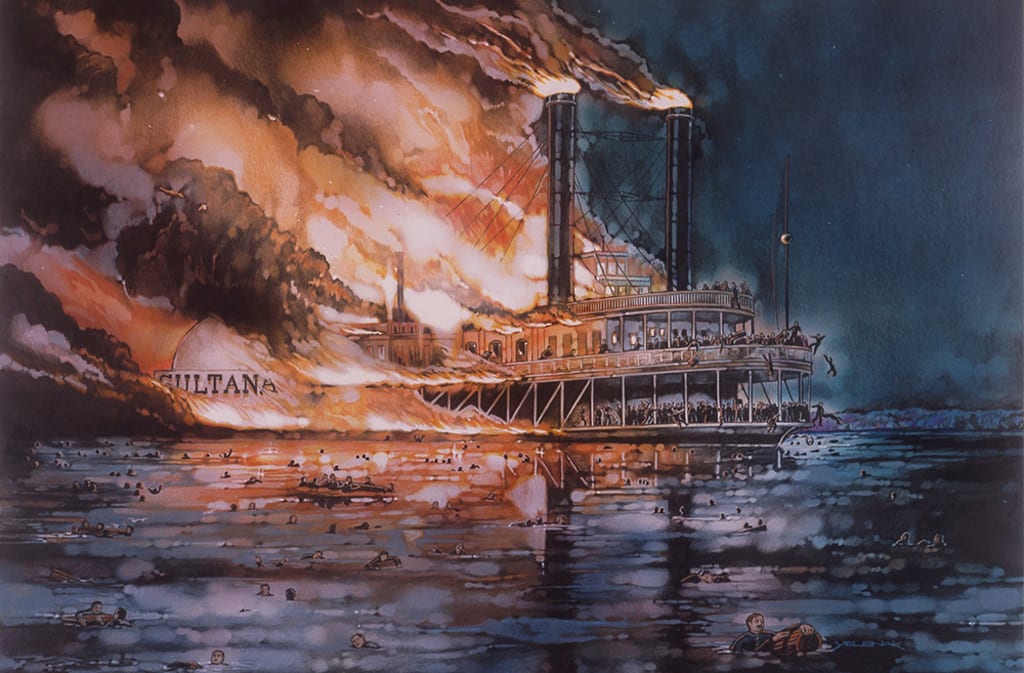
One such tragedy unfolded on April 27, 1865, involving the Sultana Steamboat, which regularly ferried passengers and cargo between St. Louis and New Orleans. This wooden behemoth, measuring 260 feet in length and 70 feet in width, was nearly twice the size of a basketball court. While it was designed to accommodate around 350 passengers, on that fateful day, over 2,000 souls were aboard.
The vessel faced mechanical issues, with a malfunctioning boiler prompting a stop in Vicksburg for repairs. Captain James Cass Mason, presented with the opportunity to transport former prisoners northward, couldn't resist the promise of financial gain. Time was of the essence, and rather than undertake thorough repairs, he resorted to makeshift solutions, patched up the boiler, and welcomed the ex-prisoners on board. This decision, coupled with an overabundance of passengers, lack of lifeboats, unfavorable river conditions, and the passengers intermingling with the ex-prisoners, set the stage for disaster.
Sailing up the Mississippi River, the Sultana found itself navigating through one of the largest floods in the river's history, where the water level surged several feet beyond its banks. The ship's boiler was pushed to its limits against the powerful current. As the vessel reached Memphis, Tennessee, more cargo and passengers were loaded, increasing its already heavy burden. Tragically, in the early hours of April 27, just seven miles north of Memphis, the overworked and makeshift-patched boiler exploded.
Survival was an elusive prospect as passengers jumped into the cold, swift river to escape the engulfing flames. The Sultana disaster remains the most tragic shipwreck in U.S. history, with the exact death toll still uncertain, ranging from 961 to 1,800 lives lost.
Yet, it's surprising that so few are familiar with this story. The tragedy of the Sultana was overshadowed, occurring just 12 days after the assassination of Abraham Lincoln, a national event that had captured the nation's attention.
In more recent history, the maritime disaster of the MV Le Joola unfolded in 2002. This Senegalese ferry, which primarily traveled along the coast of Dakar, was known for its safety, thanks to modern rescue equipment and regular maintenance. However, a year of neglect left the vessel in a state of disrepair. On September 26, 2002, it sailed with a vastly overloaded passenger count, causing problems from the outset.
While navigating toward Gambia, a strong storm turned the calm sea into a tumultuous one. The Le Joola, built for coastal waters, struggled far from shore. Waves rocked the ship, eventually causing it to capsize. For days, survivors clung to wreckage, waiting for rescue, but only a few lived to tell the tale.
The Philippines, with its treacherous waters, witnessed one of the most devastating maritime disasters on September 20, 1987. The Philippine passenger ferry Dona Paz, en route to Manila from an island, collided with the oil-laden tanker Vector. The collision ignited a massive fire and both ships sank, with only a few dozen survivors.
On September 27, 1854, the passenger ship Arctic, en route from Liverpool to New York, collided with the smaller French steamer Vesta in dense fog. The crew's decision to focus on the damaged Vesta, rather than on their own sinking ship, led to the loss of hundreds of lives.
These shipwrecks, forgotten by many, are somber reminders of the perils of the sea. While modern navigation technology has reduced such tragedies, the unpredictable forces of nature still pose a threat that technology alone cannot overcome.
These stories serve as poignant reminders of the lives lost at sea and the importance of maritime safety. Remembering these lesser-known tragedies ensures that their victims are not forgotten in the annals of history.
About the Creator
Keep reading
More stories from Alexander Peterkin and writers in History and other communities.
The Magical World of LEGO: Building More Than Just Blocks
In a world filled with high-tech gadgets and virtual reality experiences, there's a timeless and charming toy that continues to captivate the hearts and minds of children and adults alike – LEGO. Those tiny, colorful interlocking bricks are more than just toys; they are a source of creativity, inspiration, and endless possibilities.
By Alexander Peterkin2 years ago in History
A Story of the World
The history of the world is the longest story ever told—a vast journey that began long before written words, long before cities, and even before humans themselves. It is a story shaped by nature, driven by curiosity, and transformed by ideas, power, faith, and struggle. The Dawn of Life and Early Humanity Billions of years ago, the Earth was a violent and restless place. Volcanoes erupted, oceans formed, and the first simple life appeared in the seas. Over immense stretches of time, life evolved from single-celled organisms into complex plants and animals. Eventually, a branch of primates learned to walk upright, use tools, and think beyond survival. These were the early humans. For tens of thousands of years, humans lived as hunters and gatherers. They followed animals, gathered plants, and learned to cooperate in small groups. Fire changed everything—it provided warmth, protection, and a way to cook food. Language allowed ideas to pass from one generation to the next. Slowly, humans spread across continents, adapting to deserts, forests, mountains, and ice. The Agricultural Revolution and the First Civilizations Around 10,000 years ago, a turning point arrived: agriculture. Humans learned to grow crops and domesticate animals. This allowed them to settle in one place, build villages, and increase their population. Farming began independently in regions such as Mesopotamia, the Indus Valley, China, Egypt, and Mesoamerica. With settled life came civilization. Cities rose near rivers that provided water and fertile soil. Governments formed to organize labor and protect land. Writing was invented to record trade, laws, and stories. The first legal codes appeared, such as the Code of Hammurabi, which tried to define justice. Religion became organized, explaining the mysteries of life and death and giving meaning to human existence. Empires, Power, and Belief As civilizations grew, so did conflict. Powerful kingdoms expanded into empires through conquest and control. The Egyptian, Persian, Greek, Roman, Mauryan, and Han empires shaped large parts of the ancient world. Roads, armies, taxes, and laws connected millions of people under a single rule. Ideas traveled along with armies and traders. Greek thinkers explored philosophy, science, and democracy. In India and China, deep philosophies like Hinduism, Buddhism, Confucianism, and Taoism offered guidance on morality and harmony. In the Middle East, monotheistic faiths emerged, teaching belief in one God and emphasizing justice and compassion. The Roman Empire became a bridge between ancient and modern worlds. It spread law, engineering, and language across Europe and the Mediterranean. Yet no empire lasts forever. Over time, internal weakness, economic strain, and outside pressures caused great empires to fall. The Middle Ages and the Flow of Knowledge After the fall of Rome in the West, Europe entered a period often called the Middle Ages. Power was divided among kings, nobles, and the Church. Life was difficult for many, but this era was not without progress. Universities formed, architecture flourished, and faith shaped daily life. Meanwhile, the Islamic world experienced a golden age. Scholars preserved and expanded knowledge in mathematics, medicine, astronomy, and philosophy. Cities like Baghdad and Cordoba became centers of learning, where ideas from Greece, India, and Persia were studied and improved. Trade routes connected Asia, Africa, and Europe, allowing goods and cultures to mix. In Asia, powerful dynasties ruled China, advancing technology such as paper, printing, gunpowder, and the compass. These inventions would later transform the world. The Renaissance and the Age of Exploration Around the 14th century, a rebirth of learning began in Europe: the Renaissance. Artists, scientists, and thinkers looked back to classical knowledge while pushing forward with new ideas. Figures like Leonardo da Vinci and Galileo challenged old beliefs and celebrated human potential. At the same time, explorers set sail across unknown oceans. The Age of Exploration connected the world as never before. Europeans reached the Americas, Africa, and Asia, creating global trade networks. This brought wealth and knowledge—but also suffering. Indigenous civilizations were destroyed, millions were enslaved, and colonial empires rose through exploitation. Revolutions and the Modern World The 18th and 19th centuries were ages of revolution. Political revolutions in America and France challenged absolute monarchy and promoted ideas of liberty, equality, and rights. The Industrial Revolution transformed economies, as machines replaced manual labor and cities grew rapidly. Life improved for some, but workers often faced harsh conditions. New ideologies emerged—capitalism, socialism, nationalism—each offering different visions of society. Nations formed and competed, leading to global conflicts. The 20th century witnessed two devastating world wars that reshaped borders and shattered illusions of progress. Yet from the ruins came international cooperation, technological leaps, and movements for independence and civil rights. The World Today and Beyond In recent decades, technology has accelerated history. Computers, the internet, and artificial intelligence have changed how humans communicate, learn, and work. Globalization has connected economies and cultures, while also creating new challenges. Climate change, inequality, and conflict remind humanity that progress is fragile. The history of the world is not just a record of kings and wars—it is the story of ordinary people: farmers, thinkers, builders, dreamers. It is a story of mistakes and lessons, destruction and hope. Each generation inherits this long journey and adds its own chapter. The future remains unwritten. Like those who came before, humanity stands at a crossroads—guided by the past, tested in the present, and responsible for what comes next.
By The best writer a day ago in History


Comments
There are no comments for this story
Be the first to respond and start the conversation.