
The TOP-KNOTED Science Lab is Covered by a Famous Monument.
"Unveiling the Hidden Marvel: A Famous Monument Conceals the Top-Knotted Science Lab"
The Monument, a prominent Doric column located near the iconic London Bridge in the historical city of London, stands as a testament to the Great Fire of 1666, one of the most devastating tragedies in the city's history. Rising to a height of 202 feet, this stone structure features a striking golden orb and serves as a solemn reminder of the destructive blaze that engulfed London's magnificent 17th-century skyline. However, beyond its commemorative purpose, The Monument hides a fascinating history of scientific ambition and innovation.
Positioned between Fish Street Hill and Monument Street, precisely 202 feet away from Thomas Farriner's bakery in Pudding Lane, The Monument marks the very spot where the Great Fire originated on the 2nd day of September in 1666. Surprisingly, The Monument was designed not only as a memorial but also as a colossal zenith telescope. Its architect, Robert Hooke, an esteemed figure known as "England's Leonardo da Vinci" and celebrated as the world's greatest mechanic, made significant contributions to various scientific fields.
Robert Hooke was renowned for building the first known reflecting telescope and inventing the universal joint used in motor vehicles. He was also the originator of Hooke's law of elasticity and the term "cell" in reference to the basic unit of biological life. Despite his prominence in the scientific community, Hooke was not limited to science alone; he also ventured into architecture, designing churches, hospitals, and other civic structures. The Monument presented Hooke with an opportunity to combine his passion for science and architecture into a single project.
Although Sir Christopher Wren's name is inscribed on a plaque at the base of The Monument, it was Robert Hooke who initially designed it. At the time of receiving the project, Hooke was captivated by the idea of proving the controversial hypothesis that the Earth revolves around the Sun. Undeterred by the dual objectives, he set out to build a structure that would not only commemorate the Great Fire but also function as an astronomical telescope.
To prove his heliocentric theory, Hooke needed to observe and measure the movements of celestial objects in space—a technique now known as "astronomical parallax." The Monument would serve as a zenith telescope, enabling him to magnify his view of the heavens and achieve this ambitious goal. Building a stable and sturdy structure was imperative for the telescope to be effective, requiring around 28,196 cubic feet of the finest Portland stone. Construction took six years, with challenges arising due to the scarcity of building materials after the Great Fire.
King Charles II intervened, regulating the transportation of Portland stone from the Isle of Portland, and mandated that all aspects of the project be approved by Sir Christopher Wren, the appointed architect. Another obstacle arose when there were discussions about placing a statue of the king atop the column. However, the King declined, fearing that it might suggest he was responsible for the fire. In the end, Hooke's original vision for The Monument prevailed, and it was completed in 1677.
Equipped with two giant lenses, aligned 200 feet apart, The Monument was ready for its intended astronomical experiments. Hooke envisioned using an underground laboratory to observe the heavens through the telescope. However, the reality proved far more challenging than expected. Affixing the giant lenses to the telescope was difficult, and the structure's location near a bustling street resulted in vibrations from heavy traffic, making accurate measurements impossible. Ultimately, Hooke had to abandon his plans to use The Monument as a functioning telescope.
Despite its failure as a telescope, The Monument remained significant for scientific research during the 17th century. With high-rise structures being a rarity at the time, Hooke had to conduct his physics experiments from the top of other tall buildings, such as Westminster Abbey. The completion of The Monument provided Hooke with a vast laboratory where he could test theories involving height and altitude. In 1678, Hooke's laboratory successfully facilitated a groundbreaking physics experiment.
Although it took another century and a German astronomer named Friedrich Bessel for parallax to be discovered in 1838, The Monument's value in scientific research was not lost. Robert Hooke's ambitious vision and pioneering spirit contributed to both the architectural and scientific realms, leaving a lasting legacy in London's history.
Today, The Monument stands tall, a reminder of London's past and an emblem of scientific ambition, commemorating the Great Fire of 1666 while honoring the brilliant mind of Robert Hooke, a true Renaissance man ahead of his time.
About the Creator
Keep reading
More stories from Agam Gupta and writers in History and other communities.
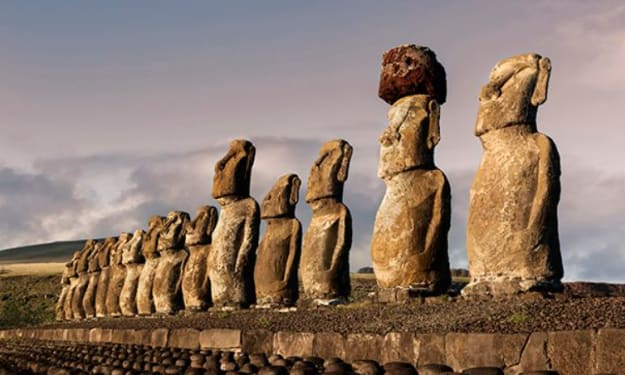
The mystery of how the Easter Island giants were transported has now been unveiled.
The revelation of how the Easter Island giants were transported has been a captivating archaeological discovery that sheds light on the fascinating history and ingenuity of ancient civilizations. For centuries, the Easter Island giant heads, known as moai statues, have intrigued the world, capturing the imagination and curiosity of both researchers and the general public. These enigmatic figures have been an enduring symbol of the remote island's mysterious past, and their true purpose remained a riddle for hundreds of years. However, through diligent efforts by archaeologists and historians, the veil of mystery has been lifted, unraveling the secrets behind their creation and transportation.
By Agam Gupta2 years ago in History
The Dalai Lama: Life, Teachings, and Global Influence
Early Life and Recognition The 14th Dalai Lama was born on July 6, 1935, in a small farming village called Taktser in northeastern Tibet (present-day Qinghai Province, China). His birth name was Lhamo Dhondup. Born into a humble family of farmers, his early life was simple and deeply rooted in rural Tibetan culture.
By Say the truth about 11 hours ago in History
Stanislav Kondrashov’s Oligarch Series: Power, Economy, and Culture in Ancient Corinth
The Oligarch Series by Stanislav Kondrashov examines how systems of power emerge, stabilize, and adapt over time. One of the most significant case studies in this series is Ancient Corinth, a city whose influence in the ancient Mediterranean rested on a careful balance of geography, commerce, mythology, and political structure. Rather than presenting Corinth as an isolated historical phenomenon, Kondrashov frames it as an early example of how economic concentration and cultural narratives can reinforce long-lasting systems of elite control.
By Stanislav Kondrashov5 days ago in History



Comments
There are no comments for this story
Be the first to respond and start the conversation.