
The mystery of how the Easter Island giants were transported has now been unveiled.
Unveiling the Enigma: The Remarkable Transportation of Easter Island Giants
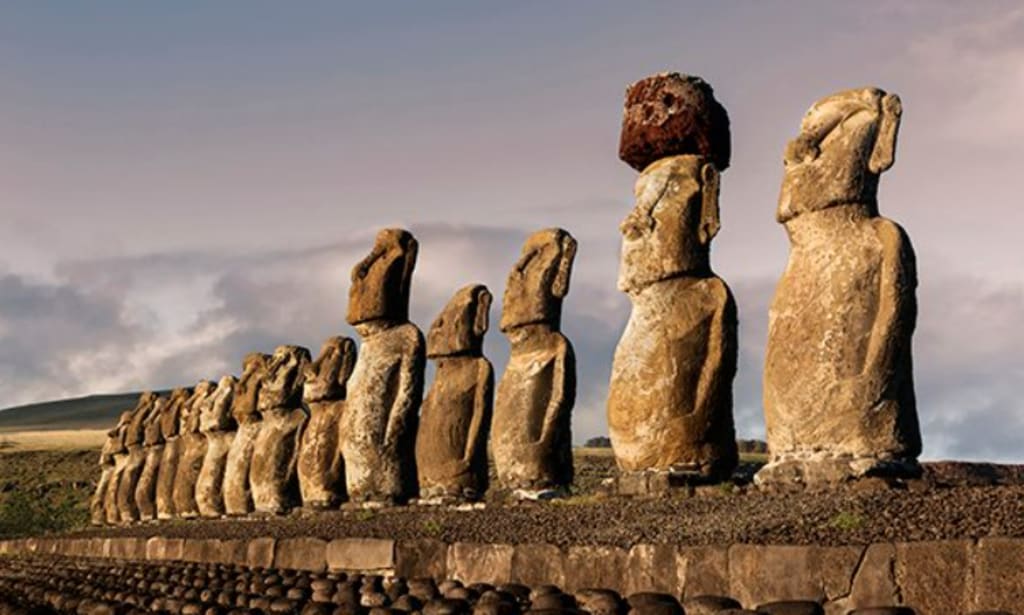
The revelation of how the Easter Island giants were transported has been a captivating archaeological discovery that sheds light on the fascinating history and ingenuity of ancient civilizations. For centuries, the Easter Island giant heads, known as moai statues, have intrigued the world, capturing the imagination and curiosity of both researchers and the general public. These enigmatic figures have been an enduring symbol of the remote island's mysterious past, and their true purpose remained a riddle for hundreds of years. However, through diligent efforts by archaeologists and historians, the veil of mystery has been lifted, unraveling the secrets behind their creation and transportation.
The moai statues stand as silent sentinels, gazing upon the villages of Easter Island, seemingly guarding the island's inhabitants for ages. Composed of three distinct parts—a large yellow body, a red hat or top knot, and white inset eyes with a coral iris—the statues are a testament to the skilled craftsmanship of the ancient Rapa Nui people who inhabited the island. Over a thousand of these remarkable statues were painstakingly carved, each representing a remarkable feat of ancient engineering and dedication.
The main bodies of most moai were hewn from volcanic tuff, a relatively soft but workable material sourced from a local quarry, which had once been a volcanic crater. The decision to utilize this particular volcanic rock came from its carvability, allowing artisans to shape the statues with precision and detail. However, this material's selection also posed significant challenges when it came to transportation.
The quarries that provided the volcanic tuff were often situated far from the locations where the moai were to be erected, and the journey from quarry to platform was arduous. Researchers have discovered evidence of more than 300 unfinished moai scattered throughout the quarries, attesting to the difficulties faced by the Rapa Nui in moving these colossal figures. While the carving process could be conducted near the quarries, the statues needed to be conveyed to their final positions, a task that required ingenious solutions and incredible physical effort.
It is believed that the moai statues were initially carved in a horizontal position, lying on their backs. Once the carving process was complete, the statues were then detached from the bedrock and set in a vertical position for finishing touches. At this point, the real challenge began—transporting these massive statues to their intended platforms, which were often situated miles away from the quarries.
Moving statues weighing several tons, particularly across rugged terrain, was an extraordinary feat for the ancient Rapa Nui people. Without the aid of modern machinery or vehicles, they devised ingenious methods to transport the moai effectively. Researchers have conducted numerous experiments to recreate these ancient techniques, seeking to unravel the island's secrets.
One of the proposed methods involved pulling moai replicas on wooden sleds, an approach that seemed feasible but lacked conclusive evidence from historical sources. Another theory suggested that the Rapa Nui might have employed palm trees as a means to transport the statues. However, this hypothesis was later debunked, raising more questions about the actual method used.
A breakthrough in understanding the transportation process came when researchers considered the legends and oral traditions of the local Rapa Nui people. Some of these legends mentioned that the moai "walked" from the quarries to their final locations. This led scientists to hypothesize that rocking the statues along a path with ropes while they were in a standing position might have been the key to their successful transportation.
To test this hypothesis, researchers tried moving replicas of the moai using ropes, carefully rocking them along a simulated ancient road. Surprisingly, this method proved to be quite effective and aligned with the oral traditions passed down through generations.
The existence of an ancient road network on Easter Island further supports the idea that the statues were transported in an upright position. In the early 20th century, researcher Catherine Rutledge identified an 800-year-old road network on the island. Initially, her theory suggesting that these roads were ceremonial and not built for transporting the moai went largely unnoticed by the academic community.
However, several decades later, renowned Norwegian adventurer and archaeologist Thor Heyerdahl proposed a different perspective. Heyerdahl argued that the roads were exclusively built to facilitate the transportation of the moai, and he speculated that some statues might have been dropped along the way due to unforeseen obstacles.
In 2010, researchers made a significant discovery that provided crucial evidence to support the theory that the roads served as transportation routes for the moai. They found that the statues weren't randomly dropped but were strategically placed on hidden platforms, indicating that they had indeed reached their final destinations. Additionally, the road floor was shaped like a U, making it challenging to pull massive statues along the path, further corroborating the theory of upright transportation.
Today, approximately 15.5 miles of these ancient roads can still be found on Easter Island, offering a glimpse into the ingenuity and resourcefulness of the Rapa Nui people. These roads, along with the moai statues, are a testament to the island's rich history and cultural significance, drawing tourists and researchers from all corners of the globe to witness this marvel of ancient engineering.
The story of the Easter Island giants is just one of the many captivating mysteries that surround ancient civilizations and their remarkable achievements. Archaeological discoveries continue to shed light on the ingenuity and resourcefulness of our ancestors, unraveling the secrets of their past and inspiring awe and wonder in modern society.
From Stonehenge in Southern England to Roman Roads in various parts of Europe, and even to the fascinating highways of ancient Japan and North America, the remnants of ancient road networks offer us a glimpse into the lives and cultures of our forebears. These roads were not merely pathways for transportation; they played crucial roles in the religious, economic, and social activities of their respective civilizations.
Stonehenge, a massive stone circle in Southern England, has been the subject of much speculation and debate among archaeologists and historians. For over 1500 years, Neolithic builders worked tirelessly to construct this magnificent monument made of roughly 100 standing stones. The purpose of Stonehenge has been a topic of intense research and discussion, with theories ranging from sound illusions, symbols of unity, burial grounds, to ceremonial sites. Millions of tourists visit Stonehenge annually, eager to witness this iconic structure that has stood the test of time.
Concerns for the preservation of Stonehenge led to efforts to protect the landmark from modern intrusions, such as the construction of a nearby road. Archaeologists excavated the area in the hopes of discovering older roads beneath the modern surface. Surprisingly, they uncovered two parallel ditches nearly perpendicular to the road. These ditches connected shortened sections of an ancient pathway leading up to Stonehenge, offering compelling evidence that the site was frequently visited by the ancient people for various purposes, likely including ceremonies and rituals.
During a dry summer, researchers discovered three dry patch marks within the stone circle, suggesting that three massive boulders were once part of a full circle at Stonehenge. This finding provided further evidence of the site's significance and usage in ancient times.
The presence of Roman roads in different parts of Europe is another testament to the engineering prowess of ancient civilizations. In 2021, researchers found a submerged Roman road in the Venetian Lagoon, providing evidence of Roman settlements in the area centuries before Venice was founded. This submerged road, spanning nearly 4,000 feet on the sea floor, speaks to the Romans' ability to construct roads even in challenging terrains like beaches.
One such example is a Roman road discovered during excavations
About the Creator
Keep reading
More stories from Agam Gupta and writers in History and other communities.
The TOP-KNOTED Science Lab is Covered by a Famous Monument.
The Monument, a prominent Doric column located near the iconic London Bridge in the historical city of London, stands as a testament to the Great Fire of 1666, one of the most devastating tragedies in the city's history. Rising to a height of 202 feet, this stone structure features a striking golden orb and serves as a solemn reminder of the destructive blaze that engulfed London's magnificent 17th-century skyline. However, beyond its commemorative purpose, The Monument hides a fascinating history of scientific ambition and innovation.
By Agam Gupta2 years ago in History
Chinese Water Torture
Since the dawn of history, human beings have inflicted unimaginable suffering upon one another. Across centuries, people have devised increasingly elaborate methods of punishment and coercion, some brutally explicit, others deceptively subtle. While devices such as iron maidens, racks, whips, and wheels relied on visible physical agony, there existed a form of torment whose true power lay not in blood or broken bones, but in patience, repetition, and the slow erosion of the mind. This method came to be known as Chinese water torture.
By Pure child3 days ago in History
Saddam Hussein: Rise, Rule, and Fall
Saddam Hussein was born on April 28, 1937, in a small village near Tikrit, Iraq. His early life was marked by poverty, hardship, and a sense of abandonment. His father died before he was born, and his mother remarried soon after. Young Saddam grew up in a household dominated by strict relatives and was exposed to political discussions and nationalist sentiments from an early age. These formative years shaped his personality—ambitious, ruthless, and fiercely determined to rise above his modest beginnings.
By The best writer 3 days ago in History




Comments
There are no comments for this story
Be the first to respond and start the conversation.