
The Time-Looped Archaeologist
Unearthing the Past, One Lifetime at a Time

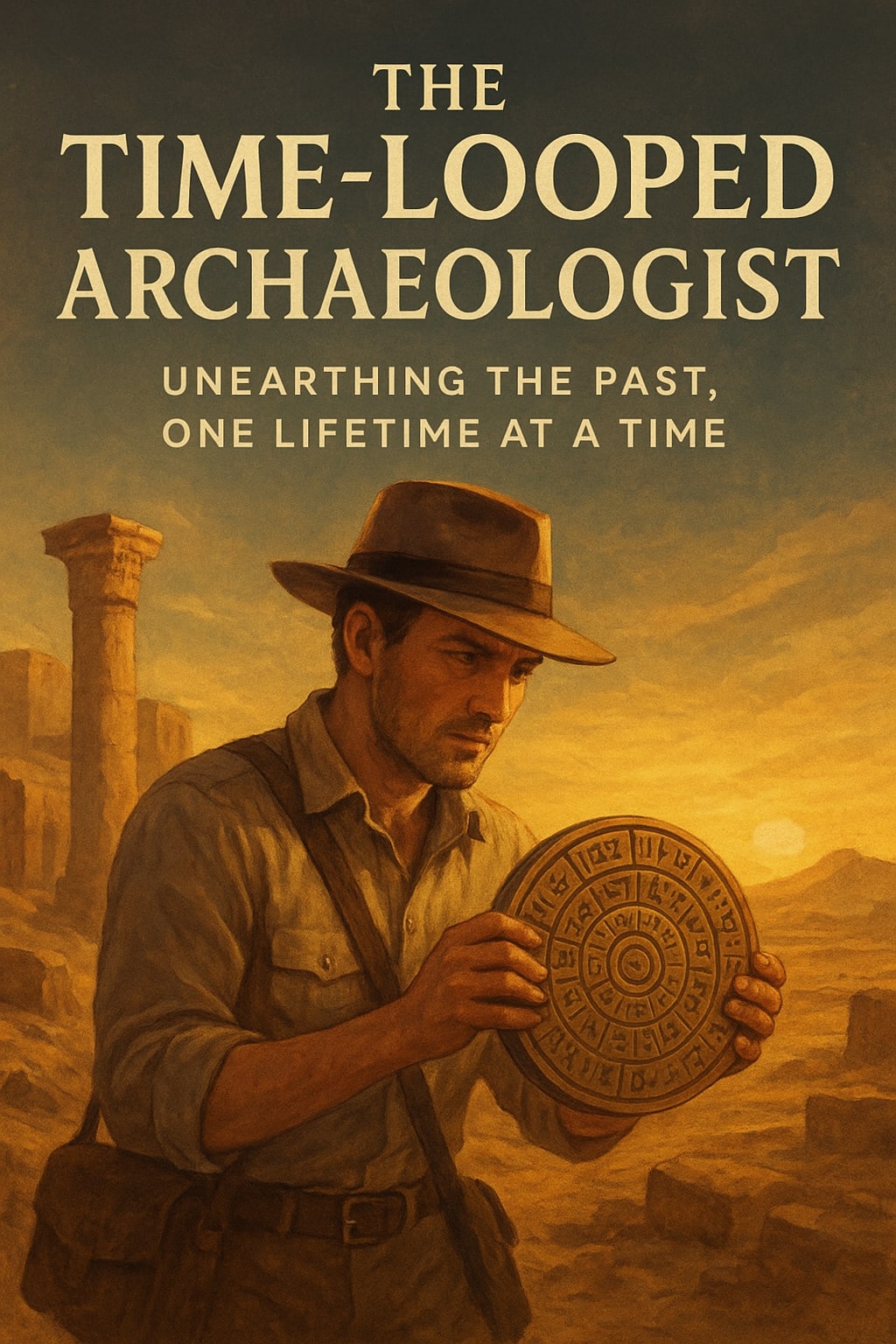
Archaeology has always been about uncovering the past—piecing together fragments of civilizations long forgotten. But what if an archaeologist didn’t just study history… what if they lived it, over and over again? Imagine a life caught in a paradox, where every discovery resets time itself, and each excavation leads back to the same moment of awakening. This is the story—or perhaps the curse—of The Time-Looped Archaeologist.
The Discovery That Changed Everything
Dr. Elias Renn was no ordinary archaeologist. Known for his fascination with ancient timekeeping devices and forgotten calendars, he dedicated his life to uncovering how early civilizations understood the flow of time. His most ambitious project took him deep into the sands of Egypt, where he uncovered what appeared to be an ordinary burial chamber. But at the center of that chamber rested a strange artifact—a circular dial inscribed with both Sumerian cuneiform and Egyptian hieroglyphs.
The locals called it The Eye of Eternity.
Elias, obsessed with its origin, worked night and day to decipher the hybrid inscriptions. What he found was both impossible and intoxicating: a sequence of symbols that translated loosely to “The Keeper of Time shall awaken again.” Thinking it poetic, he pressed the symbols in a specific pattern—and everything went black.
The First Loop
When Elias opened his eyes, he found himself standing at the entrance of the same burial chamber—days before he was supposed to have discovered the artifact. His colleagues were alive, his notes were missing, and every trace of his previous excavation had vanished. At first, he thought it was a vivid dream brought on by exhaustion. But when the same sequence of events repeated itself—the dig, the discovery, the activation he realized he was trapped in a temporal loop.
Every time he triggered the artifact, the world reset. The desert sun rose and fell in the same rhythm. The same conversation replayed with his team. Even the wind carried the same whisper through the dunes.
The Curse of Knowledge
As the loops continued, Elias began experimenting. He changed his actions tried leaving the site, refused to touch the artifact, even destroyed it but no matter what he did, time folded back to the start. The loops were not random; they were intentional, like an ancient test designed to measure the persistence of the human spirit.
He began keeping journals, burying them in different parts of the dig site to see if they would carry through the loop. None survived. Knowledge itself refused to escape the cycle. The only thing that endured was his memory—a cruel mercy that made him both the prisoner and the guardian of time’s secret.
Echoes of Civilizations
Over countless loops, Elias’s understanding deepened. The artifact wasn’t merely Egyptian or Sumerian it contained influences from multiple ancient cultures that had no recorded contact with each other. Symbols from the Indus Valley, Mayan glyphs, and early Chinese oracle script appeared woven into one unified design. It was as if the artifact were a relic of a civilization far older than any known to history a root civilization that had left a key to time itself.
The Time-Looped Archaeologist became an unintentional witness to forgotten ages. Through visions and recurring dreams within the loop, he glimpsed fragments of lost empires, meteor impacts, and cataclysms that erased entire epochs. These weren’t hallucinations they were memories imprinted in the artifact, replayed for its unwilling caretaker.
The Philosophy of the Loop
Trapped between discovery and déjà vu, Elias began to question the nature of time. Was the loop punishment for tampering with forces beyond comprehension? Or was it a preservation mechanism time’s way of preventing dangerous knowledge from leaking into the world too soon?
He wrote in his 89th loop journal (which, of course, vanished):
“Maybe the archaeologist is not meant to uncover the past, but to live it until he understands that time itself is the greatest relic of all.”
In every iteration, Elias tried something new treating his team differently, delaying the dig, or leaving messages etched into the stone walls in languages that might transcend time. Yet, when he awoke again at the same moment, he would find the walls pristine. The universe allowed no interference.
The Final Awakening
One day, after what felt like centuries of repetition, Elias stopped resisting. He began treating each loop as a new life—a chance to perfect not the excavation, but himself. He learned his colleagues’ stories by heart, helped them achieve small dreams within each cycle, and appreciated the beauty of the unchanging sunrise over the dunes.
Then, without warning, the artifact stopped glowing. The next time he awoke, he was no longer at the dig site. He was standing in a museum—his museum surrounded by artifacts he had cataloged lifetimes ago. A plaque in front of him read:
“The Eye of Eternity – Discovered by Dr. Elias Renn, 1892. Artifact lost shortly after excavation. The archaeologist disappeared without a trace.”
Elias smiled. Time had finally let him go. Or perhaps, he had finally let time go.
Legacy of the Time-Looped Archaeologist
The legend of the Time-Looped Archaeologist persists among scholars and storytellers alike. Some believe Elias Renn existed; others think he’s a metaphor for the endless cycle of human curiosity—how we dig, discover, destroy, and rediscover again.
In many ways, archaeology itself is a form of time loop. Each generation of archaeologists revisits the same questions, the same ruins, searching for meaning in the dust of centuries. And perhaps, just like Elias, we’re all trapped in our own loops—repeating the same patterns of discovery and wonder—until we finally understand the lesson history keeps trying to teach us.
Closing Reflection
“The Time-Looped Archaeologist” reminds us that history isn’t static—it breathes, repeats, and teaches. Every artifact we unearth is a message from time itself, whispering: Remember, learn, and evolve.
And maybe that’s the true meaning of the loop—not a curse, but an eternal invitation to look deeper, live wiser, and never stop seeking the truth buried beneath the sands of time.
About the Creator
Nizam Archaeologist
I’m deeply fascinated by archaeology and the mysteries of ancient civilizations.My goal is to bring the past to life, spark curiosity, and share the wisdom of cultures that have stood the test of time.
Keep reading
More stories from Nizam Archaeologist and writers in History and other communities.
Chronicles of the Earth: Unraveling the Secrets of Geological Time
Chronicle Record: From the moment Earth formed more than 4.5 billion years ago, it has been a restless planet—shifting, cracking, cooling, and reshaping itself through eons. Every mountain peak, desert dune, and ocean floor tells a chapter of a story written in stone. This chronicle seeks to uncover that story—the vast geological record of our planet that holds the memory of its creation, transformation, and the life it has sustained.
By Nizam Archaeologist3 months ago in History
A woman from a vanished female dynasty was discovered buried with 270,000 beads.
In a Copper Age tomb close to Seville, Spain, the Montelirio bead assemblage contains over 270,000 beads that identify the ladies buried there as elites. The discovery is the biggest collection of beads ever
By Francis Damiabout 8 hours ago in History
The Prophet of Mercy: How Compassion Transformed Enemies into Believers
In the heart of Arabia, in the ancient city of Makkah, society was built on tribal loyalty, power, and pride. Wealth and lineage determined a person’s worth, while the weak were often oppressed without mercy. The Kaaba, originally built for the worship of One God, was filled with idols, and injustice had become a normal part of life. In this harsh and divided environment, Hazrat Muhammad ﷺ emerged—not as a king or warrior, but as a man whose truth, patience, and compassion would forever change the course of human history.
By The best writer 4 days ago in History



Comments (1)
amazing