
Chronicles of the Earth: Unraveling the Secrets of Geological Time
A Journey Through the Layers of Our Planet’s Ancient Past

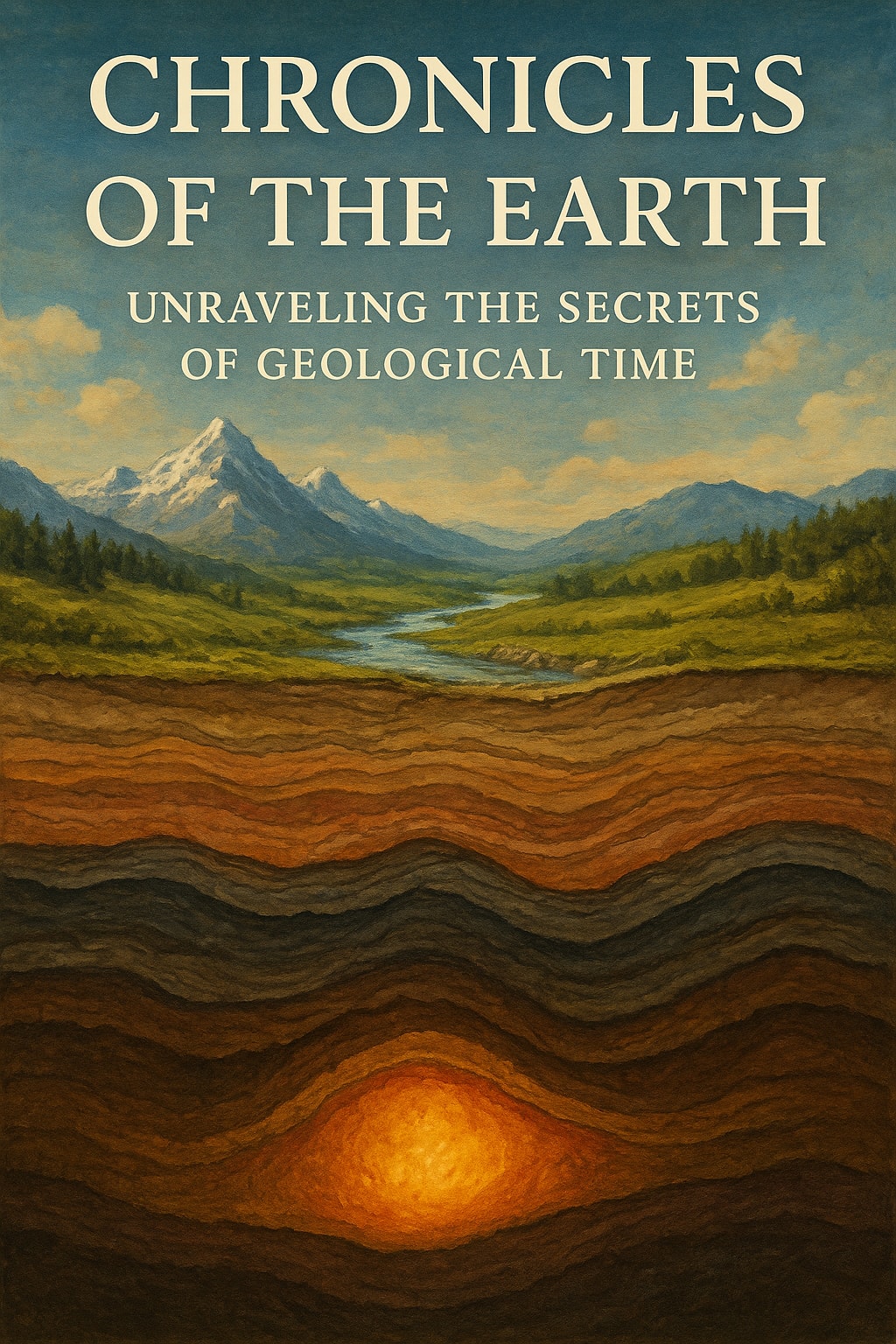
Chronicle Record:
From the moment Earth formed more than 4.5 billion years ago, it has been a restless planet—shifting, cracking, cooling, and reshaping itself through eons. Every mountain peak, desert dune, and ocean floor tells a chapter of a story written in stone. This chronicle seeks to uncover that story—the vast geological record of our planet that holds the memory of its creation, transformation, and the life it has sustained.
The Beginning: Fire and Chaos
In the earliest days, Earth was no serene blue sphere. It was a molten world—a swirling ocean of magma bombarded by asteroids and comets. About 4.6 billion years ago, dust and gas orbiting the young Sun coalesced to form our planet. The heat from collisions and radioactive decay melted the interior, allowing heavier elements like iron and nickel to sink toward the center and form Earth’s core, while lighter silicates rose to create the mantle and crust.
This fiery era is known as the Hadean Eon, named after Hades, the god of the underworld. It was a time of violent transformation, when the first crust formed, only to be destroyed again and again by volcanic upheaval. Yet even in this chaos, the foundations for life were being laid. Water vapor trapped in the atmosphere condensed into rain, forming the first oceans—a cradle for what would one day become living organisms.
The First Signs of Stability
As Earth cooled, around 3.8 billion years ago, a more stable crust emerged. This marks the Archean Eon, when continents began to form and life—primitive, microscopic life—appeared in the oceans. The oldest known rocks and fossils date back to this era, including stromatolites, layered structures created by ancient bacteria.
These microbial communities played a crucial role in Earth’s history by releasing oxygen through photosynthesis. Over millions of years, their work transformed the atmosphere from a toxic haze into one capable of supporting complex life. The stage was being set for the next great act in Earth’s geological drama.
Continents on the Move
By the Proterozoic Eon, about 2.5 billion years ago, Earth’s surface was no longer static. Massive continental plates began drifting atop the molten mantle below—a process we know today as plate tectonics. Continents collided and broke apart in a slow but powerful dance that would shape mountains, oceans, and the very face of the planet.
During this time, Earth experienced several “Snowball Earth” episodes—global ice ages where frozen seas stretched to the equator. These extreme conditions tested life’s resilience, yet they also sparked bursts of evolution as organisms adapted to survive in new environments.
The Age of Complex Life
Roughly 541 million years ago, a remarkable explosion of biodiversity occurred during the Cambrian Period. Fossils from this era reveal an incredible array of marine creatures—trilobites, brachiopods, and the ancestors of most modern animals. This was the dawn of the Phanerozoic Eon, the age of visible life.
As life flourished, so did geological activity. Continents continued to shift, forming and breaking apart supercontinents like Pangaea and Gondwana. Volcanoes erupted, seas rose and fell, and climates oscillated between tropical warmth and icy cold. Each change was etched into the rock layers, creating the geological time scale—a natural calendar that geologists use to read the history of the Earth.
Rise and Fall of Giants
The Mesozoic Era—often called the “Age of Reptiles”—brought dinosaurs, lush forests, and the first birds and mammals. It was a time of both creation and destruction. When a massive asteroid struck Earth 66 million years ago, it wiped out nearly 75% of all species, including the dinosaurs. But from that devastation rose a new chapter—the age of mammals.
The Shaping of Our World
The Cenozoic Era, beginning 66 million years ago, saw continents drift toward their present positions. The Himalayas rose from the collision of India and Asia; the Atlantic Ocean widened; and ice sheets expanded across the poles. These changes influenced global climate, leading to the cycles of ice ages that shaped the landscapes we recognize today.
Meanwhile, the evolution of humans—our species—became the latest and perhaps most transformative geological event. From the plains of Africa, early humans learned to harness fire, shape stone, and eventually alter the environment itself.
Reading the Record of Time
Today, geologists act as historians of the Earth, piecing together its narrative from rocks, fossils, and sediments. Each stratum of rock serves as a page in the planet’s autobiography, detailing ancient climates, mass extinctions, and continental shifts. Tools like radiometric dating allow scientists to measure time with extraordinary precision, giving us a clearer understanding of how our world evolved.
Yet even with all we’ve learned, many mysteries remain buried. What forces drove the earliest tectonic shifts? How did life persist through catastrophic extinctions? And what will the next chapter of Earth’s story hold as humans reshape the planet at an unprecedented pace?
Conclusion:
The Earth’s geological record is more than a history—it’s a living chronicle still being written. Mountains continue to rise, rivers carve new paths, and volcanoes forge fresh land. Every grain of sand and every stone is a witness to the story of transformation that began billions of years ago and continues today.
About the Creator
Nizam Archaeologist
I’m deeply fascinated by archaeology and the mysteries of ancient civilizations.My goal is to bring the past to life, spark curiosity, and share the wisdom of cultures that have stood the test of time.
Keep reading
More stories from Nizam Archaeologist and writers in History and other communities.
Chronicles of the Archaeologist
Archaeology is often imagined as an adventurous pursuit — dusty landscapes, ancient ruins, and the thrill of unearthing forgotten relics. Yet, beyond the cinematic image of explorers brushing away centuries of soil lies a profound journey into human memory. “Chronicles of the Archaeologist” is not just about discovering artifacts; it’s about rediscovering humanity itself — the lives, dreams, and struggles of those who came before us.
By Nizam Archaeologist3 months ago in History
An unidentified female dynasty is revealed in a tomb with the biggest collection of beads in the world.
The Montelirio Tholos Tomb is a vaulted building located beneath the present-day town of Valencina de la Concepción in Southwestern Spain that has the remains of residents who lived there between 2875 and 2635 BCE.
By Francis Damiabout 15 hours ago in History


Comments
There are no comments for this story
Be the first to respond and start the conversation.