
The Tiger of Mysore and the Last Stand Against British Colonialism
A Revolutionary Leader Who Fought Fearlessly to Defend His Kingdom and Heritage

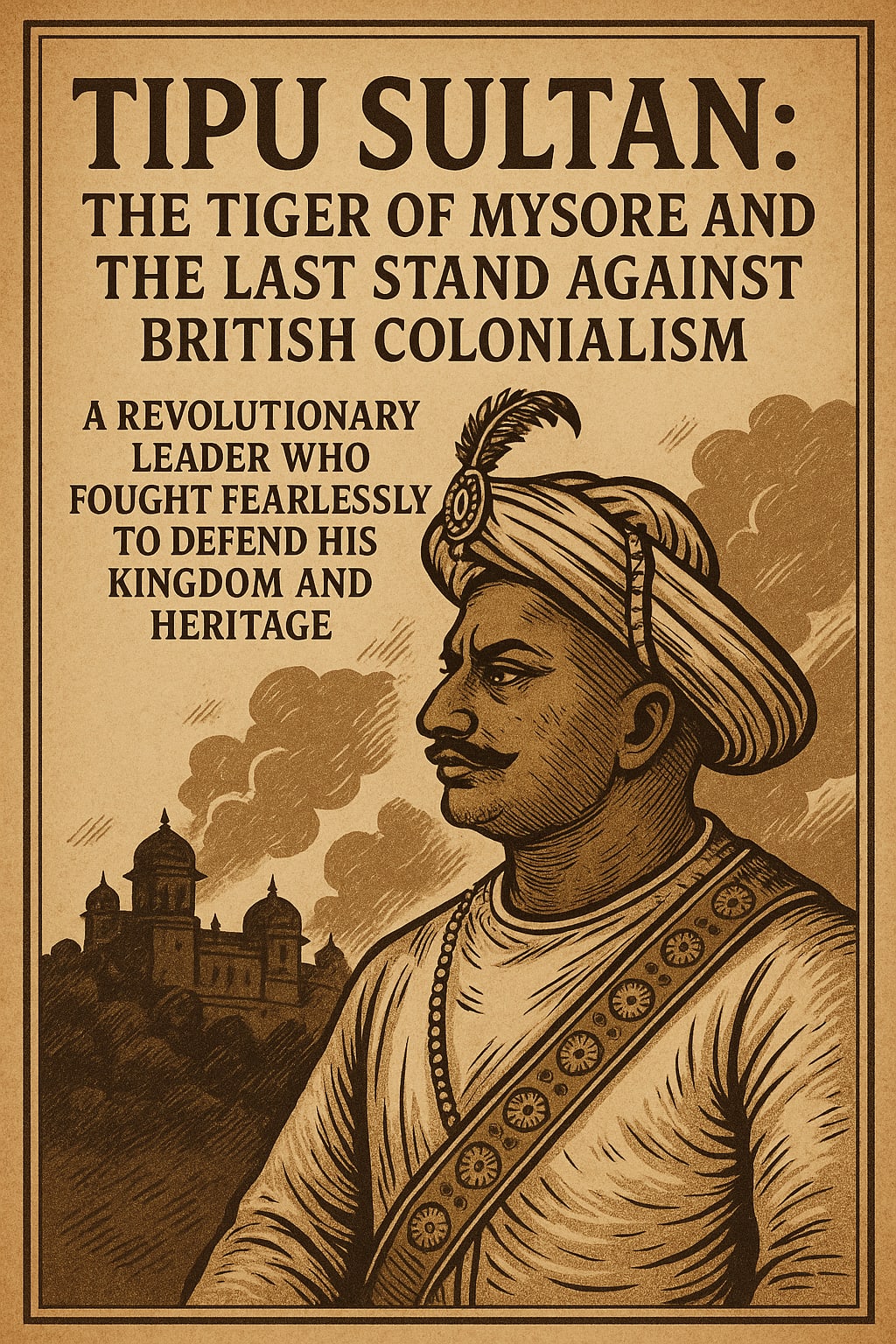
Tipu Sultan, often referred to as the “Tiger of Mysore,” was a formidable ruler, fearless warrior, and one of India’s earliest and fiercest opponents of British colonial rule. Born in November 1751 in Devanahalli (near modern-day Bangalore), Tipu was the eldest son of Sultan Hyder Ali, the powerful de facto ruler of the Kingdom of Mysore, and his wife Fakhr-un-Nissa. From a young age, Tipu was immersed in the world of politics and warfare, and under the guidance of his father, he grew to become one of the most brilliant and determined leaders in South Asian history.
Early Life and Education
Tipu Sultan received a rigorous education that combined Islamic studies with military training, science, mathematics, and languages, including Persian and Arabic. His father, Hyder Ali, ensured that Tipu gained experience in administration and warfare from a young age. At just 15 years old, Tipu accompanied his father in battles against the British and the Marathas. This early exposure helped him understand the art of war and the importance of resisting foreign domination.
Rise to Power
Hyder Ali rose from being a military commander to the de facto ruler of Mysore, sidelining the Wodeyar dynasty. His rule laid the foundation for a strong, centralized kingdom. Upon Hyder Ali’s death in 1782, Tipu Sultan succeeded him as ruler during the ongoing Second Anglo-Mysore War. At just 31, Tipu inherited a kingdom at war and under immense pressure from the British East India Company. He immediately set out to strengthen the administration, modernize the army, and continue his father’s resistance against British expansion.
Military Genius and Anglo-Mysore Wars
Tipu Sultan is best known for his military campaigns against the British during the four Anglo-Mysore Wars (1767–1799). He fought with fierce determination, often outmaneuvering larger and better-funded British forces. He introduced significant innovations in military technology, including the use of iron-cased rockets in warfare. These Mysorean rockets were so effective that the British later studied them and incorporated the technology into their own artillery.
Tipu’s most significant confrontations came during the Third and Fourth Anglo-Mysore Wars. In the Third War (1790–1792), Tipu suffered a strategic defeat but remained a major threat. He was forced to sign the Treaty of Seringapatam, ceding nearly half his kingdom and handing over two of his sons as hostages to the British as a guarantee of peace. Despite the setback, he remained defiant.
His final stand came in the Fourth Anglo-Mysore War in 1799, when British forces, led by Lord Wellesley and supported by the Nizam of Hyderabad, laid siege to Tipu’s capital, Seringapatam. Despite overwhelming odds and betrayal by some of his former allies, Tipu fought bravely to the end. He was killed on May 4, 1799, while defending his fort — sword in hand, refusing to surrender. His death marked the end of Mysore as a significant power and a turning point in British consolidation of India.
Administrative Reforms and Vision
Tipu Sultan was not just a warrior but also a progressive administrator. He reorganized his state’s finances, introduced new coinage, promoted agriculture and trade, and built an efficient taxation system. His aim was to make Mysore self-sufficient and capable of withstanding colonial pressures.
He understood the value of science and technology, importing French engineers to build factories and improve his army. He encouraged silk production and other industries, making Mysore one of the most economically developed regions in India at the time. He also established a strong navy, aware of the importance of maritime strength in defending against European powers.
Tipu was deeply committed to independence, not just in a military sense, but economically and culturally. He resisted accepting British goods and practices, promoting indigenous knowledge and production. In many ways, his policies prefigured later Indian nationalist movements.
Secularism and Religious Policy
Tipu Sultan’s religious policies have often been a subject of debate. While British historians of the colonial era portrayed him as intolerant and oppressive, modern scholarship presents a more balanced picture. Tipu was a devout Muslim, but he also showed respect toward other religions. He donated to Hindu temples, maintained a multi-religious bureaucracy, and employed people from diverse communities, including Hindus and Christians, in high-ranking positions.
He patronized temples such as the Ranganathaswamy Temple in Srirangapatna and issued land grants to several Hindu institutions. His actions demonstrate a pragmatic and inclusive approach to governance, focused on state unity rather than religious division.
Diplomacy and Global Vision
Tipu Sultan’s resistance to the British was not limited to the battlefield. He pursued international diplomacy to forge alliances against the British. He maintained strong relations with France, hoping for military aid, and corresponded with the Ottoman Empire and other Islamic states to build a broader anti-colonial coalition. He even sent an embassy to Napoleon Bonaparte, seeking assistance against the British.
Although many of these diplomatic efforts did not materialize into tangible military support, they reflected Tipu’s understanding of global politics and his willingness to seek help in defending his sovereignty.
Death and Legacy
Tipu Sultan died a martyr’s death in 1799, defending his people and kingdom. His last words reportedly were:
“I would rather live one day as a tiger than a hundred years as a jackal.”
This quote immortalized his bravery and refusal to submit to colonial rule.
After his death, the British looted his palace and library, taking valuable treasures, weapons, and documents. His children were taken into custody, and the kingdom of Mysore was placed under indirect British control.
Despite efforts to erase or vilify his memory, Tipu Sultan remains a national hero in India. He is remembered not only for his military courage but also for his progressive ideas and uncompromising stand against imperialism.
Conclusion
Tipu Sultan stands as a symbol of Indian resistance to British colonialism. He was more than a warrior — he was a strategist, reformer, and visionary leader. His courage on the battlefield, his commitment to strengthening his kingdom, and his determination to remain independent made him one of the most remarkable figures in Indian history.
Today, Tipu Sultan’s name evokes pride, courage, and a legacy of fearless resistance. His life and struggle continue to inspire generations in the ongoing fight for justice, sovereignty, and self-determination.
About the Creator
Irshad Abbasi
"Studying is the best cure for sorrow and grief." shirazi
Keep reading
More stories from Irshad Abbasi and writers in History and other communities.
The Life and Legacy of a Reluctant Philosopher
Socrates, born around 470 BCE in the city-state of Athens, remains one of the most enigmatic and influential figures in Western philosophy. Despite leaving no writings of his own, his ideas—preserved through the works of his students, particularly Plato—have shaped the very foundation of Western thought. A man both revered and reviled in his time, Socrates lived a life devoted to questioning, examining, and relentlessly pursuing the truth. He was, by many accounts, a reluctant philosopher—one who never sought fame, wealth, or influence, but instead followed his inner voice, or daimonion, toward a path of moral inquiry and intellectual rigor.
By Irshad Abbasi 8 months ago in History
Chinese Water Torture
Since the dawn of history, human beings have inflicted unimaginable suffering upon one another. Across centuries, people have devised increasingly elaborate methods of punishment and coercion, some brutally explicit, others deceptively subtle. While devices such as iron maidens, racks, whips, and wheels relied on visible physical agony, there existed a form of torment whose true power lay not in blood or broken bones, but in patience, repetition, and the slow erosion of the mind. This method came to be known as Chinese water torture.
By Pure child3 days ago in History
Saddam Hussein: Rise, Rule, and Fall
Saddam Hussein was born on April 28, 1937, in a small village near Tikrit, Iraq. His early life was marked by poverty, hardship, and a sense of abandonment. His father died before he was born, and his mother remarried soon after. Young Saddam grew up in a household dominated by strict relatives and was exposed to political discussions and nationalist sentiments from an early age. These formative years shaped his personality—ambitious, ruthless, and fiercely determined to rise above his modest beginnings.
By The best writer 3 days ago in History


Comments (1)
Tipu Sultan's military genius is impressive. I remember learning about his use of iron-cased rockets, a real game-changer in his time.