
The Life and Legacy of a Reluctant Philosopher
Exploring the Mind, Trial, and Teachings of History’s Most Influential Thinker

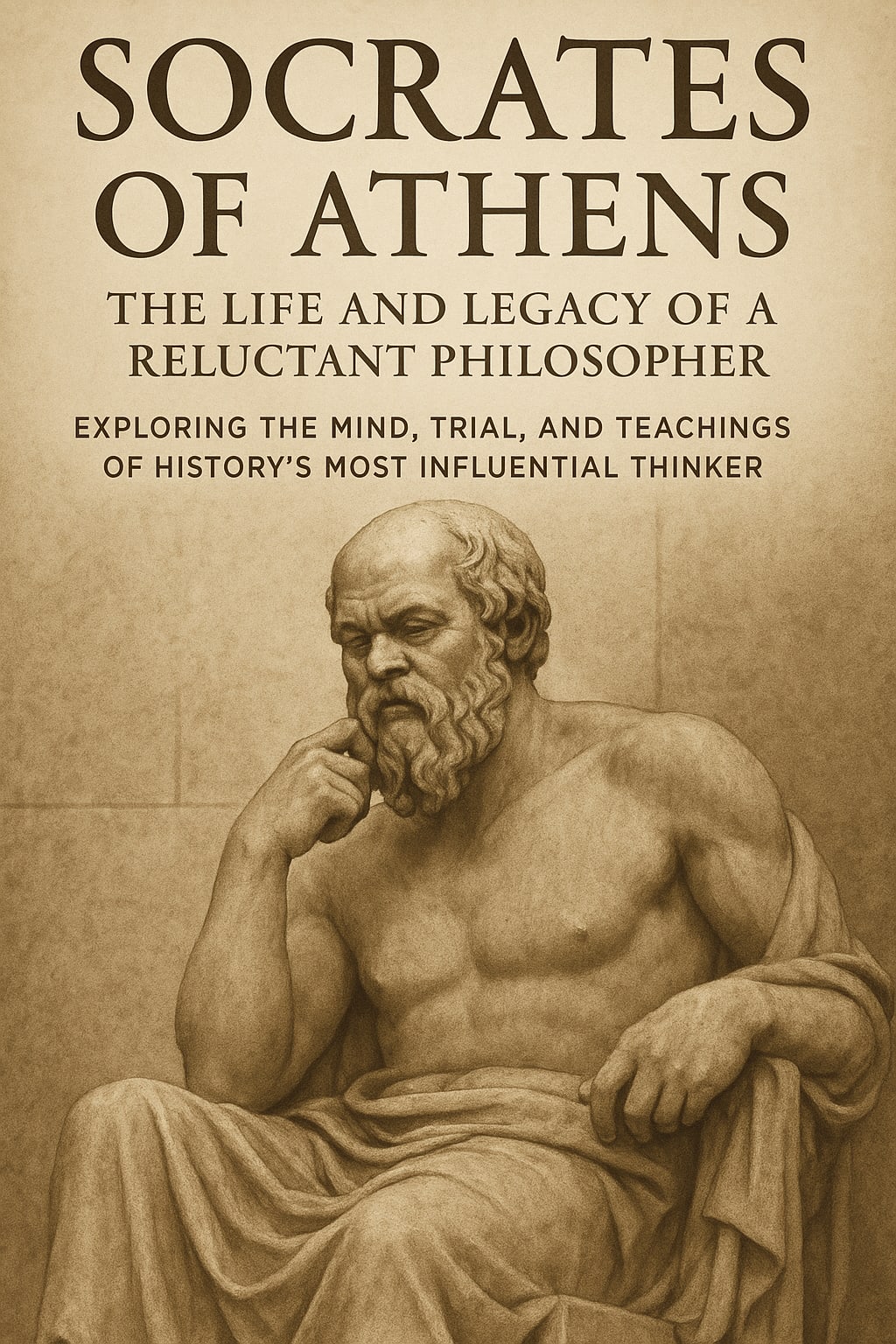
Socrates, born around 470 BCE in the city-state of Athens, remains one of the most enigmatic and influential figures in Western philosophy. Despite leaving no writings of his own, his ideas—preserved through the works of his students, particularly Plato—have shaped the very foundation of Western thought. A man both revered and reviled in his time, Socrates lived a life devoted to questioning, examining, and relentlessly pursuing the truth. He was, by many accounts, a reluctant philosopher—one who never sought fame, wealth, or influence, but instead followed his inner voice, or daimonion, toward a path of moral inquiry and intellectual rigor.
Early Life and Background
Socrates was born into modest circumstances. His father, Sophroniscus, was a stonemason, and his mother, Phaenarete, a midwife. While little is known about his early years, it is generally believed that he received a basic Greek education in music, gymnastics, and grammar, and likely learned his father’s trade. Some ancient sources suggest that he may have practiced sculpting before dedicating himself to philosophy. Despite his humble origins, Socrates would become a central figure in Athenian intellectual life.
Physically, Socrates was far from the idealized image of a Greek man. Described by contemporaries as short, stocky, and unattractive, with bulging eyes and a snub nose, his appearance contrasted sharply with the eloquence and sharpness of his intellect. His physical appearance became emblematic of his deeper message: truth and wisdom are not to be found in appearances, but in substance.
The Socratic Method
Socrates’ most lasting contribution to philosophy is the dialectical method of inquiry, known today as the Socratic method. This approach involves asking a series of probing questions to stimulate critical thinking and expose contradictions in a person’s beliefs. Unlike the Sophists of his time, who charged fees for teaching rhetoric and persuasion, Socrates engaged freely with citizens of all classes in the public squares of Athens.
Through dialogue, Socrates challenged conventional wisdom on ethics, justice, piety, and knowledge. Rather than present himself as a teacher, he saw himself as a midwife of ideas, helping others give birth to truth through introspection and reasoned debate. His famous assertion, “The unexamined life is not worth living,” encapsulates his philosophy.
Relationship with Athens
Socrates lived during a turbulent time in Athens. The city endured the Peloponnesian War with Sparta, a temporary oligarchic coup, and the eventual restoration of democracy. Through it all, Socrates maintained a reputation as a social gadfly—provoking discomfort in the powerful and admired by many young intellectuals.
His association with controversial figures, such as Alcibiades (a brilliant but untrustworthy general) and Critias (a leader of the brutal Thirty Tyrants), eventually cast a shadow over him. Although he never aligned himself with any political faction, his tendency to challenge authority and question tradition made him a figure of suspicion in a city struggling with its identity and democratic values.
The Trial of Socrates
In 399 BCE, Socrates was brought to trial on charges of corrupting the youth of Athens and impiety—specifically, not recognizing the gods of the city and introducing new deities. The real motives behind the trial, however, were likely political. Socrates had become a symbol of intellectual defiance in a city yearning for stability.
The trial is most famously recounted in Plato’s Apology, where Socrates delivers a defense that is both fearless and provocative. He refuses to flatter the jury or beg for mercy. Instead, he affirms his role as a moral and philosophical gadfly, necessary for the health of the city. He even suggests, half-seriously, that instead of punishing him, Athens should reward him with free meals for life.
The jury, composed of 500 Athenian citizens, found him guilty. Socrates was sentenced to death by drinking a cup of poison hemlock. He accepted the verdict without resistance, believing that a true philosopher should not fear death. His final days, described in Plato’s Phaedo, depict him calm, surrounded by friends, discussing the immortality of the soul.
Philosophical Legacy
Though Socrates wrote nothing himself, his legacy is immense. His ideas were preserved through the dialogues of Plato and the writings of Xenophon, and later developed by thinkers such as Aristotle, the Stoics, and countless others. Socrates laid the groundwork for epistemology, ethics, and logic, and his insistence on reasoned debate and moral inquiry has become the cornerstone of philosophical education.
One of his most influential teachings was his belief that virtue is knowledge—that to know the good is to do the good. For Socrates, wrongdoing was not the result of evil intent but of ignorance. Therefore, education and self-examination were the highest callings. This perspective marked a radical shift from mythological explanations of morality toward rational, individual responsibility.
The Socratic paradoxes, such as “I know that I know nothing,” emphasize intellectual humility and the infinite pursuit of truth. These principles have not only endured in philosophy but have influenced modern science, legal systems, and democratic discourse.
A Reluctant Philosopher
What makes Socrates a “reluctant” philosopher is not hesitance or apathy, but his sincere humility. He did not consider himself wise. He did not seek followers, wealth, or fame. His reluctance was in presenting himself as an authority. Instead, he was compelled by a divine inner voice to continue questioning, challenging, and searching for truth.
Socrates lived a life of integrity, unwavering even when faced with death. He subordinated personal comfort to principle, believing that maintaining a just soul was more important than survival. This reluctant philosopher became, paradoxically, one of history’s boldest intellectuals—precisely because he embraced ignorance, dialogue, and the never-ending journey of learning.
Conclusion
Socrates of Athens was more than a philosopher; he was a moral exemplar, a cultural critic, and a martyr for the examined life. His death marked the end of one life, but the beginning of a philosophical tradition that would endure for millennia. By refusing to compromise his beliefs, Socrates became a symbol of intellectual courage and ethical commitment. His life and legacy continue to challenge us to ask deeper questions, confront our assumptions, and pursue wisdom—not as a destination, but as a way of life.
About the Creator
Irshad Abbasi
Ali ibn Abi Talib (RA) said 📚
“Knowledge is better than wealth, because knowledge protects you, while you have to protect wealth.
Keep reading
More stories from Irshad Abbasi and writers in History and other communities.
The Visionary Poet of the East
Allama Muhammad Iqbal stands as one of the most influential thinkers, poets, and visionaries of the 20th century. Widely known as “Mufakkir-e-Pakistan” (The Thinker of Pakistan) and “Shair-e-Mashriq” (The Poet of the East), Iqbal’s legacy extends far beyond poetry. His philosophical insights, passionate advocacy for Muslim self-determination, and deep spiritual intellect laid the ideological foundation for the creation of Pakistan.
By Irshad Abbasi 9 months ago in History


Comments
There are no comments for this story
Be the first to respond and start the conversation.